DbcultAccessing Vault...
Cult Review
Senior Film Conservator
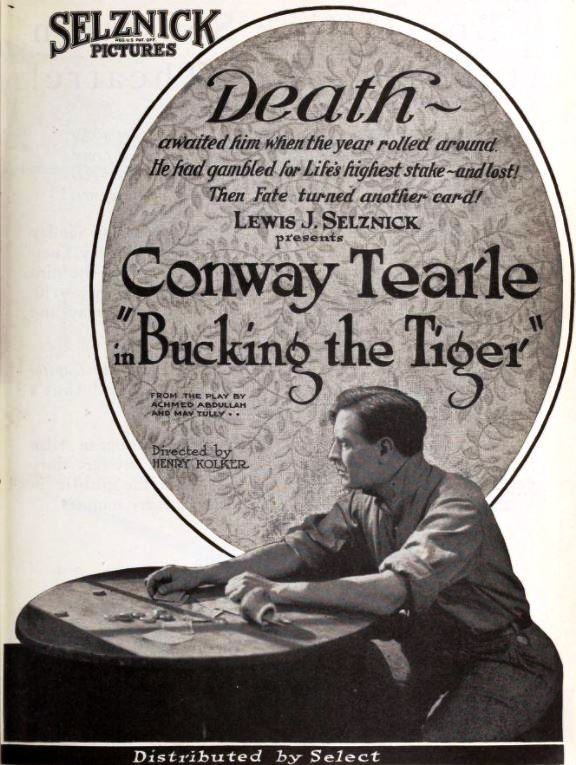
A review of a 1920s drama where survival hinges on luck, love, and the alchemy of gold.
Bucking the Tiger, a 1920s silent film directed by Achmed Abdullah and co-written with May Tully and Edward J. Montagne, is a masterclass in narrative tension and atmospheric minimalism. Set in the fictional Circle City, Alaska, the film unfolds within the decaying splendor of Eslick's Grand Palace Hotel, where five Klondike prospectors—reduced to dereliction by the unforgiving gold rush—conspire to resurrect their fortunes through a scheme as morbid as it is pragmatic. At the heart of the film lies Emily Dwyer (Winifred Westover), a woman whose journey from despair to unexpected entanglement with the enigmatic MacDonald (Gladden James) forms the emotional spine of this taut drama.
The film opens with a haunting close-up of the hotel’s chandelier, its once-gleaming crystals now dulled by coal dust and neglect. This visual motif of faded grandeur recurs throughout, mirroring the protagonists’ diminishing prospects. The five men, each bearing the weight of failure, gather in a smoke-filled room to discuss their options. Their plan—a deadly game of faro where the ace of spades dictates a suicide pact—reveals a society fractured by desperation. The insurance policy, a macabre lottery, becomes both a symbol of their nihilism and a perverse commentary on capitalist greed.
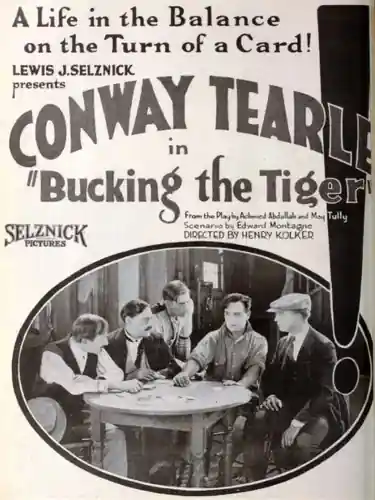
MacDonald’s entrance is electrifying. Played by Gladden James with a brooding intensity, his character is a former football star turned drifter, a man whose physical prowess contrasts with his moral ambiguity. His intervention in Emily’s suicide attempt—a scene shot in stark chiaroscuro—cements his role as both savior and catalyst. The film’s most striking sequence is the faro game, rendered with a slow-burning tension reminiscent of The Reign of Terror’s political machinations. As the ace of spades is drawn, the camera lingers on the men’s faces, each expression a study in resignation or resolve. Yet the narrative pivots when MacDonald abandons the plan upon discovering a gold vein, a twist that undercuts the film’s fatalism with a glimmer of redemption.
The chemistry between James and Westover is electrifying, their romance unfolding with a rawness that transcends the film’s silent format. Emily’s arc, from a woman on the brink of self-annihilation to one entangled in MacDonald’s newfound prosperity, is rendered with nuance. The supporting cast—Helen Montrose as a jaded gambler, George A. Wright as a stoic prospector—adds layers to the ensemble, their performances steeped in the pathos of a bygone era. The film’s score, though absent in the original, can be imagined as a mournful fiddle, echoing the isolation of the Alaskan frontier.
Visually, Bucking the Tiger is a feast of contrasts. The cinematography—guided by an uncredited director of photography—uses the hotel’s grandeur to juxtapose the characters’ internal decay. Wide shots of the icy wilderness frame the narrative within a broader context of nature’s indifference to human folly. The gold vein’s discovery, shot in a kaleidoscope of warm hues against the film’s otherwise monochrome palette, marks a symbolic rebirth for the characters and the film itself.
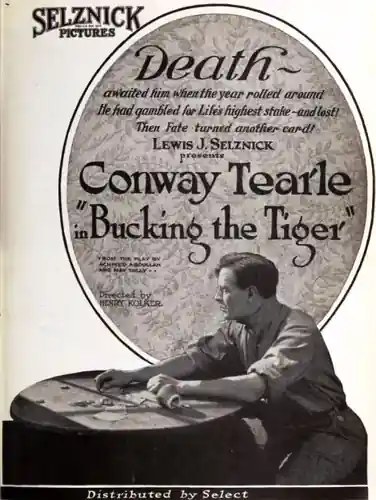
Thematically, the film interrogates the duality of human nature. The suicide pact, a rational solution to financial ruin, is undercut by the irrational hope that defines the characters’ subsequent prosperity. This tension is mirrored in the romantic subplot between MacDonald and Emily, a relationship forged in desperation yet sustained by a mutual recognition of vulnerability. The film’s resolution—where the five men thrive under MacDonald’s leadership—leaves an ambiguous legacy. Are they saved by luck, or merely delaying the inevitable? This question lingers like the smoke from the hotel’s hearth.
Comparisons to contemporaneous works are inevitable. The Coward, with its exploration of moral cowardice, shares thematic ground, though Bucking the Tiger’s fatalism is more pronounced. Sweethearts, a tale of romantic aspiration, contrasts sharply with this film’s bleak pragmatism. Yet the most compelling parallel lies with Love's Pilgrimage to America, both films navigating the intersection of personal and economic survival in frontier settings. The Vanderhoff Affair, with its labyrinthine plot devices, pales next to the stripped-down urgency of Bucking the Tiger’s narrative.
The script, penned by Abdullah, Tully, and Montagne, is a testament to the power of restraint. Dialogue is minimal, replaced by a visual lexicon of glances, gestures, and the silent language of the Klondike. The faro game sequence, a masterstroke of narrative economy, requires no exposition—a single shot of the ace of spades is enough to convey the characters’ collective fate. This economy of means is perhaps the film’s greatest strength, proving that less can be more in the hands of a skilled director.
In conclusion, Bucking the Tiger is a gem of early cinema, a film that uses its setting and characters to explore the fragility of human ambition. Its exploration of morality in extremis, coupled with stellar performances and stark visuals, cements its place in the canon of pre-code American dramas. For those seeking a film that marries existential dread with glimmers of hope, this is a must-watch.
IMDb 5.2
1931
Community
Log in to comment.