DbcultAccessing Vault...
Cult Review
Senior Film Conservator
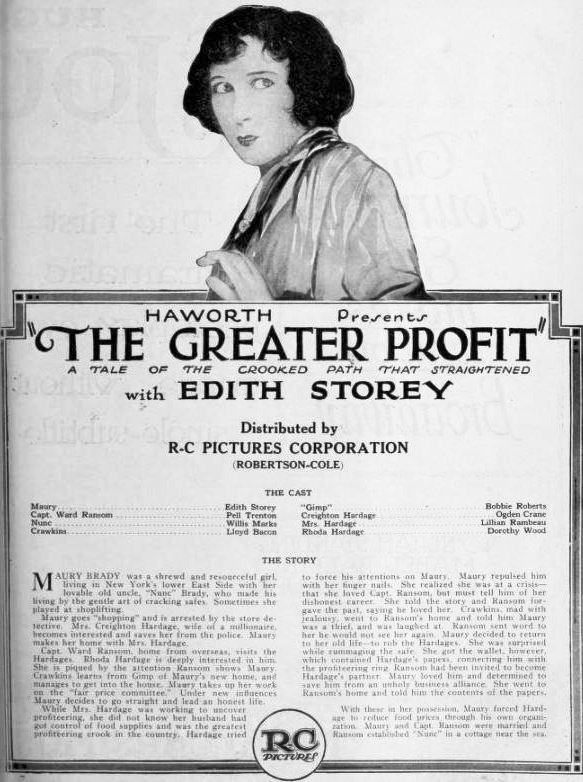
When the flickering reels of The Greater Profit begin to whirl, the audience is thrust into a world where the gritty streets of early twentieth‑century New York clash with the gilded corridors of high society. The film, directed by an unnamed hand yet buoyed by the magnetic presence of Edith Storey as Mauri Brady, operates as a compact yet potent commentary on class stratification, gender agency, and the moral calculus of capitalism.
At its core, the narrative follows Mauri, a product of the East Side's underbelly, whose apprenticeship in safe‑cracking and shoplifting is less a glorification of crime than a survivalist pedagogy imparted by her uncle, the enigmatic Nunc. The inciting incident—a lost poodle belonging to Mrs. Hardage—serves as a narrative fulcrum, pivoting Mauri from a life of petty theft to an unexpected partnership with the very elite she once scorned.
The film deftly employs the poodle as a symbolic conduit: a creature of innocence that bridges the chasm between two disparate worlds. When Mauri rescues the animal, she inadvertently rescues herself from the abyss of anonymity, gaining entry into the Hardage household where the stakes are dramatically amplified.
Mrs. Hardage, portrayed with a steely grace by Lillian Rambeau, embodies the paradox of benevolent aristocracy. Her decision to shelter Mauri after a lace‑theft incident is less an act of charity and more a calculated maneuver against her husband’s nefarious profiteering. This layered motivation injects a refreshing complexity into what could have been a simplistic savior‑victim dynamic.
Edith Storey’s portrayal of Mauri is a masterclass in silent‑era expressivity. Without spoken dialogue, Storey relies on a repertoire of glances, clenched fists, and subtle shifts in posture to convey a spectrum ranging from defiant grit to vulnerable yearning. Her chemistry with Lloyd Bacon’s Captain Ransom is palpable; the tension between duty and desire crackles in every lingering frame.
Lloyd Bacon, as the earnest yet conflicted fiancé, provides a counterpoint to Mauri’s street‑wise pragmatism. His internal struggle—torn between familial expectations and an emerging moral compass—mirrors the larger societal tensions the film scrutinizes. When he receives the incriminating ledger, his decision to weaponize it against the profiteering machine is both a personal redemption and an act of civic rebellion.
Pell Trenton’s Mr. Hardage is rendered with a rotund, almost caricatured avarice that nonetheless feels grounded in the historical realities of post‑World War I profiteering. The supporting cast—Ogden Crane, Dorothy Wood, Willis Marks, and Bobbie Roberts—populate the narrative with textured side‑stories that enrich the central plot without diluting its focus.
Visually, the film exploits chiaroscuro lighting to underscore the moral dichotomies at play. Dark alleys are bathed in harsh, angular shadows, while the Hardage manor glows with a soft, almost saccharine illumination that gradually reveals its underlying rot. The cinematographer’s use of deep focus during the pivotal ledger‑reveal scene allows the audience to simultaneously absorb the characters’ reactions and the incriminating text, a technique reminiscent of later noir classics.
The editing rhythm oscillates between brisk, kinetic cuts during Mauri’s shoplifting sequences and languid, lingering shots within the opulent drawing rooms. This deliberate pacing accentuates the protagonist’s transition from frenetic survival to contemplative resistance.
While The Greater Profit stands as a singular artifact, it resonates with thematic currents found in other silent dramas of the era. For instance, the class‑struggle motif echoes the social critique of The Life and Adventures of John Vane, where a rogue hero challenges colonial authority. Similarly, the moral awakening of a privileged male protagonist mirrors the trajectory of Captain Ransom, akin to the ethical dilemmas faced by the lead in The Breath of a Nation.
Where The Greater Profit diverges is in its explicit focus on economic exploitation, predating the more overtly political narratives of later Depression‑era cinema. Its treatment of profiteering as a villainous force anticipates the social realism of films like Held Up for the Makin's, albeit with a more optimistic resolution.
Gender dynamics in the film are particularly noteworthy. Mauri’s agency is never diminished by her association with male characters; instead, she remains the catalyst for change. Her decision to hand the incriminating paper to Ransom is a moment of empowerment, subverting the era’s typical damsel‑in‑distress trope.
Mrs. Hardage’s role further complicates the gender narrative. As a woman of wealth who leverages her position to undermine her husband’s illicit empire, she embodies a proto‑feminist figure whose strategic cunning rivals that of any male antagonist.
The film also interrogates the concept of redemption. Both Mauri and Ransom undergo transformative arcs, suggesting that personal integrity can be reclaimed even amidst systemic corruption. Their eventual union is less a romantic cliché than a symbolic convergence of disparate social strata, hinting at a hopeful, albeit idealized, vision of societal harmony.
Although largely eclipsed by the more celebrated works of its contemporaries, The Greater Profit endures as a prescient meditation on economic justice. Its portrayal of a single ledger exposing a nation‑wide profiteering network feels eerily resonant in an age of data leaks and whistleblower revelations.
Modern audiences may find the film’s silent format a barrier, yet its visual storytelling transcends linguistic constraints, allowing the narrative’s core concerns—class inequity, moral courage, and the power of individual agency—to reverberate across decades.
In sum, The Greater Profit is a compact yet richly layered work that marries compelling performances with incisive social commentary. Its deft blending of melodrama and moral inquiry renders it a valuable study for cinephiles interested in the evolution of American social cinema. For those seeking a film that balances entertainment with a pointed critique of early twentieth‑century capitalism, this silent gem offers an unexpectedly vibrant viewing experience.
IMDb —
1923
Community
Log in to comment.