DbcultAccessing Vault...
Cult Review
Senior Film Conservator
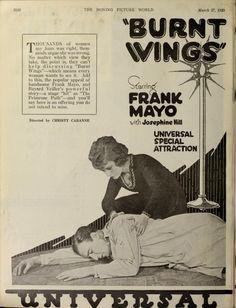
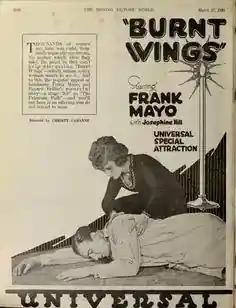
A charcoal smudge of moonlight slants across the opening iris shot and already Burnt Wings announces itself as something fiercer than your average Jazz-Age weepie. Christy Cabanne, a Griffith apprentice with a nose for moral sulfur, orchestrates this 1920 cautionary tale like a fever dream in two movements: the first, a frost-bitten Parisian nightmare shot in slate grays; the second, a chromium Manhattan fantasy that reeks of champagne and turpentine. The pivot between those worlds is Joan Templeton—played by Betty Blythe in a performance so combustible it feels unsafe to watch by nitrate light—whose body becomes the coin that purchases her husband’s art out of starvation.
Cabanne lingers on textures: frost lacework on cracked windows, the trembling flame of a single candle reflected in a cracked mirror, the papery rustle of Ned’s unfinished canvases—huge, wrathful things that look like they were painted with a trowel and his own blood. Rudolph Christians plays Ned with the hollow-eyed conviction of a man who believes genius exempts him from groceries. When the landlord slams the door for non-payment, the thud reverberates like a judge’s gavel; the couple’s last edible item, a heel of bread, is shared in a medium two-shot that makes the morsel look like communion.
Enter James Cartwright—an icily courteous predator swaddled in cashmere and cold cologne. Frank Mayo gives him the bored eyes of a card-shark who has already stacked the deck. His bargain is simple: Joan’s body for enough francs to keep the wolves pacing outside the door one more night. The transaction is never shown, only insinuated by a smash cut from Joan’s tear-stained consent to Cartwright’s gloved hand extinguishing a lamp. The blackout is followed by a title card—white letters trembling on black—that reads: "And the night took her piece of eternity."
Time travel on a whip-pan and we’re dockside at Ellis Island again, but now Ned’s steamer trunk is stuffed with francs-turned-dollars and newspaper clippings hailing him as the new Manet. Manhattan’s skyscrapers rise like chrome bookends to his ego. Cabanne films these sequences in wide shots that swallow the actors—suddenly the humans are decorative mites on the face of capital. At gallery soirées, Joan glides in beaded gowns, but her smile has the brittle temperature of porcelain left in the freezer. Meanwhile Ned, drunk on praise, flirts with Helen Cartwright (Josephine Hill), a flapper whose laugh ricochets like stray bullets.
The tension coils tighter once Helen’s father recognizes Joan as the woman he once rented by the hour. His dilemma is paternal: he wants Ned—the social prestige of a lionized son-in-law—yet cannot risk his daughter marrying a man yoked to a former courtesan. In a drawing-room scene worthy of Henry James, Cartwright corners Joan, murmuring that her past can be vaporized if she simply disappears. Beatrice Burnham, as Helen’s spinster aunt, hovers in the background like a gargoyle, her fan snapping shut like steel jaws.
Silent-era heroines were expected to swoon prettily; Blythe refuses. Her Joan is a slow-burn detonation: watch the micro-movements—eyelids fluttering like trapped moths when Cartwright enters a room, shoulders hitching a millimeter as Ned kisses Helen for the camera. In close-up, Blythe’s irises seem to darken from hazel to obsidian, as if shame pools there and can’t drain. The film’s most devastating moment is a mere insert: Joan’s gloved finger tracing the engraved name "Mrs. Templeton" on a wedding invitation meant for the Cartwrights. The fingertip tremor conveys a lifetime of self-loathing in twelve frames.
Ned’s arc is less redemption than humiliation. Christians lets the cockiness leach out incrementally: shoulders cave, voice (via title cards) shrinks from baritone declarations to pleading interrogatives. The film indicts the male artist mythos: genius as moral exemption, women as disposable pigment. Ned’s climactic epiphany—overhearing Cartwright threaten Joan—lands not as heroic but as obscene belatedness. Cabanne frames him in a mirror, doubled and split, suggesting the man he believed himself to be has already shattered.
Though monochromatic, the tinting strategy speaks volumes. Paris sequences bear a cold blue tint, giving skin tones the bruised pallor of drowned corpses. New York nightlife glows amber—money filtered through whiskey. Intermittent red flashes (fireplace embers, traffic lights) foreshadow the burnt of the title. The final tableau, a conflagration in Ned’s studio, is printed in crimson so saturated it feels like the celluloid itself is hemorrhaging.
Percy Heath’s intertitles eschew the cutesy alliteration of many silents. Instead, he opts for staccato poetry: "Love bought with bread leaves crumbs of conscience." Bayard Veiller’s scenario contributions tighten the third act, compressing a potentially melodramatic divorce trial into a single midnight confrontation. The writers also avoid punishing Joan—the film’s moral ledger ultimately condemns the purchaser, not the purchased.
If you’ve seen His Parisian Wife (1920), you’ll recognize the transatlantic morality swap, yet Burnt Wings is bleaker, refusing the comic deus ex machina that rescues that film’s heroine. The transactional eroticism also predates A Woman Who Understood (1921), but where that latter picture aestheticizes courtesan life, Cabanne rubs our noses in the fiscal odor. Conversely, Before Breakfast (short, 1919) shares the claustrophobia of marital pressure, yet lacks the class-obsessed sting here.
Lensman Allen Siegler employs deep-focus compositions that keep foreground and background in cruel dialogue. In one shot, Joan descends a staircase while Cartwright’s silhouette looms behind a translucent curtain—two planes of action, one moral trap. The camera rarely moves, but when it does—tracking back as Ned rushes to confront Cartwright—it feels like the ground itself recoiling from scandal.
Original release prints shipped with a cue sheet recommending Saint-Saëns’ Danse Macabre for Paris scenes and Joplin rags for New York. Modern festival restorations often commission new scores; the MoMA 2019 presentation used a string quartet that detuned mid-performance to mirror Joan’s fraying psyche—an effect so unnerving several patrons covered their ears. Silence, however, remains the sharpest tool: the film’s final thirty seconds are purely visual, no musical sting, just the soft hiss of projector emulsion—an absence louder than any chord.
Contemporary critics praised Blythe but dismissed the plot as "sordid"; Variety 1920 harrumphed that "decent audiences deserve cleaner canvases." Yet the film minted money in urban theaters, proving post-war viewers craved unvarnished grit. Today it reads as proto-noir, anticipating the femme fatale moral calculus of the 1940s, while its critique of art-world commodification feels eerily predictive of Instagram self-branding.
Only two incomplete negatives survive—one at the BFI, one at Gosfilmofond. Digital stitching has reconstructed about 87% of runtime; missing scenes are covered by explanatory title cards illustrated with surviving production stills. The resulting patchwork actually enhances the fragility, reminding us how close Joan’s story came to permanent erasure.
Burnt Wings is less a relic than a wound that refuses to scab. It indicts male ego, market morality, and the high price of pigment and pride. Every frame flickers with the uncomfortable knowledge that art, like love, is too often bought with someone else’s flesh. Nearly a century on, the film still radiates heat—proof that some burns leave no scar, only light.
IMDb 8.6
1924
Community
Log in to comment.