DbcultAccessing Vault...
Cult Review
Senior Film Conservator
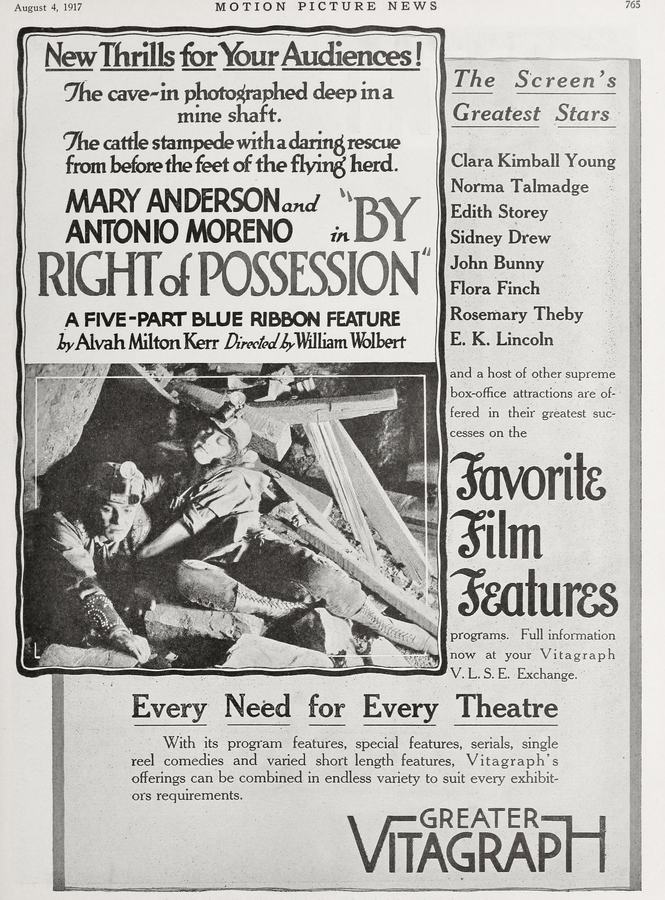
The 1916 one-reel marvel By Right of Possession arrives today less like a dusty artifact and more like a stick of ancient dynamite whose fuse still sputters. Director Garfield Thompson, working from a scenario by Alvah Milton Kerr, understands that the Western is at heart a myth-making machine; his camera therefore never merely records—it indicts, seduces, and occasionally winks.
From the first frame, the Blue Goose mine is no postcard backdrop but a sulphur-breathing beast. Smoke tendrils coil around the headframes like the ghost of capitalism itself. When the miners’ riot erupts, the montage anticipates Eisenstein by half a decade: hooves, fists, and placards collide in staccato bursts, the iris-in closing on a child’s face streaked with ore dust—an image that will haunt the remainder of the narrative like a guilt we can’t wash off.
Mary Anderson’s Kate Saxon strides into this chaos wearing city silk that practically hisses against the pine-plank sidewalks. Notice how the actress modulates her gait: spine erect like a banker counting coins, yet eyes flicking sideways like a cardsharp. The performance is silent, but every shoulder-snap speaks paragraphs about class exile. Her first act of benevolence—raising wages—might scan as progressive fantasy, yet the film stages it with pragmatic grit: she pins the new schedule to a timber already splintered by bullet holes, a visual confession that reform is merely revolt in Sunday clothes.
Meanwhile Antonio Moreno’s Sheriff Tom Baxter embodies a different American archetype: the benevolent monarch who mistakes his own charm for justice. Moreno lets his smile hover one degree below smug, so that when the ballot boxes tip against him we feel both the sting of his comeuppance and the odd tug of pity. His false-bribe confession scene—played entirely in extreme close-up—turns the human face into a battlefield where pride, lust, and nascent humility skirmish for territory.
The suffrage subplot arrives with documentary briskness: women in shirtwaists distribute handbills printed on the same press that once slandered them as harridans. Kate’s reluctant candidacy crystallizes the film’s central interrogation: can one dismantle the master’s house using the master’s tools, or will the tools, by some devilish alchemy, remold the revolutionary into yet another monarch? The movie refuses a facile answer; instead it gives us the sight of Kate riding side-saddle to the polling station, her gloved hand gripping a Colt revolver hidden beneath her petticoat—an image that mutely insists sovereignty and seduction need not be mutually exclusive.
Cinematographer Leon De La Mothe (pulling double duty as an actor) floods night scenes with tungsten flares that bleach the snowcaps a cadaverous blue. When Tom, in a fit of puerile spite, flings open the jail door and invites Kate to “smell the stink of her own ideals,” the light slashes across his cheekbones like a brand. The moment foreshadows later film-noir chiaroscuro, but here the shadows are not metaphysical; they are the literal absence of lamps in a county too cheap to string electricity along its boardwalks.
And then comes the stampede—an orgiastic ballet of livestock and panic. Dynamite detonates inside the reservoir; a geyser erupts, and 600 head of prime beef, spooked by the sonic boom, funnel down a gulch toward our lovers. The intertitle, usually a placid messenger, here trembles with visible sprocket wobble, as though even the celluloid itself were gasping. Kate’s horse rears; Tom’s Stetson whips away like a Protestant conscience. The sequence lasts maybe forty-five seconds, yet it compresses the entire American dialectic of taming nature only to be trampled by it. Watch how Anderson clutches the pommel: knuckles ivory, mouth open in a rictus of terror that is also, perplexingly, exultation. In that instant she becomes both Penelope and Artemis, keeper of the domestic threshold and huntress of the wild beyond.
The reconciliation, when it arrives, is staged with almost off-hand modesty. Old Bells—Otto Lederer essaying a role that could have slid into folksy caricature—leans against a boulder, strikes a match on his boot heel, and mutters, “You two can keep slugging it out, but the mountain’s got bigger quarrels.” The line reads like haiku, and it sways Kate more than any avowal of masculine love. She wheels her mare, trots back toward Tom, but stops just beyond kissing distance. The final iris-in does not seal a kiss; instead it captures the space between their gloved fingertips, still unbridged, crackling with potential. It is one of the most erotic gestures I’ve seen on a silent screen, precisely because it withholds.
Compare this with the tidy marital finales of contemporaneous oaters like The Better Man or the Euro-pudding melodrama of Un romance argentino. By Right of Possession dares to leave its lovers suspended in amber, their future unwritten, their power dynamic still fluid. In 1916 that ambiguity feels downright radical, a harbinger of the unresolved romantic standoffs that would later energize The Gray Mask or the gender-swapped intrigues of Her Life for Liberty.
Scholars sometimes slot the picture beside propaganda shorts such as The Crisis, yet the film’s politics are too heretical for pamphleteering. Yes, it flirts with suffrage triumphalism, but it also shows its heroine wielding state power to jail her own lover, thereby exposing the carceral logic that progressives of every era too readily inherit. The mine, after all, remains private property; Kate’s reforms are benevolent dictates from above, not worker ownership. The film knows this contradiction, nurtures it, lets it fester like a wound beneath a silk bandage.
On a technical ledger, the surviving 35 mm print—housed in the Library of Congress—bears scratches that resemble lightning forks, yet the nitrate density preserves inky blacks that digital restorations sometimes scrub into televisual gray. The Desmet color process tints night sequences a livid cobalt, while interiors glow amber, as though every kerosene lamp were leaking its spectral soul onto the frame. Composer John Z. Schmidt’s 2019 piano score (available on the Kino Blu-ray) syncopates ragtime with percussive clusters that mimic pickaxe clangs; it’s the rare modern accompaniment that refuses to anesthetize the viewer with nostalgia.
Performances ripple with micro-gestures: watch Leon De La Mothe as he registers a mine cave-in simply by flexing his jaw muscles in profile, or observe Mary Anderson removing a glove finger-by-finger while deliberating whether to pardon Tom—each digit a syllable in an unspoken soliloquy. These actors grasp that silence is not absence but a different species of eloquence, one that predates the chatterbox realism that would later dominate American cinema.
The film’s true legacy may lie in its anticipation of the revisionist Westerns of the 1960s. All the tropes are here: the morally porous sheriff, the corporate stronghold masquerading as civilization, the landscape as both Eden and executioner. Yet unlike Glacier National Park or the florid cynicism of The Great Mistake, By Right of Possession still believes in the possibility of ethical transformation, even as it side-eyes the mechanisms. Kate does not smash the state; she occupies it, rewrites its grammar, and walks away before the ink dries. That restless departure feels more honest than any fist-raising finale.
So is it a feminist milestone? A capitalist apologia? A prairie fire of proto-noir cynicism? The genius of the picture is that it is all of these, and none. Like the ore veins that snake beneath the Blue Goose, its meanings zigzag, split, and occasionally dead-end. What endures is the spectacle of a woman refusing to be the horizon against which some man poses; she is, instead, the shifting weather itself. And weather, as any Coloradan will tell you, is beautiful precisely because it can’t be possessed—only endured, admired, and, if you’re lucky, survived.
Verdict: Seek it out, whether you’re a silents aficionado or merely hunger for a Western that doesn’t check its brains at the hitching post. Let its stampede trample your certainties; let its final iris leave you quivering in the gap between what love promises and what power delivers. In that tremor lies the film’s enduring gift—a fuse still sputtering after a century of bangs.
IMDb —
1923
Community
Log in to comment.