DbcultAccessing Vault...
5.2/10
Senior Film Conservator
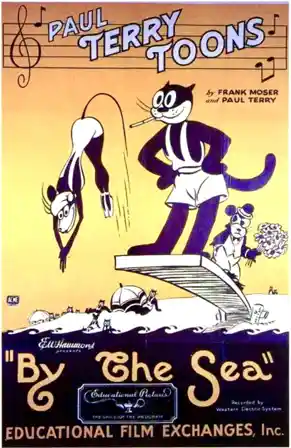
A definitive 5.2/10 rating for a film that redefined the boundaries of cult cinema. By the Sea remains a cornerstone of transgressive art.
If you have about six minutes to spare and you like looking at old drawings that wiggle, By the Sea is probably worth your time. It is not a masterpiece by any means, but it has that specific 1930s charm where everything feels like it’s made of rubber. I think people who love animation history will dig it, but if you need a plot that actually makes sense, you will probably hate this. It’s just a series of things happening one after another without much logic.
The whole thing starts with a mouse and a cat on a date at the beach. I don’t know why a mouse is dating a cat, but in 1931, nobody seemed to care about the food chain. They look happy enough until this giant octopus shows up out of nowhere. It’s one of those movie moments where you realize the villain has no motivation other than being a jerk.
The octopus is honestly the best part of the whole short. His arms are all over the place and they move in these weird, fluid loops that must have been a pain to draw back then. He just grabs the lady and drags her under the water like it’s no big deal. It is actually kind of creepy if you think about it too much, but the music stays so happy that you forget it’s a kidnapping.
Then we get the lifeguard. He is this big, buff guy who spends more time posing than actually swimming. He really likes his own muscles. Every time he flexes, his chest makes this weird squeaking sound in my head, even though the movie is mostly just music and some sound effects. It reminds me a bit of the characters in Beach Nuts, where everyone is just there to look silly in a swimsuit.
I noticed the background looks incredibly flat, like it was painted on a piece of cardboard that someone forgot to finish. The waves don’t really move; they just kind of sit there while the characters bounce in front of them. It makes the whole beach feel very small, like a stage play instead of a real ocean. But that’s part of the fun of these early Terrytoons, I guess.
The mouse is kind of a wimp for the first half of the movie. He just stands there while the octopus takes his girlfriend. But then he gets some courage—or maybe he just realizes he’s the main character. He starts throwing these tiny punches that don't look like they would hurt a fly, let alone a giant sea monster. 🐭
One reaction shot of the mouse looking surprised lingers for way too long. It becomes funny because he just stares at the screen with these huge eyes. I wonder if the animators just needed to fill a few seconds of screen time and decided to leave him there. It’s those little imperfections that make me like these old films more than the shiny new stuff.
The music is very plinky-plonky. That is the only way I can describe it. It never stops, even when the characters are underwater or in trouble. It’s like the band was told to keep playing no matter what happened on screen. It’s much more upbeat than the stuff you’d hear in something like The Little Yank, which has a bit more drama to it.

I was moveing my head to the beat without even realizing it. The rhythm is the most important part of these shorts. If the beat stops, the whole thing falls apart. Paul Terry, who wrote this, really understood that even if the story was thin, the movement had to be fun. It’s not quite as smart as Whys and Otherwise, but it’s more energetic.
There is a strange moment where the lifeguard tries to use a life ring, but it keeps bouncing back at him. It goes on for about four times too many. You can almost feel the movie trying to convince you this gag is the funniest thing ever. It’s not, but it’s charming in a dumb way.
The way they draw water is basically just white blobs splashing around. 🌊 It doesn’t look like water at all, but it works for the style. I think I prefer this to the hyper-realistic CGI we get now. There’s something honest about a bunch of ink splashes representing the Atlantic Ocean.
I also noticed the lady cat—or mouse, I’m still not 100% sure—has these long eyelashes that disappear and reappear between shots. Continuity was definitely not a priority in 1931. It’s the kind of thing you only notice if you’re watching closely, like we do here. It’s a bit like the rough edges you see in Cupid Forecloses, where the focus is more on the feeling than the technical perfection.
The ending is very sudden. They beat the octopus, everyone is happy, and then it just ends. No wrap-up, no conversation, just a quick fade to black. It feels like they ran out of paper or just decided they’d done enough for one day. I respect that. Why drag it out?
Is it a must-watch? Probably not unless you’re a completionist. But if you’re bored and want to see a mouse fight a sea creature, it’s a good way to spend five minutes. It’s definitely better than some of the other random shorts from that era that just have characters dancing in a circle for no reason.
The animation on the lifeguard's chest when he breathes is weirdly detailed. Someone put a lot of work into that one specific thing while the rest of the characters are just circles and lines. It’s those weird priorities that make me love old animation. You can tell which animator was obsessed with which body part that week.
Overall, it’s just a beach day gone wrong. It has a lot of heart, even if it doesn't have much of a brain. If you liked the vibes in The Peacock Fan, you might find this a bit too silly, but it’s a nice palette cleanser. Just don't expect anything deep. It’s just a mouse, a cat, and a very grabby octopus. 🐙
IMDb —
1932
Community
Log in to comment.