DbcultAccessing Vault...
Cult Review
Senior Film Conservator
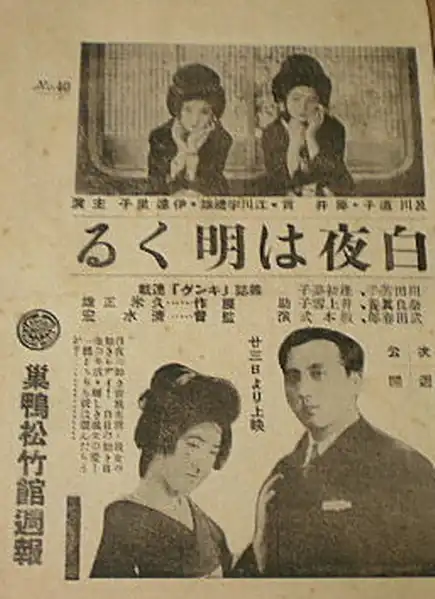
Alright, let's talk about Byakuya wa akaruku, which you might know as Bright Nights. Is it worth tracking down today? Well, that depends. If you’re the kind of person who needs explosions and fast cuts, honestly, you’ll probably find this a bit of a snooze. 😴
But for those of us who appreciate the slower, more observational pace of early Japanese cinema, the kind that makes you actually *lean in* to catch a subtle glance or a quiet sigh, then yes, absolutely. This is a film for the patient, for the curious about a bygone era, and for anyone who loves just sitting with characters, even when they’re not doing anything particularly flashy.
The first thing that really hit me watching this was the pacing. It’s… deliberate. There's this scene early on where Mitsugu Fujii's character just walks down a street. It goes on, and on, and on. You start wondering if the film reel got stuck. But then, you realize it’s showing you the world around him, the little shops, the way people move. It's not about getting somewhere fast; it’s about *being there*. It just kind of washes over you.
And the way the camera lingers on faces, too. Yukiko Inoue, especially, has this incredible ability to convey so much with just a slight shift in her eyes. There's this one shot, I think it’s when she’s looking out a window, and the light hits her just so. You can almost feel the weight of whatever she's thinking, without a single word spoken. It's powerful, you know?
Some of the dialogue, when it does come, is incredibly sharp but also very natural. It feels like eavesdropping. There's a conversation between Takeshi Sakamoto and another character about, oh, I think it was about the cost of living or something small like that. But it hints at so much more, about the struggles and hopes of people just trying to get by. No grand speeches, just honest talk.
It's not a film that spells everything out. It trusts you to pick up on things. Like, one of the sets, a little teahouse maybe, has this vase that’s slightly off-center. It's not a huge deal, but it just felt so *real*, like someone actually lived there and just moved it, not some perfectly arranged movie set.
There are these small, almost mundane interactions that stay with you. A child chasing a ball across a dusty courtyard. Someone lighting a cigarette with a careful, slow motion. These are the threads that weave the story together, rather than some big, overarching plot.
What’s interesting is how it handles emotion. It doesn't shout. When something sad happens, it’s not with big tears or dramatic music. It’s often just a quiet resignation, a pause, a slow turn of the head. It's **subtle**, but it lands harder sometimes because of that quietness. It really makes you lean in to *feel* it.
The film isn't trying to be a masterpiece, I don't think. It's just trying to show you a slice of life, a moment in time. And in that, it truly succeeds. You walk away with a feeling, more than a memory of specific events. It’s like you spent a quiet afternoon with these people, and now they’re just part of your thoughts.
It reminds me a bit of just watching people at a train station; you don't know their whole story, but you catch glimpses, and you can imagine so much. That's the vibe here. It's less a story with a beginning and end, and more of an extended observation.
If you're looking for an entry point into this kind of cinema, or just want to slow down for a bit, Byakuya wa akaruku is a pretty good place to start. It’s **not flashy**, it’s **not loud**, but it has a real quiet power. Don't go in expecting Hollywood, and you might just find something really special.
Didja notice?

IMDb —
1924
Community
Log in to comment.