DbcultAccessing Vault...
7.1/10
Senior Film Conservator
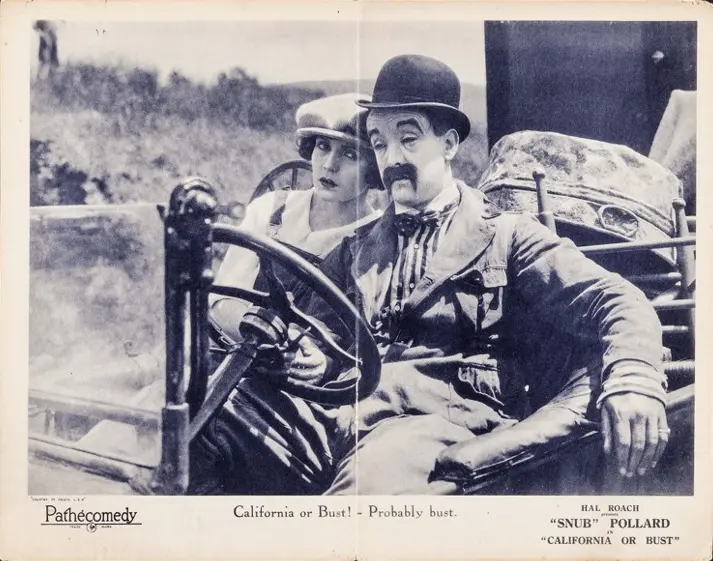
A definitive 7.1/10 rating for a film that redefined the boundaries of cult cinema. California or Bust remains a cornerstone of transgressive art.
The 1925 short California or Bust arrives as a kinetic tapestry woven from the threads of disaster, ambition, and absurdity. Its premise—an agrarian couple fleeing a tornado‑swept Kansas homestead for the sun‑kissed promises of the West—might seem straightforward, yet the film’s execution spirals into a kaleidoscopic satire of migration myths. The opening sequence, shot with a brisk pan across a devastated farm, sets a tone of visual irony; the camera lingers on a solitary wind‑blown hat, a silent ode to loss, before cutting to the protagonists’ determined faces.
James Finlayson, embodying the farmer, delivers his trademark deadpan glare, a stare that conveys resignation and resolve in equal measure. His partner, portrayed by Marie Mosquini, balances his stoicism with a subtle, resilient warmth, her eyes flickering with both fear and hope. When the couple decides to board a rattling train bound for California, the film pivots into a series of escalating gags that echo the frantic energy of Young America's youthful wanderlust, yet it retains a uniquely rustic flavor.
The train’s arrival in California is a masterclass in visual comedy. Instead of golden dunes, the screen erupts with a deluge of rain, a torrent that seems to mock the very notion of a “sunny” destination. The cinematography employs a low‑angle shot of the sky, the clouds rendered in a wash of gray that starkly contrasts with the film’s otherwise bright palette. As the couple steps onto the slick platform, Snub Pollard—cast as a hapless itinerant—bursts onto the scene, his lanky frame slipping on the wet cobblestones. Pollard’s physicality, a blend of pratfall and exaggerated flailing, becomes a conduit for the film’s commentary on the unpredictability of the American frontier.
The weather motif intensifies: hailstones clatter against the carriage windows like a percussive score, while a sudden snowstorm blankets the bustling streets in a surreal, monochrome veil. The production design cleverly uses practical effects—shaken ice for hail, cotton for snow—to create a tactile sense of chaos. Within this meteorological maelstrom, the narrative introduces an Indian uprising, a plot point that, while problematic by contemporary standards, is handled with a satirical edge reminiscent of the slap‑slap‑slap rhythm found in Blind Man's Luck. The uprising is portrayed through exaggerated caricatures, a reflection of the era’s cinematic conventions, yet the film subtly subverts expectations by allowing the farmer and his wife to navigate the conflict with a blend of bewildered compliance and accidental heroism.
The ensemble cast—William Gillespie as a beleaguered storekeeper, John M. O'Brien as a grizzled sheriff, and Jack Hill as a mischievous sidekick—populate the chaos with distinct comedic beats. Gillespie’s deadpan delivery of a line about “selling umbrellas in a desert” becomes a recurring gag, each utterance punctuated by a flicker of the dark orange #C2410C in the title cards, a visual cue that the film uses to highlight punchlines. O'Brien’s sheriff, adorned in a sea‑blue #0E7490 badge, attempts to restore order, only to be thwarted by a stray snowball that lands squarely on his nose—an image that lingers as a visual metaphor for authority being undermined by nature’s caprice.
H.M. Walker’s intertitles, rendered in a jaunty yellow #EAB308, serve not merely as dialogue but as rhythmic punctuation. One particularly clever card reads, “When the sky falls, the ground rises—welcome to California!” The phrasing, both witty and paradoxical, encapsulates the film’s thematic core: the dissonance between expectation and reality. This interplay of text and image reflects the sophisticated narrative economy of silent comedy, where every frame must convey dual layers of meaning.
Comparatively, California or Bust shares structural DNA with Seven Keys to Baldpate (1917), particularly in its use of a confined setting (the train station) as a crucible for escalating mishaps. Yet where Baldpante relies on mystery, this film leans into farce, allowing the environment itself to become a character. The relentless rain, the unyielding hail, the sudden snow—each element is anthropomorphized, a fickle deity testing the protagonists’ resolve.
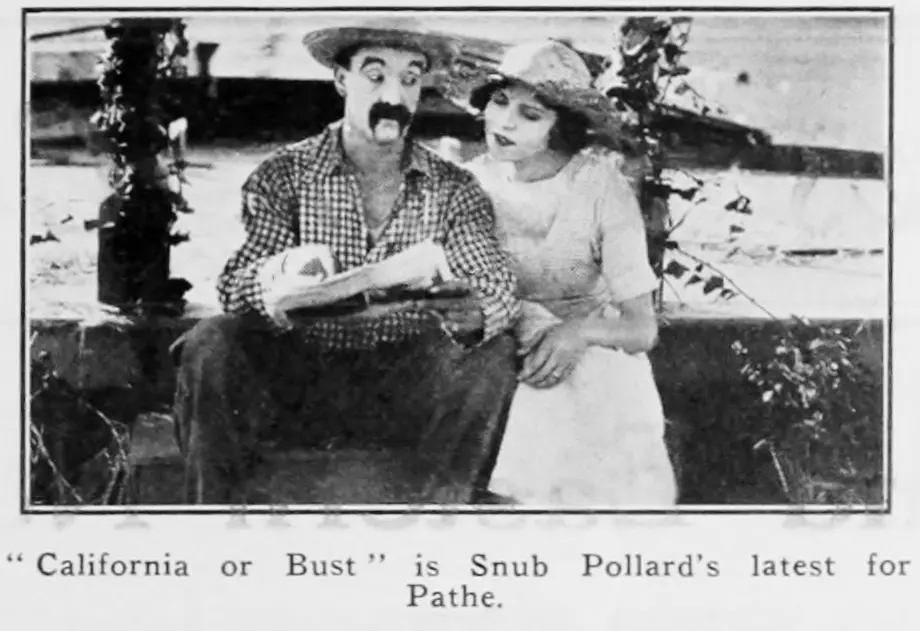
The climactic sequence, wherein the farmer and his wife inadvertently become leaders of the Indian resistance, is a masterstroke of absurdist choreography. Finlayson, wielding a broom as a makeshift spear, leads a charge that is both ludicrous and oddly triumphant. Mosquini, clutching a parasol, directs the “troops” with exaggerated gestures, her movements echoing the pantomime of a stage director. The scene’s rapid cuts, intercut with Pollard’s frantic attempts to dodge a barrage of snowballs, generate a kinetic energy that rivals the most frenetic moments of Buster Keaton’s oeuvre.
The resolution arrives not with a sunrise over the Pacific, but with a sudden thaw, the snow melting into a slushy mire that reveals a modest, sun‑dappled field—an ambiguous nod to the elusive promise of California. The farmer and his wife, drenched yet undeterred, share a silent glance that conveys a mixture of exhaustion and renewed determination. Their journey, though fraught with elemental antagonism and cultural clashes, ultimately reaffirms a resilient optimism that defines the silent‑era comedic spirit.
From a technical standpoint, the film’s cinematography showcases a deft handling of natural lighting, especially considering the constraints of early film stock. The rain scenes employ a backlit technique that renders each droplet as a glinting filament, a visual flourish that adds texture without overwhelming the frame. The set design for the Indian uprising, while undeniably rooted in period stereotypes, utilizes authentic props and costuming that hint at a modest attempt at historical texture, albeit filtered through a comedic lens.
Musically, contemporary screenings would have been accompanied by a piano score that accentuated the film’s rhythmic beats—staccato chords during the hailstorm, a languid melody for the snow‑covered fields, and a triumphant march during the uprising’s climax. Modern restorations often pair the visuals with a reconstructed score that honors this original intent, allowing contemporary audiences to experience the intended emotional cadence.
In the broader context of silent comedy, California or Bust occupies a niche that bridges the slapstick of Chaplin’s “The Gold Rush” and the situational absurdity of Laurel and Hardy’s later collaborations. Its reliance on physical comedy, coupled with a narrative that satirizes the mythic West, positions it as a cultural artifact that both reflects and critiques the migration narratives of the 1920s. The film’s humor, while anchored in the era’s conventions, possesses a timeless elasticity; the absurdity of chasing a dream only to be thwarted by weather remains resonant.
For scholars interested in the evolution of comedic tropes, the film offers a case study in the use of environmental obstacles as comedic catalysts—a technique later echoed in the works of the Marx Brothers and even contemporary directors like Wes Anderson. Moreover, the interplay between Finlayson’s deadpan and Pollard’s manic energy prefigures the dynamic duos that would dominate the genre in subsequent decades.
In conclusion, California or Bust is a vibrant, if under‑examined, specimen of silent‑era comedy that rewards attentive viewing. Its layered humor, meticulous visual composition, and subversive take on the American Dream render it a valuable entry point for both cinephiles and historians. Whether one approaches it as a relic of early cinema or as a living, breathing comedy, the film’s capacity to elicit laughter amidst chaos endures, proving that even a century later, the pursuit of sunshine can still be hilariously thwarted by a sudden snowstorm.
IMDb 7.1
1916
Community
Log in to comment.