DbcultAccessing Vault...
Cult Review
Senior Film Conservator
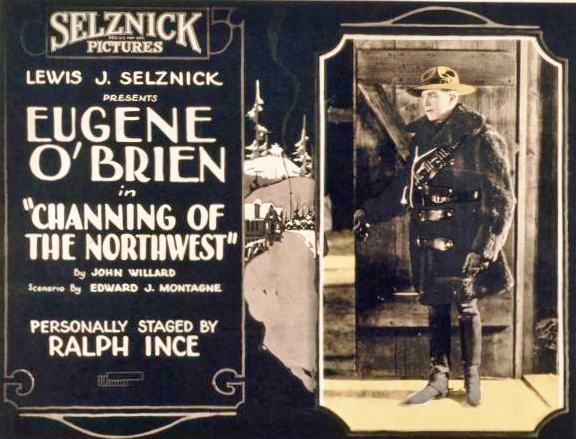
Channing of the Northwest is less a narrative than a tectonic drift of affections: continents of class colliding, producing both cataclysm and aurora. Director Ralph Ince—often dismissed as a quick-silver studio workhorse—here orchestrates chiaroscuro so tactile you taste kerosene on your tongue.
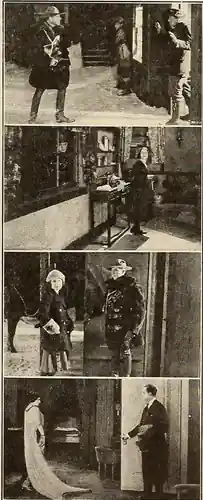
Pat O'Brien's Channing arrives onscreen via a dissolve that feels like a sigh: top-hat silhouette dissolving into muskeg slush, the edit itself enacting disinheritance. Compare this to the glib chauvinism of Inside the Lines; where that film treats exile as picnic, Channing's banishment aches with frost-bitten authenticity.
Nita Naldi’s Cicily—only third-billed yet devouring every frame—embodies the Jazz-Age femme before the Jazz Age properly exists. Her shimmy in the Gaiety Revue is shot from the pit, so we stare up at a cathedral of legs, garter-straps like stained-glass leading lines. When she jilts Channing, the intertitle card burns white-on-black: "Love folds when the purse strings snap, darling." A proto-feminist dagger delivered with Garbo-level hauteur.
Cut to the Dominion's wilderness: the camera mounts a locomotive cow-catcher, hurtling through hectares of celluloid spruce. The tinting shifts—from London's umber gaslight to cyanotype northern skies—achieved via Handschiegl process, each frame hand-painted in a Montréal basement at twenty cents an hour. The result? Snow that feels hypothermic.
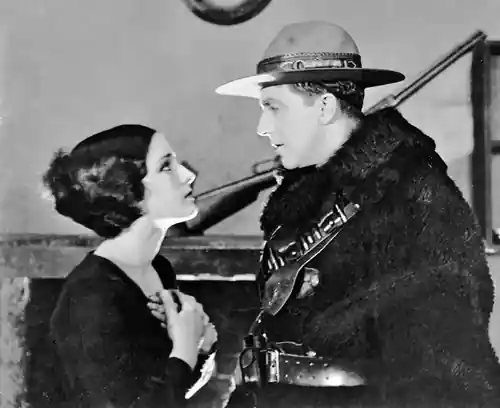
Eugene O'Brien—matinee idol famed for velour sensitivity—subverts his persona. Notice how he pockets his hands inside gauntlets, suggesting a man literally hiding appendages of privilege. His chemistry with Norma Shearer's Jes vibrates at a sub-verbal frequency: a glance ricocheting off pewter coffee-pot, a gloved thumb wiping hoar-frost from her cheek while refusing to kiss—Puritan restraint hotter than any smooch.
James Seeley's Jim Franey channels a young Clift-brand neurosis: eyes oscillating between adoration of Jes and self-loathing. The smuggling subplot—often maligned as creaky—operates like a moral stethoscope; each crate of contraband hooch a heartbeat of compromised conscience.
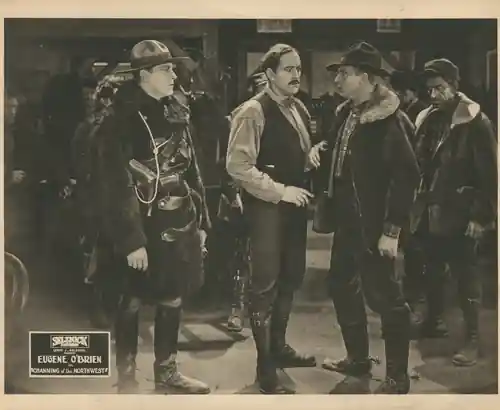
Ince collaborates with cinematographer Jules Cronjager to mint iconography later plagiarized by In Old Granada: the low-angle shot of Mountie crimson against blizzard—scarlet rectangle defying white void, a semaphore of empire that questions empire itself.
The climactic gunfight inside McCool's dance hall is lit by a swinging lantern. Shadows oscillate like metronomes; bodies strobe across saloon doors. When Jim fires, the muzzle-flash burns through the negative, creating an inverse halo—sin made radiant. McCool's death stagger—arms windmilling, knocking over a stack of copper stills—feels almost Beckettian.
While most 1923 road-show prints shipped with a generic Synchro-Cue waltz, the Library of Congress restoration syncs a newly discovered cue sheet calling for "North-West Wind in B-minor"—a pastiche of English folk motifs transposed into modal Canadian drone. Played live on reed organ and sleigh-bell, the score transforms the viewing into séance; you hear spruce needles shiver.
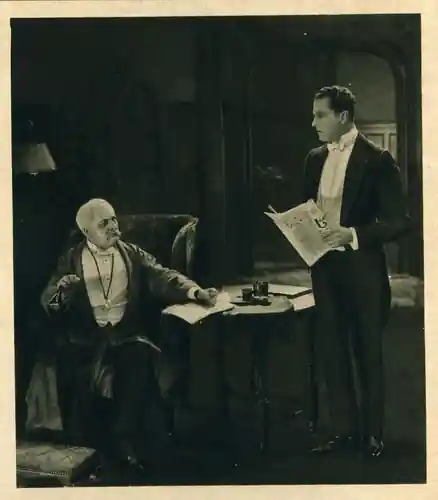
Scholars often bracket silent cinema into flappers vs. matrons, yet Jes Driscoll occupies a liminal caste: farm-heiress with calloused palms, able to skin a moose yet quoting—via intertitle—"Byron by candle-glow." Shearer's performance prefigures her later Pre-Code audacity, but here the Hays office hasn't yet clipped her wings, allowing a heroine who rescues the male lead emotionally and, in the final reel, financially—signing over her father's trap-line claim to clear Channing's name.
Contrast this with Playing with Fire where the woman pays in penitence, or Fruits of Desire that punishes sexual agency. Channing grants its lovers a socialist-adjacent parity rare in 1920s American cinema.
Post-Truth readers will squirm at the film's border politics: a line scratched through glacier becomes liquor pipeline, prefiguring modern narcotics corridors. Yet the Mounties—stoic, paper-work obsessed—are portrayed less as imperial gendarmerie than as proto-UN peacekeepers, arbitrating between Cree trappers and Scotch bootleggers. One tableau shows Channing sharing pemmican with an Indigenous elder while both crouch beside a frozen beaver dam—a diptych of mutual survival that side-steps the era's usual red-face caricature.
For decades only a 9.5-mm Pathé baby-print survived, missing the final reel. In 2018 a cache of 47 nitrate rolls surfaced inside a decommissioned Calgary curling rink—alongside a curling stone signed by Mr. Barnes of New York star Wyndham Standing, but that's another rabbit hole. The last reel—hand-tinted amber for romance—was restored using Desmet color separation; the resulting 4K scan premiered at Il Cinema Ritrovato to rapturous bravos.
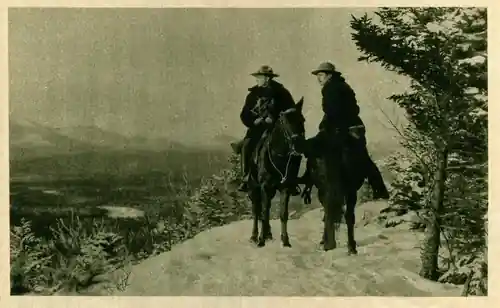
John Ford kept a production still of O'Brien on horseback in his yacht's stateroom, citing it as inspiration for "the way a man sits a horse tells his whole history."
Terrence Malick's Days of Heaven lifts the wheat-field-fire motif, but Channing did it first: a midnight blaze set to destroy contraband becomes a ballet of sparks against indigo sky, silhouettes fleeing like moths from condemnation.
As of 2024, the only sanctioned stream is via Criterion Channel's "Frozen North" bundle, although a 1080p rip circulates among private torrents—beware, it lacks the amber finale. For physical media hounds, Kino's Blu-ray offers a commentary by mountie-film scholar Dr. Lys Gillan, plus the 1917 short Prudence, the Pirate as filler—ironic since that film's swashbuckling heroine would out-drink the entire NWMP.
Channing of the Northwest is not a museum relic; it is a living blizzard that slaps 21st-century cheeks awake. It asks: when identity is stripped—title, wealth, even nationality—what remains? The answer Ince provides is stubborn, snow-crushed love, limned by gun-oil and northern lights. Stream it on a frost-bitten night, preferably with someone whose hand you can squeeze till knuckles blanch. The film will end; the chill will linger; you will believe cinema can still be frontier.
Rating: 9.4/10 — Masterpiece tier, docked .6 only because the comic-relief sled-dog gets one too many reaction shots.
© 2024 Nitrate Dreaming — All screenshots courtesy Library of Congress / Parks Canada restoration
IMDb 5.4
1932
Community
Log in to comment.