DbcultAccessing Vault...
Cult Review
Senior Film Conservator
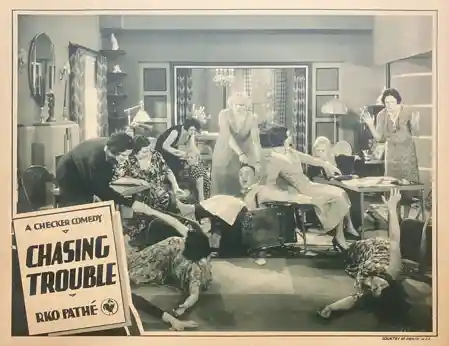
Alright, so we’re talking 1931 here. So, is Chasing Trouble worth your time today? Look, if you’re a dyed-in-the-wool classic film fan, or just curious about what cinema was like before the Code really kicked in, then yes, absolutely give it a spin. Everyone else? Probably going to find it slow, maybe a bit baffling, and definitely not the 'trouble' you’re expecting. 🤷♀️
It’s a peculiar beast, this one. The plot, what little there is, feels like someone sketched it on a napkin during a particularly boozy lunch. Our main guy, played by Frank Coghlan Jr., is just trying to do a simple task. And then, well, _trouble_ ensues, mostly of the mistaken identity variety.
What really stuck with me, though, was Franklin Pangborn. He pops up as a fussy hotel manager, naturally. Every single gesture he makes is just *so* precise, *so* exaggerated, it’s a masterclass in early cinematic camp. His hand-wringing when a minor incident occurs? **Chef's kiss.** It’s honestly the most lively part of the whole thing.
Dot Farley, as some kind of gossipy busybody, has this one scene where she’s trying to discreetly listen in on a conversation. She keeps adjusting her hat, inching closer to a door, then pretending to admire a potted plant. It goes on a good 15 seconds longer than it needs to, and it becomes this wonderful, almost _absurd_ bit of physical comedy. You just gotta watch it. 👀
The whole chase aspect, the 'chasing trouble' bit, is less about high stakes and more about people running around in circles. There’s a sequence through a department store that feels incredibly clunky. You can almost feel the camera operator trying to keep up with the chaos, and sometimes, they just… don’t. It’s endearing in a weird way.
Dialogue often feels a bit stilted, like the actors are still getting used to talking on film. Some lines land with a thud, others have this accidental charm. There’s a moment where Coghlan Jr. blurts out, “Oh, for crying out loud, what *now*?” and it feels surprisingly modern, despite the old-timey inflection.
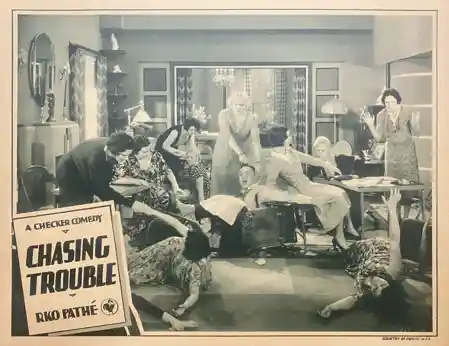
The sound quality, as you’d expect for 1931, is all over the place. Sometimes voices are crystal clear, other times it sounds like they’re speaking from inside a tin can. You really gotta crank the volume up and down. It’s part of the experience, I guess.
One thing that’s really noticeable is how quickly they move from one scene to the next without much in the way of smooth transitions. It’s like they just cut. Boom, new scene. It’s a very different rhythm than what we’re used to now.
And the lighting! Some interiors are just bathed in this flat, bright light that makes everyone look a bit washed out. Then a scene outdoors might have these really deep, dramatic shadows. It’s _wildly_ inconsistent, but it gives it a certain raw, unpolished feel that’s kinda cool.
There’s a small bit where a character accidentally knocks over a fruit stand. The apples just kinda roll around, and one extra just *stares* at them for a solid five seconds before anyone bothers to pick them up. It’s a tiny, forgotten detail, but it made me chuckle. Like, _somebody_ forgot their cue.
The actual 'trouble' they’re chasing? It’s so minor, you almost forget what started it all. It’s not a grand mystery or anything. More like a misunderstanding that got out of hand. And it’s kind of refreshing, really, not everything needs to be world-ending stakes.
Ultimately, Chasing Trouble isn’t going to change your life. But it’s a sweet, slightly awkward peek into early talkie comedies. It’s got a few genuine laughs, mostly from the sheer earnestness of it all. It’s a good one to put on if you’re cooking dinner and want something in the background that occasionally makes you go, “Huh, look at that.” 📽️
IMDb 6.1
1929
Community
Log in to comment.