DbcultAccessing Vault...
Cult Review
Senior Film Conservator
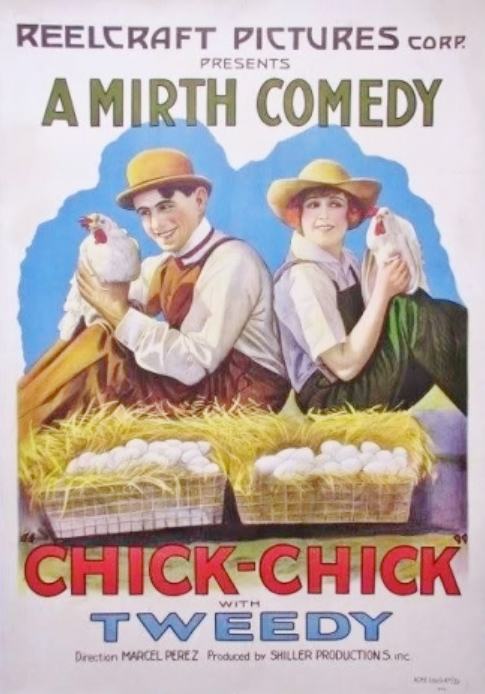
A single reel, scarcely twelve minutes of brittle 35 mm, yet Chick-Chick crackles like a thundersnow sky—absurd, luminous, lethal to complacency.
Start with the title, nonsense syllables that peck at class pretense the way a hen torments a dropped pearl. Director-star Marcel Perez, circus-clown turned cinema prankster, understood that nicknames weaponized into slurs: chick-chick, the barnyard taunt Marcel hisses at Dorothy’s straw-hick innocence, becomes the ricochet that will floor him once she molts into urbane splendor.
Dorothy Earle, mostly forgotten outside archives, here suggests a hybrid of Constance Talmadge’s kinetic eyebrows and Pickford’s cupid bow. Watch her fingers in the first reel: they fidget with apron hems, counting heartbeats like rosary beads. After the city interlude those same digits rest on a walking-stick handle, gloved in kid leather, tapping 3/4 time to unheard rag. Performance via extremities—silent-film semaphore at its most eloquent.
Perez’s camera strategy is thrift-shop genius. He cannot afford tracking shots, so he lets foreground clutter do the traveling: a swinging signboard, a careening goat, a parasol that pops open like a bored iris. The lens stays planted while the world jostles past, implying that modernity itself is the dolly, hurtling Dorothy from hayloft to cabaret.
Compare the film’s dialectic to The Marriage Bond where the city corrupts and the farm redeems. Chick-Chick refuses such moral bookkeeping. Dorothy’s rural shack, festooned with wash-basin geese and a suitor who chews straw like cud, is no Eden; the muddy yard literally sucks the shoes off her feet. Yet Chicago’s champagne salons glitter with predatory smiles—men who treat women like options on the grain exchange. The film’s cynicism is egalitarian: both arenas peddle humiliation, only the currency changes.
Thus education, not geography, becomes the film’s true protagonist. Dorothy’s metamorphosis is boot-strapped, financed by sweatshop sewing and library cards—details flashed in a brisk montage of ticking clocks and piling coin stacks. The montage lasts maybe twenty seconds, but it seeds the fantasy that class mobility can be purchased with gumption plus a J-stitch. Feminist historians will note that 1919 audiences, many themselves immigrant seamstresses, could project their own horizon onto those quick frames.
Enter the gown that ignites the third act: gun-metal silk, dropped waist, appliqué of jet beads swirling like comet tails. Costume designer (uncredited, as was custom) scavenged surplus war crepe, dyed it in a vat once used for Navy uniforms. Under carbon-arc lights the fabric registers lunar grey; under sunlight it bleeds bruised lavender, announcing Dorothy’s liminal identity—part soldier, part starlet.
Marcel’s sartorial downfall arrives via a straw boater that wilts in every scene. Note the running gag: each time he belittles country folk the hat slips lower, as if scalp-disapproval. When Dorothy reappears in couture, his brim finally collapses—visual shorthand for emasculation that Buster Keaton would echo two years later in Are Flirts Foolish?
Perez, veteran of European circuses, times gags like a Swiss horologist. The centerpiece stunt: Dorothy, now sleek citified, strides a boardwalk just as Marcel struts from the opposite direction. A banana-cartwheeling urchin crosses frame; both elites leap to dodge, crash into a mountain of produce. The collision is symmetric—silk and spats alike slathered in tropical slime—implying that capital, whether rural acreage or urban stock, is one peel away from slapstick erasure.
The film’s most subversive laugh lands when Dorothy, feigning strangeness, baits Marcel into a wager: he must teach the “provincial cousin” to dance the turkey-trot. Cut to a cut-glass ballroom. Marcel preens, counting the tuition fee already. Dorothy unleashes a turkey-trot so electrically precise that couples freeze mid-step. Musician violins screech like factory whistles; the camera dollies back to reveal every onlooker aping her moves, creating a Busby Berkeley tableau before Berkeley. Power reverses in the tempo of a saxophone riff.
Most one-reelers squander text; Chick-Chick weaponizes it. When country-Dorothy first boards the train, the card reads: “She left the land that forgot her name—seeking a city that might mispronounce it.” Later, as Marcel ogles her reinvention, the intertitle sneers: “He adored the painting, never guessing the brush.” These epigrams, penned by an anonymous studio wit, anticipate the brittle banter of Where Are Your Husbands? yet compress Wildean twang into telegram length.
Yes, the plot hinge—woman polishes herself to recapture man—reeks of retrograde wish-fulfillment. But the execution sabotages that moral. Dorothy’s polish is not cosmetic but epistemological: she learns how to weaponize information, how to let Marcel’s own lexicon ricochet. Her final line, delivered in a medium-close-up that swerves rare for 1919, is both proposal and warning: “I’ll marry the man, not the myth—break the mirror if you must.” The camera lingers until her gaze burns through the emulsion; Marcel, and by extension the audience, is the one reflected, fragmented, reassembled on her terms.
Contemporary viewers may taste echoes of Jack Spurlock, Prodigal yet with gender roles inverted and runtime compressed to espresso shot. Where Jack needs reels of moral contrition, Dorothy claims absolution in a glance.
Archivists at EYE Filmmuseum stitched the extant copy from two decomposing negatives—nitrate bouquets blooming fungus like white lace. Hence the perpetual snowfall of scratches. Rather than mourn, lean into it: those white cicatrices mimic the strobe of electric bulbs in Dorothy’s Chicago nightclub. Every gouge is a metronome counting the century-long tango between preservation and loss.
Music? The copy I screened came with a new score: toy piano, ukulele, typewriter bells struck for percussion. The contraption underscores the film’s hand-made ethos; it sounds like someone rifling through a junk-drawer of history, yanking out noise that still jingles.
Because TikTok reboots the same plot daily: rural teen migrates to metropolis, grooms self via algorithmic tutorials, returns home to flaunt glow-up. The virality hinges on the same tension Perez milked—status as performance, authenticity as currency. Only the bandwidth has swelled.
Because debates over “coastal elites” still map moral worth onto zip codes. The film’s final tableau—lovers embracing between corn stalk and skyscraper blueprint—offers no synthesis, only détente, a stance healthier than most cable-news rhetoric.
Because silent comedy, at its apogee, is punk rock: three chords of narrative, distortion pedal of speed, chorus that lodges in the collective cortex. Chick-Chick is a 1919 mosh pit where class, gender, and geography slam-dance until the floorboards splinter.
If the aftertaste leans bittersweet, chase it with A Bit o’ Heaven for Mary’s lambent nostalgia. If you crave darker vinegar, try The Dishonored Medal where revenge sours into tragedy. Should you want gender vengeance served colder, cue Maddalena Ferat and watch another woman weaponize rumor.
But best of all, run Chick-Chick again. Silent cinema rewards re-viewing the way vinyl rewards re-needle-drop: each rotation reveals a hiss that once sounded like silence, a background grin now foregrounded as smirk.
The country did not civilize her; the city did not corrupt her. She metabolized both, and what emerged was neither hayseed nor harlot, but horizon.
IMDb —
1917
Community
Log in to comment.