DbcultAccessing Vault...
Cult Review
Senior Film Conservator

The year 1926 coughed up jazz, bathtub gin, and Chicken à la Cabaret, a two-reeler that feels like a pickpocket brushing your sleeve—you exit lighter, though you never felt the fingers. Chester Conklin, mustache waxed into twin exclamation points, headlines as the magician whose grin says trust me while his eyes whisper run. Beside him, Dorothy Lee glitters like a nickelodeon star hurled into champagne; her every sidelong glance is a fuse. Together they stage the slickest jailbreak in silent cinema: not from prison, but from the very notion of accountability.
Watch the film once and you chase plot. Watch twice and you chase time. The policemen’s watches—those circular microcosms of duty—become eggs the way bullets become kisses in Buñuel’s later dreams. Editors intercut the onstage disappearance with a city symphony: elevated trains exhale steam, neon pharmacy signs sputter Latin mottos, a stray balloon shaped like a badge drifts toward the river. The montage predates The Home Trail’s urban lyricism by a full year, yet history shelved it as mere trifle.
Most silent escapes rely on locomotive peril—ropes, cliffs, runaway coal carts. Chicken à la Cabaret weaponizes etiquette. The benefit setting drips decorum: wives in tulle, medals clinking like silverware. When the magician requests those watches, he requests trust itselfschedule.
Conklin’s physical lexicon deserves scholarly scrolls. Note how his elbows flare at forty-five degrees, a geometry that says both welcome and keep distance. When the final curtain lifts to reveal absence, his body has already rehearsed the void: the space where a torso should be is carved by negative grace. You’ll spot the same silhouette in Idolators, yet there it serves melodrama, not mischief.
If Conklin is the scheme, Lee is the flicker that persuades you to blink. Her role, officially "charming confederate," expands off-script through micro-gestures: the way she thumbs the lip of her sequined clutch right before the trapdoor falls, as if testing a fruit for ripeness. In close-up, her pupils reflect the footlights—two tiny crime scenes. Contemporary reviewers, drunk on Fairbanks swagger, overlooked her; modern eyes see a proto-femme fatale who chooses complicity like a perfume. Compare her to the sacrificial wives in Greater Love Hath No Man and you realize how radically Chicken lets its woman exit the moral ledger unscathed.
Director Harry Booker, otherwise sentenced to one-reel curios, here stages a master-class in spatial bamboozlement. The stage trapdoor is shown twice—first from above, a yawning rectangle of pitch; seconds later from beneath, as the lovers descend past sandbags into a sewer alive with nickel flashes. Continuity geeks will howl: the sewer’s brickwork bears zero resemblance to the civic-hall basement. But the splice feels truthful because emotion, not masonry, is the architecture. Booker understood that silent comedy’s grammar is the ellipses, not the paragraph.
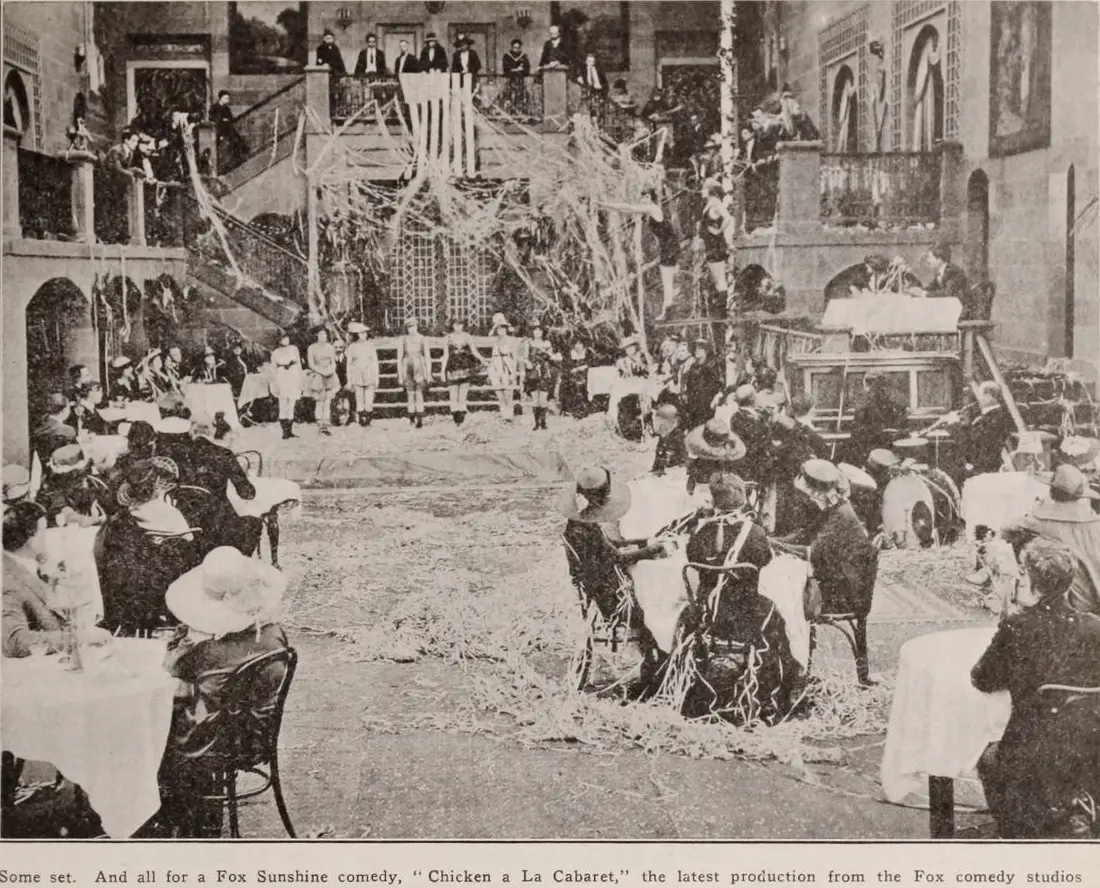
Lighting cameraman Billy Armstrong chisels each frame with shafts of mercury vapor, gifting the fugitives a nimbus of dust motes. When they surface in a laundry chute, the white sheets billow like cumulonimbus, their shadows inked cobalt. Seek a similar chiaroscuro in Ashes of Hope and you’ll find it—three years later, twice the budget, half the wit.
There is no synchronized score surviving; archives screen it mute. Paradoxically, this absence amplifies the film’s heartbeat. You hear the vanished watches: a phantom chorus of ticks stitched into the ether by your own anxiety. Each cut back to the dumbfounded policemen is a rest in music, a caesara where the audience’s breath becomes percussion. I recommend pairing with a live trio improvising in C-minor pentatonic; the result tastes of brass and ozone, like sticking your tongue on a battery.
Place Chicken à la Cabaret beside Jane or Charley on the Farm and note how rural romps treat escape as restoration: boy must return to pasture, girl to calico. Urban capers like Chicken posit escape as transmutation; the city is an ouroboros of side doors and speakeasies where identity dissolves faster than sugar in gin. The magician and his moll do not flee from justice but through it, emerging somewhere else wearing new epithets.
Fast-forward to 1955: Hitchcock’s To Catch a Thief luxuriates in identical motifs—jeweled watches, rooftop shadows, a woman complicit in larceny. Cary Grant even duplicates Conklin’s half-bow, though silkier. The lineage is unmistakable, yet you’ll search Hitch’s interviews in vain for any nod to this buried gem. Perhaps the master never admitted debt because Chicken itself swiped its own finale from stage revues that swiped from Pickpocketing Pan, ad infinitum. Plagiarism, like magic, is just redirection.
As of this breath, the only 35 mm print languishes in the Eastman House vault, digitized at 2K but buried beneath bureaucratic molasses. Bootlegs circulate on nostalgia forums—watermarked, sprocket-holed, yet pulsing with mischief. Streamers shuffle feet over rights; criterion channels claim "pending restoration." My advice: haunt your local silent-film society, bribe accompanists with bourbon, agitate for a touring print. The day Chicken à la Cabaret screens with live score is the day your retinas will feel like they’ve been minted anew.
Great cinema pickpockets more than wallets; it lifts the seams of reality. Chicken à la Cabaret steals the hour you thought you owned, then vanishes, leaving you grinning at your own empty wrist, hunting for a pulse that marches to a different tick. In an age when blockbuster escapes cost the GDP of island nations, this 22-minute whisper proves the purest magic needs nothing but a stageboard loose at the corner, a confederate who believes, and an audience—us—willing to surrender our most precious commodity: the belief that time belongs to anyone at all.
⭐⭐⭐⭐½ (4.5/5) — a pocket-watch permanently set to mischief
IMDb 5.2
1916
Community
Log in to comment.