DbcultAccessing Vault...
Cult Review
Senior Film Conservator
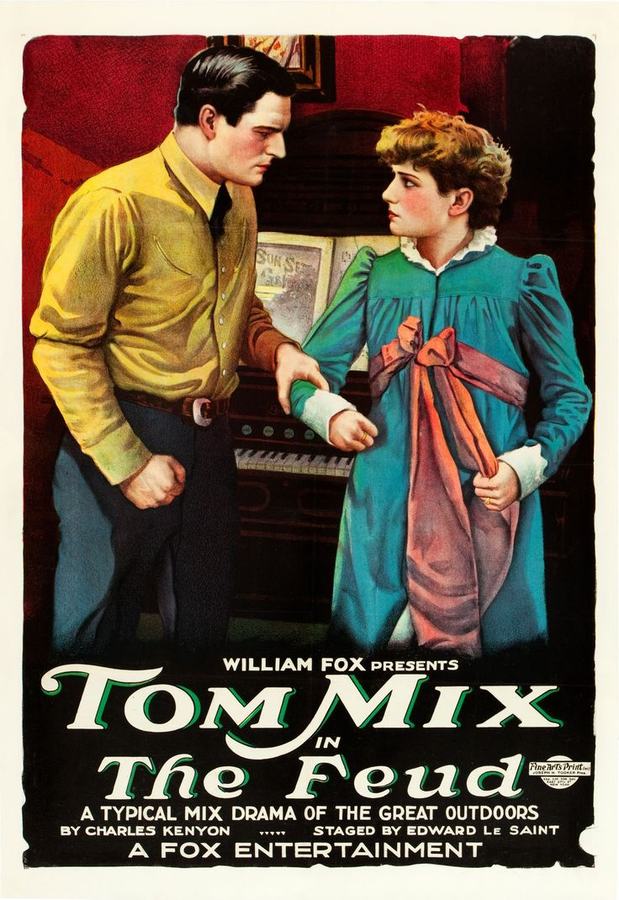
In the annals of silent cinema, particularly the output of the Fox Film Corporation during the late 1910s, there exists a peculiar tension between the rugged athleticism of the burgeoning Western genre and the high-octane melodrama of the Victorian stage. The Feud, directed by Ernest C. Warde and starring the indomitable Tom Mix, stands as a fascinating specimen of this stylistic collision. It is a film that refuses to be categorized simply as a 'horse opera,' instead opting for a sprawling, multi-generational narrative that feels more akin to a Greek tragedy transposed onto the limestone hills of Kentucky and the dust-choked plains of the West.
The film opens with a deliberate, almost oppressive sense of history. We are introduced to the Lynch and Summers families, whose mutual loathing is so deeply ingrained that it has become a fundamental part of their identity. Tom Mix, usually seen performing death-defying stunts on his horse Tony, here displays a surprising degree of dramatic restraint as Jere Lynch. His secret romance with Betty Summers (played with a luminous vulnerability by Eva Novak) is framed through the lens of a doomed pastoral. The early scenes are thick with the atmosphere of the pre-Civil War South, a setting that serves as a pressure cooker for the violence to come.
The inciting incident is a masterclass in narrative economy. Jere’s attempt to save Betty’s father, Horace, from a runaway horse team results in his own unconsciousness. It is a cruel irony: a gesture of heroism leads to the discovery of the locket containing Betty’s picture, which in turn ignites the dormant embers of the feud. The subsequent duel between Jere and Betty’s brother, Ben, is staged not with the flamboyant gunplay of later Westerns, but with a grim, funereal gravity. When Jere kills Ben—after Ben has already dispatched Jere’s father—the cycle of violence is sealed. This isn't just a plot point; it is a thematic statement on the inescapable nature of inherited trauma, a theme explored with similar intensity in The Woman and the Law.
One of the most striking elements of The Feud is its reliance on the power of the written word—or rather, the perversion of it. After Jere flees to the West, the narrative shifts into a mode of tragic irony. The intervention of Jere’s sister, who writes a series of fabrications that lead each lover to believe the other has moved on or died, is a narrative device that elevates the film above standard frontier fare. It transforms the physical distance between Kentucky and the West into a psychological abyss. This manipulation of domestic space and familial trust echoes the social critiques found in The Master of the House, where the home becomes a site of structural deception.
The transition to the West also marks a shift in the film’s visual language. The shadows of Kentucky are replaced by the harsh, unforgiving light of the frontier. It is here that Mix is allowed to flex his action muscles, most notably in the rescue of Ray Saunders (Jean Calhoun) from a buffalo stampede. This sequence remains a marvel of early practical effects and stunt coordination. Yet, even as Jere builds a new life and marries Ray, the ghost of the Summers feud lingers. The film suggests that the West is not a place where one can truly escape the past; it is merely a larger stage upon which the past eventually catches up.
The third act of The Feud takes a daring leap forward in time, a structural choice that was relatively sophisticated for 1919. The death of Jere and Ray in an Indian massacre—a stark, brutal sequence that highlights the inherent dangers of the 'untamed' land—clears the slate for the next generation. We are introduced to John Smith (actually the Lynch heir) and Betty Brown (the Summers heir). The fact that they meet and fall in love without the burden of their family names is a poignant commentary on the arbitrary nature of such hatreds. Their union is a biological and social synthesis, a theme that resonates with the moral explorations in Old Hartwell's Cub.
The climax of the film is not found in a final shootout, but in the birth of a child: Summers Lynch. The name itself is a linguistic bridge, joining the two warring houses in a single identity. It is a rare moment of optimism in a film that is otherwise steeped in loss. The resolution suggests that the only way to end a feud is not through victory, but through the total dissolution of the separate 'selves' that fueled the conflict. The birth of the child acts as a form of social alchemy, turning the lead of a century-old grudge into the gold of a new beginning.
Visually, the film benefits immensely from the cinematography of the era, which utilized natural lighting to create a sense of gritty verisimilitude. The contrast between the lush, almost suffocating vegetation of the Kentucky scenes and the barren, epic scale of the Western plains serves as a visual metaphor for the characters' internal journeys. While Tom Mix is often remembered for his more lighthearted, 'showman' Westerns, The Feud offers a glimpse into his capability as a dramatic lead. He carries the weight of Jere Lynch’s grief with a stoicism that feels entirely modern, avoiding the histrionic gesticulations that plagued many of his contemporaries.
The supporting cast is equally formidable. Eva Novak provides a soulful counterpoint to Mix, while the various family patriarchs and brothers are played with a menacing conviction that makes the threat of violence feel constant and real. The film’s pacing, handled with a keen eye for tension by Warde, ensures that the 1500-foot-plus narrative never feels stagnant, despite its multi-year timeline. It is a precursor to the epic Westerns of John Ford, sharing that director’s preoccupation with the intersection of family, land, and law.
Ultimately, The Feud is a significant work because it attempts to grapple with the American character at a crossroads. Coming just after the first World War, its themes of reconciliation and the futility of ancient grudges must have resonated deeply with an audience looking to move past global carnage. It uses the specific idiom of the American South and West to tell a story that is universal in its scope. It reminds us that while blood may be thicker than water, it is also the very thing that stains the soil of progress until it is washed away by a new generation's refusal to remember.
For those interested in the evolution of the Western or the dramatic range of early cinema's biggest stars, this film is essential viewing. It lacks the cynicism of modern revisionist Westerns but possesses a raw, emotional honesty that many of its successors lack. It is a testament to the power of silent storytelling—where a locket, a letter, and a child can carry more narrative weight than a thousand lines of dialogue. In the grand tapestry of 1919 cinema, alongside works like The Sign of the Poppy or Mrs. Dane's Defense, The Feud holds its own as a compelling, deeply human epic that deserves its place in the pantheon of early American film.
Review by the Cineaste Collective – A deep dive into the shadows and light of the silent era.
IMDb —
1918
Community
Log in to comment.