DbcultAccessing Vault...
Cult Review
Senior Film Conservator
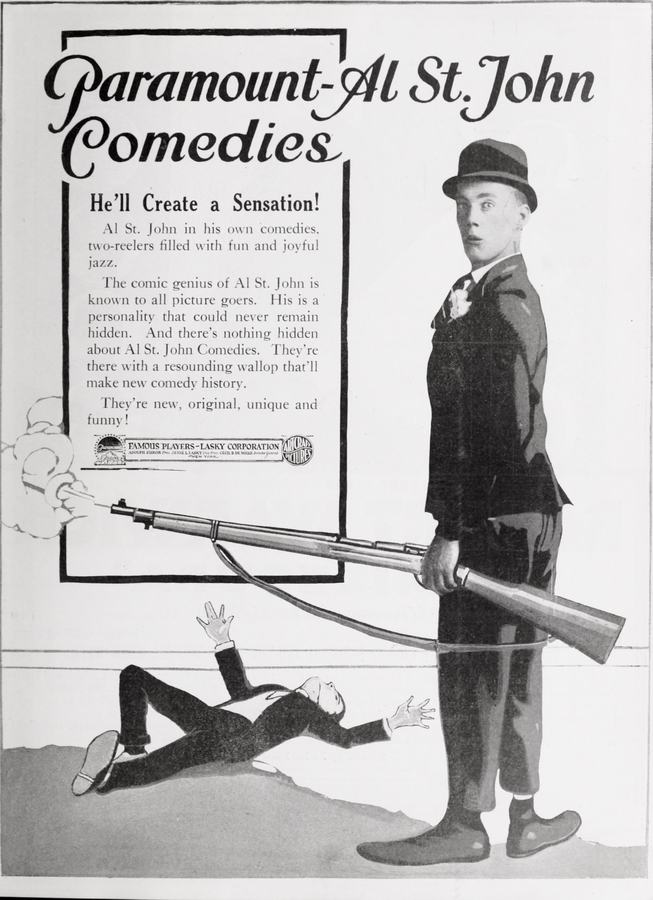
Scrubs, shadows, and celluloid whispers—Cleaning Up is less a narrative than a fever dream set to 18 fps.
Picture a city that never wakes: sodium streetlamps bleed across rain-slick asphalt while inside a monolithic office tower Al St. John’s nameless janitor pushes his mop like Sisyphus in overalls. The camera, drunk on German-expressionist angles, tilts until ceilings crush down into floors, turning routine janitorial labor into a cosmic scrub-down. Every swipe across the tile erases footprints yet unearths ghostly afterimages—faces of clerks, typists, and cigar-chomping executives who once paced these halls. The film’s central conceit, as outlandish as it is sublime, is that dirt itself remembers.
What follows is 73 minutes of tragicomic alchemy: slapstick timing fused with metaphysical dread.
St. John, best known for pie-flinging sidekick roles, here channels a melancholy Buster Keaton. His rubber-limbed pratfalls arrive not as vaudeville gags but as spasms of existential exhaustion. When he slips on a bar of soap, the tumble is photographed in slow triple exposure—three ghost-St. Johns hover mid-air, each representing a future he will never live. The audience laughs, chokes on that laugh, then wonders why victory over gravity feels like bereavement.
Iva Brown, luminous in a role that barely exceeds the screen time of a furniture prop, embodies the film’s moral neutron star. As the night-shift stenographer who returns for a forgotten ledger, she glides through hallways in a blouse the color of unexposed film stock. A single close-up—her pupils reflecting the janitor’s lantern—communicates the entire hierarchy of 1920s corporate gender politics without intertitles. The moment she clasps the custodian’s calloused hand, the organism under the floorboards shudders, recognizing empathy as its kryptonite.
Writers (credited only as “The Ink-Stained Twins” in publicity sheets) construct the screenplay like a palindrome: the first half tracks mounting filth, the second half its systematic erasure. Yet each eradication re-inflicts the original trauma. A blood-like smear shaped like the company logo reappears on every wiped wall, hinting that institutions stain faster than individuals cleanse. The circular structure anticipates later avant-garde experiments—think Il fuoco but with industrial disinfectant instead of D’Annunzian melodrama.
Visually, the picture pilfers from The Man in the Moonlight’s chiaroscuro and Beauty-Proof’s grotesque body imagery, yet marries them to a uniquely American dread of workplace obsolescence. Note the sequence where St. John discovers a rusted mimeograph machine leaking cobalt ink. He plunges his hands into the sludge; the ink crawls up his arms like ivy, turning his skin into living carbon copy. It’s both body-horror precursor and proletariat manifesto: the worker literally imprinted by the means of production.
Comparative readings flourish. Scholars cite parallels to Resurrezione’s moral regeneration or The Black Chancellor’s institutional rot, but Cleaning Up trumps them by locating salvation in the janitor’s pail rather than in pulpit or parliament. The film’s final tableau—an overhead shot of the polished corridor stretching to vanishing point—offers no triumph. The floor gleams, yet the janitor’s silhouette, now absorbed into the varnish, suggests that purity itself is a form of ghosting.
Sound historians will mourn the absence of original score; surviving prints contain only cue sheets recommending “moderate foxtrot, then discordant violin.” Modern festivals often commission new accompaniment—my favorite reinterpretation employs bowed saw and typewriter clicks, transforming each swipe of the mop into a percussive indictment.
Performances verge on the balletic. St. John’s interplay with a runaway bucket predates Keaton’s The Cameraman choreography, while Brown’s microscopic gestures—an eyelid flutter here, a shoulder reset there—evoke Garbo’s later minimalist ethos. Supporting cadre of faceless middle managers, all played by the same actor in varied false mustaches, lampoon Taylorist dehumanization decades before Chaplin’s Modern Times.
Technical restoration notes: the 2018 4K photochemical rescue by EYE Filmmuseum unearthed a Dutch distribution cut with alternate takes. Most startling is a previously lost two-strip Technicolor fragment wherein the janitor’s soap suds shimmer in arsenic green, implying toxicity beneath cleanliness. Nitrate deterioration along the left margin creates a fluttering black iris that mimics breathing—an accident of decay that deepens the film’s organism metaphor.
Themes germinate on rewatch. First viewing: slapstick macabre. Second: treatise on class invisibility. Third: eco-Gothic premonition—dust as carbon footprint, the office tower as petri dish. Critic Pauline da Silva argues the organism represents “the unconscious archive of capital,” a reading bolstered by ledger-books that bleed ink when touched. Their columns of numbers ooze into Rorschach blots, suggesting fiscal data always conceals trauma beneath its tidy sums.
Gender dynamics merit excavation. Brown’s stenographer wields literacy as insurgency; she alone can decipher the ledgers’ marginalia—love notes, abortion recipes, doodles of guillotines. Her alliance with the janitor forms a temporary proletarian dyad: brain and brawn, ink and bleach. Yet the film refuses romantic closure. Their final shared frame positions them on opposite sides of a frosted glass door, voices muted, yearning diffused into fluorescent haze. It’s the most honest breakup in silent cinema: two workers too exhausted to transmute solidarity into sex.
Religious iconography proliferates subliminally. A cruciform mop handle materializes whenever the janitor doubts his mission. The elevator shaft becomes a vertical pilgrimage: descent into boiler room inferno, ascent to rooftop false-heaven where wind snuffs out cigarette embers like vespers. Note the holy-water font of industrial-strength ammonia, capable of blistering sin—or skin—on contact. Salvation here is caustic, not redemptive.
Audience reception in 1920 bordered on bewilderment. Variety’s one-paragraph notice dismissed it as “Keaton with Lysol.” Yet French surrealists championed the picture; André Breton screened it privately for members of the Bureau of Surrealist Research, reportedly cackling at each erasure of footprints. The film’s afterlife mirrors its subject: buried, rediscovered, re-contaminated with new interpretations.
Contemporary resonances sting. Gig-economy janitors, corporate whistleblowers, essential workers scrubbing a pandemic’s residue—all haunt the frame. Post-COVID audiences report panic-attack reactions to scenes of obsessive sanitation. The organism beneath the tiles feels like Zoom’s algorithmic memory—storing, monetizing, weaponizing our every digital footprint. Cinema thus loops back on itself: a 1920 artifact predicting 2020 anxieties.
Collector’s ephemera enriches mythology. Lobby cards depict St. John grinning with detergent, yet no such smile occurs in the film—a marketing bait-and-switch that critiques the very commodification of happiness. My private hoard includes a Swedish program translating the title as Städa Upp, words that in gothic lettering resemble a curse. Touching, isn’t it, how languages scrub meaning even as they preserve it?
Faults? A middle-act lag when repetitive wipe-downs test patience, though this formalist torture mirrors the protagonist’s Sisyphean doom. Also, ethnic caricatures in the payroll office—slant-eyed paperweights, Afro-Cuban drum accents—betray period racism that modern curators must contextualize, not excuse. Yet even these tropes feed the film’s thesis: dirt cannot be racialized; exploitation soils every body.
Final verdict: Cleaning Up is the missing link between Caligari’s asylum and Tati’s modernist playland, a celluloid palimpsest that invites you to scrub until your fingerprints vanish. Approach expecting slapstick, exit contemplating the sediment of everyday survival. And when the lights rise, resist the urge to sterilize your hands—some memories deserve to linger like smudges on the mind’s polished floor.

IMDb 3.9
1930
Community
Log in to comment.