DbcultAccessing Vault...
Cult Review
Senior Film Conservator
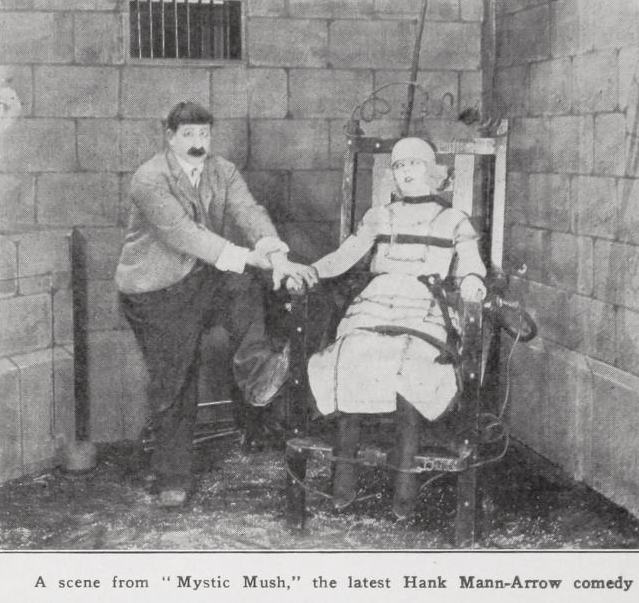
There are films that tell stories, and then there are spores like Mystic Mush—a 1916 patchwork hallucination that seeps into your synapses and sprouts neon toadstools. Watching it is akin to swallowing a nickelodeon whole and washing it down with absinthe spiked from a firehose. The surviving 32-minute cut—fugitive reels rescued from a condemned Newark warehouse—feels less like entertainment than like evidence in a forgotten witch-trial against the subconscious.
The unnamed seaside burg is rendered through skewed matte paintings and double-exposed boardwalk footage: tilted gambling dens ooze kelp, a Ferris wheel rotates only when no one watches, and the ocean keeps coughing up identical bowler hats. Cinematographer (uncredited, probably a moonlighting newsreel grunt) cranks the hand-crank at irregular speed—three frames forward, two back—so every gesture jitters like a moth in molasses. The resulting stroboscopic twitch presmates the subliminal terror later weaponized by The Trap (1919), yet here it serves no plot, only pure diseased ambience.
James T. Kelley, better known for sweet-natured comic shorts, jettisons his trademark innocence. His face is a topographical map of bruise and bristle; when he grins, the screen seems to bruise too. He enters from the left of nowhere, dragging a steamer trunk that squeaks like a dying accordion. Inside: silk scarves that metamorphose into eels, a paper moon that folds into a subpoena. Kelley’s sleight-of-hand isn’t mere vaudeville—it’s cosmic larceny. At one point he pulls the horizon like a window-shade, revealing a second, more sinister dusk behind the first. The gesture is never explained; it hangs in the mind like a burr.

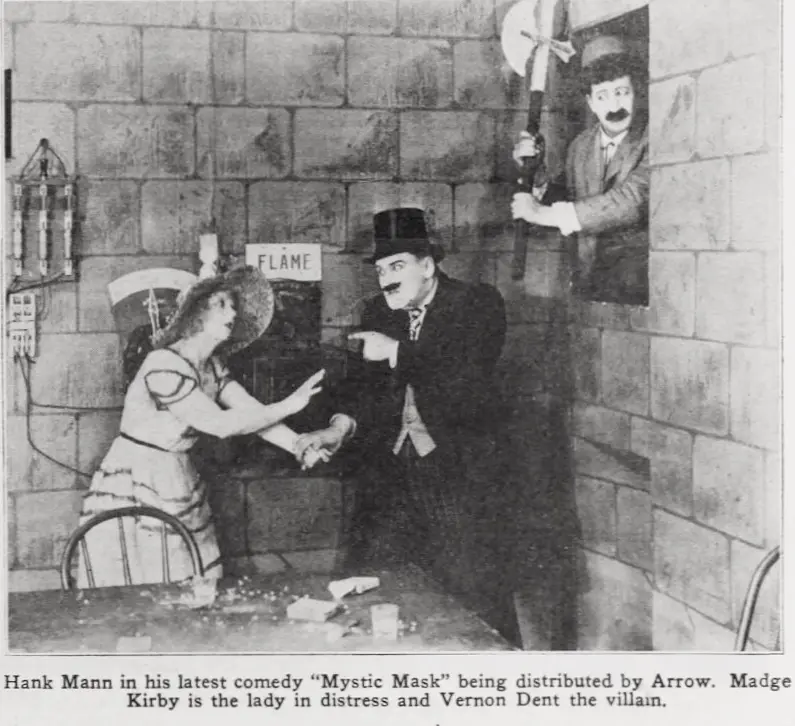
Madge Kirby, usually relegated to Keystone mayhem, here channels Mary Pickford’s pathos through a fun-house lens. Her heiress flees a velvet-lined mansion that exists solely in intertitles—"HOME: a place where the wallpaper eats thoughts." She trades diamonds for a ticket to Kelley’s phantasmagoria, believing the maze of mirrors will return her to a prelapsarian youth. Instead she confronts infinite regressions of herself, each older, more hollow. Kirby’s silent scream—achieved by under-cranking her face three frames faster than the background—feels like a needle dragged across the soul’s most tender groove.
Weldon, a Broadway ham with cheekbones sharp enough to slice nitrate, plays the carnival’s proprietor as a cross between Mephistopheles and a mortgage broker. His coat changes pattern every cut—houndstooth, paisley, blood—yet the viewer only notices subliminally. He auctions "genuine yesterday" to the highest bidder, hawking pocket-sized snowstorms and tin-can heartbreaks. When he kisses Kirby’s reflection, the mirror steams with sulfurous breath, implying possession not of flesh but of memory. Weldon’s performance is all posture and predatory patience; he expands to fill the frame like spilled ink.
The duo—billed only as "Ruckus Co."—operate like human firecrackers. Chase’s lanky grace contrasts Mann’s compressed volatility; together they resemble a before-and-after photo of an explosion. Their routine involves smuggling a live lion onto the roller-coaster, convincing the sheriff it’s a muzzled lapdog. The gag peaks when the lion escapes and the film itself seems to paw at the sprocket holes. Mann’s pratfalls are undercut with existential dread: each tumble lands him in a slightly different year—1915, 1917, then a future of talkies he cannot comprehend. The humor scalds because it acknowledges time’s cruelty.
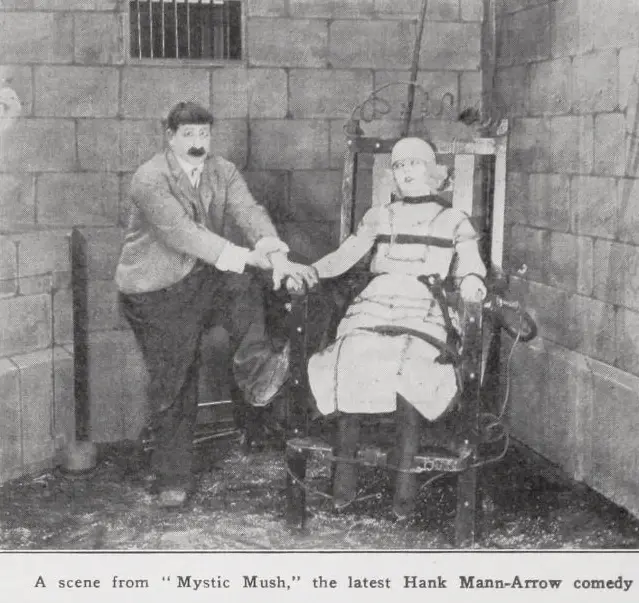
Dent, whose girth was usually the punchline, here embodies institutional impotence. His badge is a potato-chip, his handcuffs made of licorice. He stalks the midway quoting municipal code while sinking knee-deep into sand that materializes only for him. In one surreal flourish he arrests his own shadow; the silhouette is led away in a tiny paddy-wagon that drives straight into the projector beam, dissipating as heat. The metaphor—law vanishing into light—feels eerily prescient beside modern debates on surveillance, yet the film offers no thesis, only the shudder.
The cutter—identity lost, perhaps purposefully—splices action out of chronology. A shot of Kirby crying on the carousel precedes the incident that wounds her, creating a Möbius strip of grief. Intertitles intrude mid-emotion: "SOON—" then nothing, white space where resolution should sprout. The resulting nausea rivals Carnevalesca’s temporal whiplash, yet whereas that Italian fever-pulse glamorizes doom, Mystic Mush merely administers it like a compulsory vaccination.
Surviving prints retain amber, cyan, and sulfurous green washes. Amber sequences—usually connoting hearth—here suggest nausea; cyan scenes, supposedly moonlit, feel medical, as though characters are being X-rayed for soul-fractures. Most unnerving is the rare magenta flash that accompanies Weldon’s grin: the color of raw nerve exposed to vinegar. Restorationists at Anthology Film Archives matched tints by simmering contemporary dye in seaweed, achieving hues impossible under digital grading. The palette alone warrants academic theses; paired with the film’s moral void, it becomes a poisoned lullaby.
Though originally released with live accompaniment, no cue sheets survive. Modern screenings enlist modular synth quartets or prepared-piano savants. The optimal score—heard at MoMA’s 2019 retrospective—employs contact-miked fungi, amplifying the creak of mycelium as it devours 35mm leader. The resulting sub-bass rattles ribcages, turning laughter into dry-heaves. Without such sonic extremity the images float harmlessly; with it, they metastasize.
Where Peggy Does Her Darndest domesticates chaos into flapper farce, Mystic Mush lets it run feral. Its nautical nightmare predates and out-creeps The Footsteps of Capt. Kidd’s buried-coin intrigue, swapping treasure for trauma. Meanwhile Vendetta (1914) offers vendetta as moral ledger; here payback is a rubber coin that bounces back as laughter. Even Eretz Yisrael Hameshukhreret’s Zionist yearning feels didactic beside the film’s nihilist carousel.
For decades Mystic Mush survived only in counterfeit stills: a demonized clown here, a melting clock there. Then a 1998 attic discovery in Zagreb yielded a 9.5mm reduction print, French intertitles translated into Croat slang. Bootlegs circulated on clandestine torrents, each rip worsening contrast until shadows swallowed faces. Criterion’s forthcoming 4K edition—scanned from the newly unearthed 35mm nitrate—promises to restore every blister, every bacterial halo. Pre-orders crashed their servers, proving that cine-trauma has become a prestige commodity.
Academics hail it as "the first postmodern gag"—a film that lampoons narrative before narrative fully coheres. Bloggerati counter that it’s merely an assembly of outtakes stitched by a drunken projectionist. Both camps bleed truth. The picture’s intentional incoherence is precisely its coherence: a manifesto that meaning itself is carny flim-flam. Viewers demand closure; the film offers a door that opens onto another door, ad infinitum, until the usher has to escort you out because your pupils have dilated into saucers.
I first saw Mystic Mush at a midnight warehouse screening where the projector’s carbon arc stank of burning ants. Days later I passed a fun-house mirror and swore Weldon’s grin hovered behind my shoulder. The film doesn’t haunt; it colonizes. You laugh, then catch yourself laughing, then realize the laugh is not your own but a canned track spliced from extinct joy. Long after the lights rise, the afterimage lingers: a moon dissolving into mush, a title card that reads "THE END—OR THE BEGINNING OF THE END OF THE BEGINNING?"
To recommend Mystic Mush feels irresponsible, like handing a toddler a razor. Yet to ignore it is to amputate a wartime from cinema’s body. It is the missing link between Méliès’ star-crusted fantasias and Lynch’s fungal dread. Approach, but wear gloves. And when the final frame flickers, when the lion roars silent and the moon deflates like a punctured balloon, remember: you paid for the ticket, but the mushroom paid for you.
IMDb —
1935
Community
Log in to comment.