DbcultAccessing Vault...
Cult Review
Senior Film Conservator
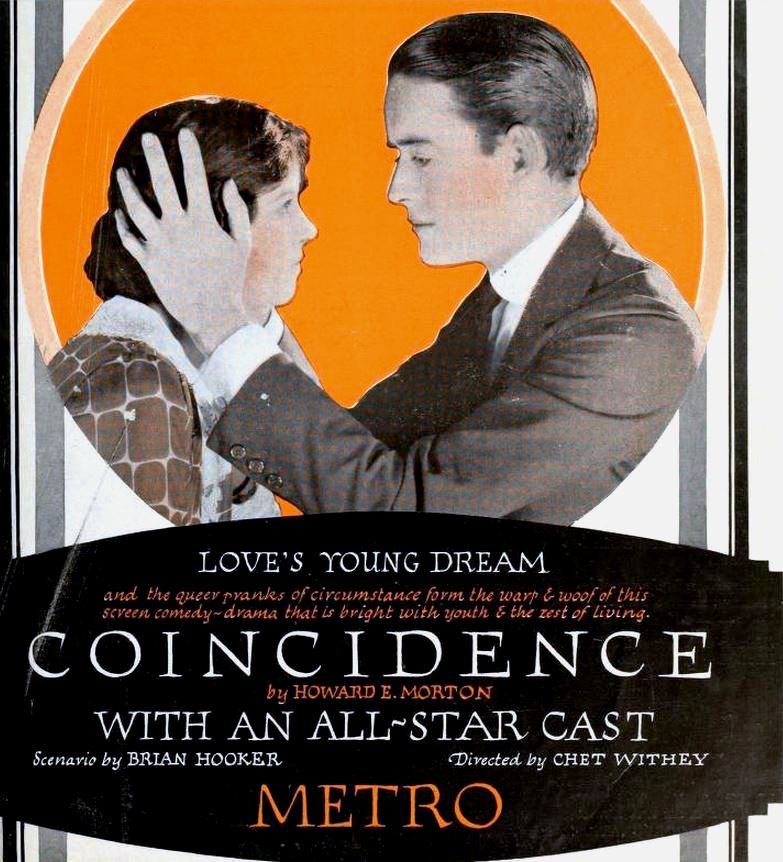
From the opening frame, Coincidence thrusts the viewer into a world where the ordinary collides with the extraordinary, and every gust of wind seems to carry a hidden agenda. Billy Jenks, portrayed with earnest vulnerability by William Frederic, embodies the archetype of the small‑town dreamer, his aspirations as palpable as the ledger he once tended. The film’s visual palette—sharp contrasts of neon against the perpetual night of the city—mirrors Billy’s internal oscillation between hope and disillusionment.
The inciting incident—dollar bills escaping a cash register—functions as a literal and metaphorical catalyst. The choreography of the bills fluttering down Broadway is captured in slow motion, each note a silvered promise. When they alight upon Phoebe Howard’s (June Walker) hat, the camera lingers on the juxtaposition of her immaculate attire against the crumpled currency, a visual metaphor for the collision of order and chaos.
Bradley Barker’s turn as "Handsome Harry" Brent is a masterclass in suave duplicity. His silver‑tongued persuasions are underscored by a subtle tremor in his eyes, hinting at a past marred by failed cons. Meanwhile, Robert Harron delivers a compellingly frantic portrayal of John Carter, the desperate thief whose desperation fuels the narrative’s most frantic chase sequence.
The screenplay, penned by Brian Hooker and Howard E. Morton, employs a cyclical structure: each act begins with an accidental event that spirals into a cascade of further coincidences. This deliberate recursion underscores the film’s central thesis—that life is an intricate tapestry of unintended intersections, each thread tugging at another in unforeseen ways.
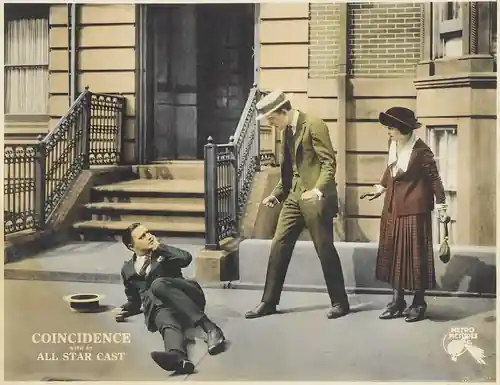
The motif of money operates on multiple levels. On the surface, the $100,000 inheritance appears as a deus ex machina, rescuing Billy from financial ruin. Yet, the film interrogates the moral weight of sudden wealth, probing whether fortune can truly cleanse the stains of previous missteps. The inheritance scene—where a lawyer’s head is struck by a rogue alarm clock—juxtaposes comedy with existential dread, forcing the audience to confront the fragility of human plans.
When placed alongside contemporaneous works such as The Broken Law or the whimsical caprice of Le Dieu du hasard, Coincidence distinguishes itself through its relentless commitment to the absurdity of chance. While The Broken Law leans into gritty realism, and Le Dieu du hasard embraces magical realism, this film dwells firmly in a liminal space where realism is constantly undercut by improbable happenstance.
Cinematographer Frank Belcher employs a palette dominated by deep shadows punctuated by bursts of neon orange (#C2410C) and electric sea blue (#0E7490). These hues are not merely decorative; they serve as emotional signposts. The orange glows during moments of romantic fervor, while the sea‑blue washes over scenes of introspection, such as Billy’s solitary contemplation atop the Empire State Building, where he watches the city pulse beneath him.
The decision to retain a black background for the entire HTML container reflects the film’s underlying darkness—a world where destiny’s hand is both invisible and unforgiving. All textual content is rendered in stark white, ensuring readability while echoing the film’s chiaroscuro visual language.
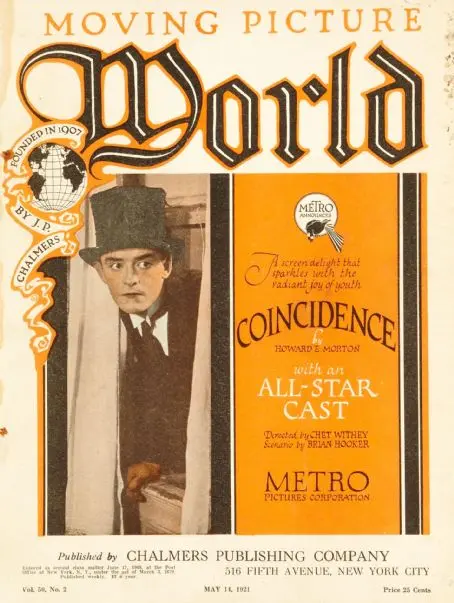
The score, a blend of jazzy saxophones and minimalist piano motifs, accentuates the film’s oscillation between chaos and calm. The recurring leitmotif—a single, lingering note played on a muted trumpet—surfaces whenever a coincidence occurs, subtly reminding the audience of the unseen threads binding the narrative.
At its core, Coincidence interrogates whether agency can exist in a universe governed by randomness. Billy’s decision to chase after the runaway bills is an act of will, yet the outcome—meeting Phoebe—is preordained by the script’s relentless reliance on chance. This tension is further amplified when Billy’s aunt’s death and the subsequent inheritance arrive via a series of improbable accidents, prompting viewers to question the authenticity of the characters’ choices.
The film also posits love as an economic transaction. Billy and Phoebe’s relationship blossoms amidst financial turbulence; their mutual neglect of employment underscores a belief that affection can supersede material stability. However, the narrative does not romanticise poverty; instead, it portrays love as a precarious balance between emotional fulfillment and fiscal responsibility.
Billy’s arc is a study in maturation through misfortune. He begins as a naïve clerk, evolves into a frantic pursuer of fortune, and ultimately emerges as a man capable of navigating the chaotic currents of fate with measured composure. Phoebe, initially presented as a stoic stenographer, reveals layers of vulnerability when she confides in Billy about her own aspirations beyond the confines of her office. Their eventual marriage is less a conventional happy ending and more a symbolic sealing of the chaotic pact they forged.
The supporting cast, particularly the morally ambiguous Handsome Harry and the desperate John Carter, serve as mirrors reflecting society’s varied responses to sudden wealth—exploitation, desperation, and opportunism. Stephen Fiske’s misidentification as the thief highlights the film’s commentary on the perils of snap judgments in a world where appearances are often deceptive.
When juxtaposed with The Game's Up, which also explores the interplay of chance and ambition, Coincidence distinguishes itself through its relentless pacing and its willingness to let absurdity dictate narrative momentum. Unlike the measured, almost procedural unfolding in The Game's Up, this film embraces a kinetic rhythm, mirroring the unpredictable gusts that set its plot in motion.
Similarly, the thematic preoccupations echo those found in His Wife's Money, where financial windfalls expose underlying relational fissures. However, Coincidence resolves these tensions through union rather than division, suggesting a more optimistic worldview.
Released in the post‑pandemic era, the film resonates with audiences grappling with uncertainty and the desire for serendipitous breakthroughs. Its portrayal of a young adult migrating to a megacity in search of opportunity mirrors real‑world migration trends, while the absurdist tone offers a cathartic escape from the rigidity of contemporary socioeconomic structures.
Coincidence succeeds as a cinematic experiment in narrative causality, blending slapstick mishaps with heartfelt romance. The direction maintains a brisk tempo, never allowing the audience to settle into complacency. Performances are nuanced, with William Frederic delivering a layered portrayal that oscillates between earnest optimism and quiet desperation. The film’s visual language—anchored by the triadic palette of dark orange, vibrant yellow, and sea blue—creates a cohesive aesthetic that enhances thematic depth.
While some may argue that the reliance on improbable events strains credulity, the film’s self‑awareness mitigates this risk; it invites viewers to suspend disbelief in exchange for a meditation on the role of randomness in shaping human destiny. In the final tableau, as Billy and Phoebe exchange vows against a backdrop of twinkling city lights, the audience is left with a lingering question: are we all merely actors on a stage set by chance, or do we possess the agency to rewrite our scripts? Coincidence offers no definitive answer, opting instead for a lingering sense of wonder that lingers long after the credits roll.
For cinephiles seeking a film that marries whimsical absurdity with earnest emotional stakes, Coincidence stands as a testament to the power of serendipity, reminding us that sometimes, the most profound stories arise from the simplest of accidents.
IMDb —
1926
Community
Log in to comment.