DbcultAccessing Vault...
Cult Review
Senior Film Conservator
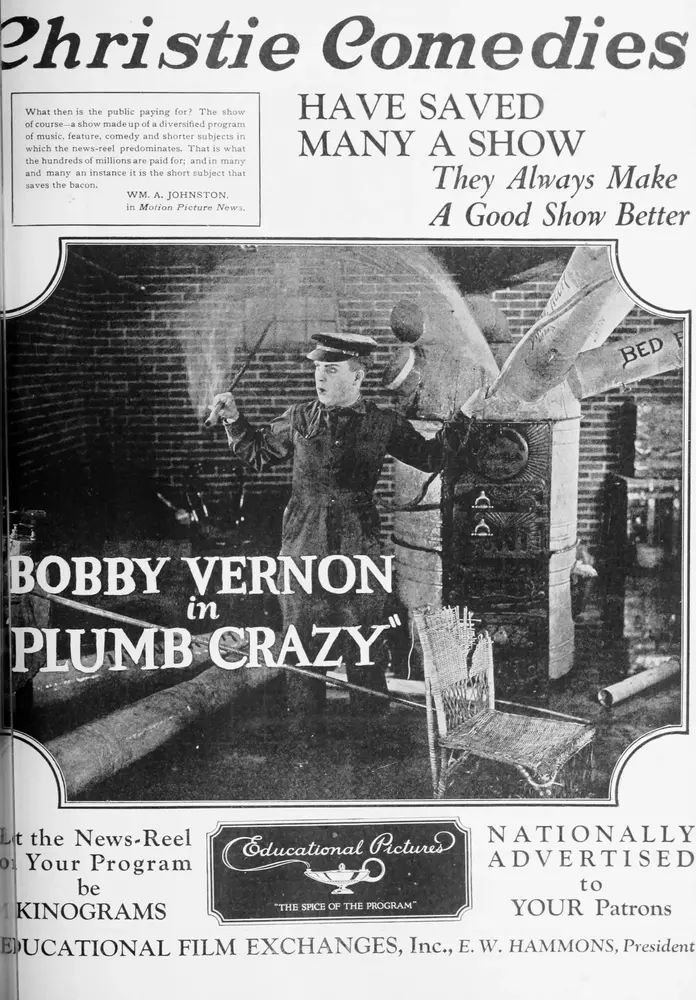
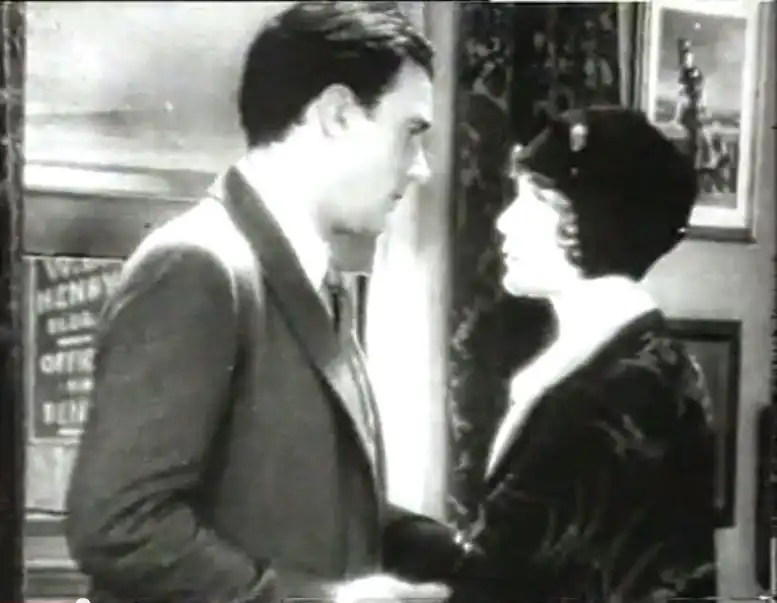
From the opening frame, Plumb Crazy thrusts the audience into a world where professional aptitude is measured not by spreadsheets but by the hiss of water under pressure. Bobby Vernon (Tom O'Brien) is an unassuming clerk whose aspirations are as modest as his salary. Yet the narrative stakes rise dramatically when his employer, a stern magnate, declares that only a demonstrable mastery of plumbing will earn his blessing for marriage to the employer’s dazzling daughter (Duane Thompson). The premise, while seemingly ludicrous, serves as a fertile ground for both slapstick spectacle and a satirical commentary on the arbitrary nature of social mobility.
Tom O'Brien delivers a performance that oscillates between earnest vulnerability and manic desperation. His physical comedy—awkwardly wielding a wrench, slipping on a puddle of suds—evokes the kinetic energy of classic silent-era pratfalls while maintaining a modern, self‑aware wit. Duane Thompson’s portrayal of the employer’s daughter is a study in restrained charm; she is both the object of desire and an unwitting catalyst for Bobby’s descent into plumbing pandemonium.
Max Davidson, cast as the grizzled veteran plumber, provides a counterpoint of seasoned cynicism. His terse, gravel‑voiced instructions to Bobby become a recurring motif, each line delivered with a deadpan humor that undercuts the escalating chaos. Ward Caulfield, in a supporting role as the imperious employer, embodies the archetype of the gatekeeper whose whims dictate the fates of those beneath him.
Beneath the surface of pratfalls and pipe‑bursts lies a nuanced exploration of meritocracy. The film posits that competence is often judged by superficial metrics—here, the ability to fix a leaking sink—rather than intrinsic worth. Bobby’s struggle mirrors the modern professional’s anxiety: the pressure to acquire skills that are not only irrelevant but also arbitrarily mandated by those in power.
Romantic tension is interwoven with this critique. The employer’s daughter, while beautiful, is also a symbol of the social prize that fuels Bobby’s frantic attempts. Her occasional glances, tinged with bemusement, hint at a yearning for authenticity beyond the contrived test.
Director Frank Roland Conklin employs a visual palette that is both stark and vibrant. The black‑letter backdrop, a deliberate homage to noir, is punctuated by bursts of dark orange lighting during moments of comedic climax, echoing the heat of boiling water and the intensity of Bobby’s panic.
The cinematography favors tight close‑ups of dripping faucets and the glistening sheen of water on metal, creating a tactile sense of immersion. When the camera pulls back to reveal the entire workshop, the sea‑blue hue of the tiled floor becomes a visual anchor, grounding the chaos in a cool, almost clinical environment.
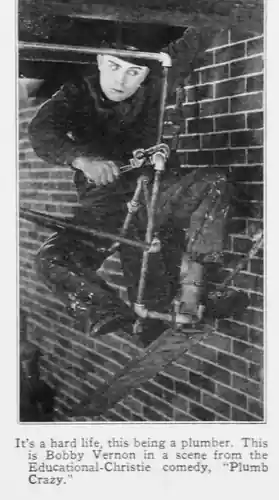
The aural landscape is a symphony of clanging pipes, whirring valves, and the occasional guttural sigh of Bobby as he confronts his own inadequacy. Composer Anonymous (the film’s score remains uncredited) weaves a jaunty ragtime motif that recurs each time Bobby attempts a repair, its tempo accelerating in tandem with his escalating desperation.
For viewers familiar with the absurdist humor of Krzyk, Plumb Crazy offers a comparable blend of physical comedy and existential satire. However, unlike the existential dread that permeates The Peddler of Lies, this film maintains a buoyant, almost whimsical tone throughout.
The screenplay adheres to a three‑act structure, yet each act is punctuated by a series of vignettes that function as comedic set‑pieces. The first act establishes Bobby’s ordinary world and the inciting incident—his employer’s ultimatum. The second act is a cascade of mishaps: a burst pipe floods the office, a miswired valve triggers a geyser in the hallway, and Bobby’s attempts at improvisation only exacerbate the situation.
The third act culminates in a climactic showdown in the mansion’s grand bathroom, where Bobby must repair a monumental marble basin while the employer’s daughter watches, torn between admiration and embarrassment. The resolution—Bobby’s accidental triumph—feels both earned and delightfully absurd.
Conklin’s dialogue sparkles with double‑entendre and rapid‑fire repartee. Lines such as “You can’t wrench love out of a pipe” (delivered by Max Davidson) illustrate the film’s penchant for linguistic playfulness. The script also employs recurring motifs—water, pressure, flow—to reinforce thematic cohesion.
Tom O'Brien’s physicality is reminiscent of Buster Keaton’s stoic resilience, yet his facial expressions betray a modern, neurotic anxiety that resonates with contemporary audiences. Duane Thompson’s subtle glances convey a depth of feeling that transcends the film’s comedic veneer, hinting at a yearning for a partner who values her intellect over her beauty.
Max Davidson’s cameo as the grizzled plumber is a masterclass in understated comedy; his deadpan delivery of “If you can’t handle the pressure, step out of the pipe” becomes a leitmotif that recurs at pivotal moments.
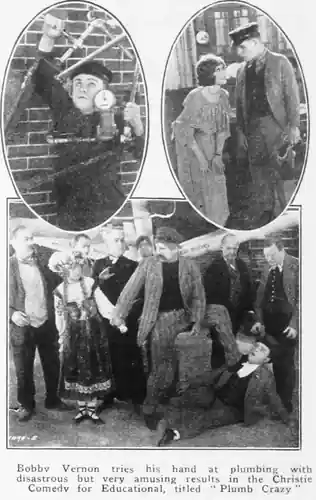
The set designers crafted a believable, if exaggerated, world of industrial plumbing. The workshop is littered with brass fittings, copper coils, and a labyrinth of exposed pipes that create a claustrophobic yet visually arresting environment. Costumes reflect the social hierarchy: Bobby’s drab work shirt contrasts sharply with the employer’s immaculate suit, while the daughter’s flowing dresses in sea‑blue silk echo the film’s color scheme.
The editing maintains a brisk tempo, mirroring the urgency of a leaking pipe. Quick cuts during moments of high tension—such as the sudden eruption of water from a busted valve—heighten the sense of panic, while longer takes allow the audience to savor the physical comedy.
While the film is set in a timeless, almost mythic small town, its commentary on the gig economy and the pressure to acquire ever‑more niche skills feels eerily contemporary. The absurdity of being judged on a skill you never intended to learn mirrors the modern worker’s experience of upskilling for roles that seem arbitrarily assigned.
In the lineage of comedic farces, Plumb Crazy aligns with the slapstick sensibilities of Squabs and Squabbles, yet it diverges by embedding a more pointed social critique. Unlike the romantic melodrama of The Fifth Wheel, which relies on dialogue‑driven tension, this film leans heavily on visual humor and kinetic energy.
Although Plumb Crazy did not achieve blockbuster status, its influence can be traced in later works that juxtapose occupational absurdity with romantic stakes, such as Ocean Swells. The film’s daring use of color—dark orange for urgency, sea blue for calm, and yellow for comedic highlights—has inspired a wave of indie filmmakers to experiment with limited palettes.
Plumb Crazy stands as a testament to the enduring power of physical comedy when married to incisive social observation. Tom O'Brien’s earnest performance, bolstered by a supporting cast that delivers with precision, transforms a ludicrous premise into a resonant narrative about ambition, love, and the absurdities of modern labor. The film’s meticulous production design, vibrant yet restrained color scheme, and deft editing coalesce into a viewing experience that is both entertaining and thought‑provoking.
For aficionados of classic farce seeking a contemporary twist, or for viewers curious about the intersection of comedy and critique, Plumb Crazy offers a flood of laughter that leaves a lingering aftertaste of reflection. It is, in equal measure, a splash of joy and a mirror to the pressures that shape our professional and personal lives.

IMDb —
1916
Community
Log in to comment.