DbcultAccessing Vault...
Cult Review
Senior Film Conservator
Step into the hallowed halls of early cinema, and you'll occasionally unearth a gem that, despite its antiquity, resonates with a startling contemporary urgency. Such is the case with Conscience, a film from 1918 that transcends its silent era origins to deliver a potent, unflinching critique of the justice system and the irreversible tragedy of capital punishment. It’s a narrative that grips you from its initial moments, weaving a complex tapestry of human fallibility, societal judgment, and the slow, inexorable march towards truth, however belated.
The film opens not with grand pronouncements, but with the quiet hum of innovation. George Grant, portrayed with a compelling gravitas by Joseph W. Girard, is an inventor, his genius manifested in a device destined to alter the landscape of its utility. His partner, John Benson (Allen Holubar), facilitates the lucrative sale of the patent rights, a deal that sets the stage for the ensuing drama. This initial premise, seemingly straightforward, quickly unravels into a labyrinth of misunderstanding and misjudgment, a testament to the intricate plotting by writers Stuart Paton and Curtis Benton. Benton also plays a role in the film, highlighting the multi-talented nature of early filmmakers.
The first ripple in this calm surface occurs in a barroom, a locus of human interaction and often, human failing. Here, Grant encounters Dave Wilson (Curtis Benton), a young man adrift in unemployment, reprimanded by an elder for his idleness. Grant intervenes in the ensuing scuffle, a seemingly benign act that leaves Dave with a black eye. It’s a minor incident, yet profoundly consequential, a seemingly insignificant brushstroke that will define the trajectory of a young life. The casualness with which this initial conflict unfolds underscores the arbitrary nature of fate, how a chance encounter can set in motion an unstoppable chain of events.
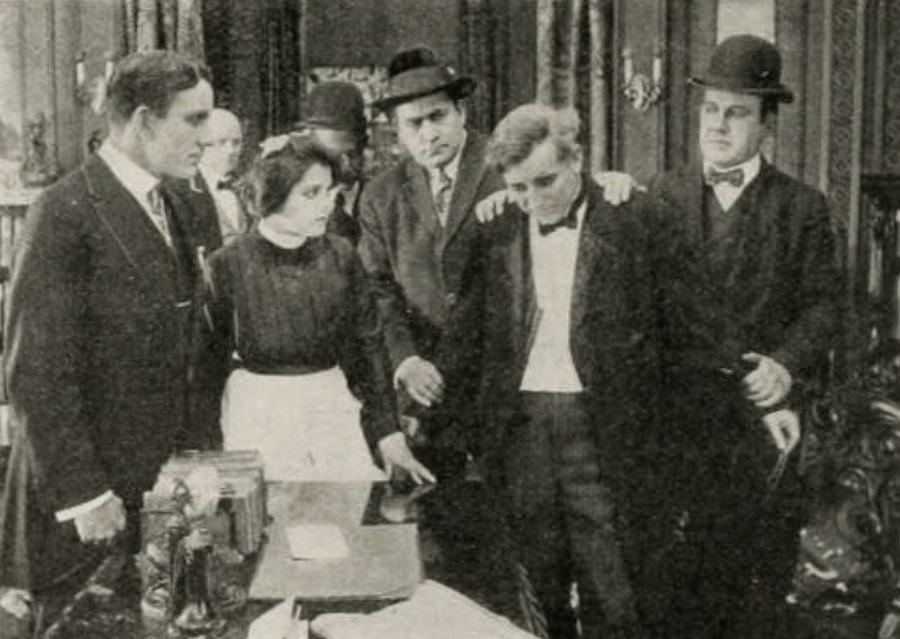
The narrative then pivots with a chilling swiftness. Dave, spurred by his mother's counsel, seeks out Grant to offer an apology. This act of contrition, a beacon of emerging moral responsibility, is tragically interrupted. As Dave stands before Grant in his home office, Grant collapses, dead. The suddenness is jarring, a brutal interruption of a moment of reconciliation. The sound of a police whistle, a harbinger of impending doom, sends Dave scurrying into the next room, seeking refuge beneath a bed. This visceral reaction of fear, of a young man caught in an incomprehensible nightmare, is palpable, a silent scream against an unfolding injustice. The arrival of law enforcement and Grant’s household members, discovering the lifeless body, marks the beginning of Dave’s harrowing ordeal.
Detective Doyle (William Welsh) is assigned to the case, and his initial investigation is a masterclass in procedural misdirection. Dave, in his terror and confusion, attempts to explain the inexplicable, only to be met with the cold, hard logic of circumstantial evidence. The discovery of a pistol in the yard, a seemingly damning piece of evidence, solidifies the burgeoning suspicion against him. What follows is a devastating portrayal of how quickly a life can be derailed by a confluence of unfortunate circumstances and the inherent flaws within a legal framework. Benson, the partner, is summoned, and Dave desperately implores him to corroborate his story, to testify to his presence for an apology. But Benson, perhaps paralyzed by fear or a nascent guilt, denies knowledge of the apology, confirming only the earlier altercation. This betrayal, whether deliberate or born of cowardice, seals Dave's fate. He collapses, a broken figure, and is dragged off to the police station, a journey towards an inevitable, tragic conclusion.
The courtroom scene is depicted with a stark, almost brutal efficiency. The jury, swayed by the weight of circumstantial evidence and the absence of a credible defense, finds Dave guilty. His electrocution, depicted with a quiet, devastating finality, is a visceral punch, an indictment of a system that prioritizes expediency over truth. This segment of Conscience is a powerful predecessor to later films that would scrutinize the machinery of justice, echoing the grim realities explored in similar narratives of wrongful conviction, perhaps even prefiguring the moral dilemmas found in films like Chains of the Past, where an innocent's life is irrevocably altered by institutional failings.
One year later, the film undergoes a significant temporal and thematic shift, a bold narrative choice that elevates it beyond a mere crime drama. James Sprague (Howard Crampton), a criminologist, visits his old friend, the warden, to observe the reforms sweeping through the prison system. The warden, a believer in the transformative power of the 'golden rule,' champions a more humane approach to incarceration, allowing prisoners greater freedom and treating them as individuals. It is here that the film's central thesis on capital punishment truly emerges. The warden, expressing relief at its abolition, laments the countless innocent lives extinguished by its finality. He presents Sprague with a photograph of Grant's home, expressing his profound conviction that the man electrocuted for Grant’s murder was, in fact, innocent. This moment is a turning point, a spark igniting Sprague's meticulous intellect and setting him on a quest for posthumous justice.
Sprague's investigation is a masterclass in methodical deduction, a stark contrast to the initial, flawed police work. He meticulously examines Grant's home, particularly the room where the tragedy unfolded. His gaze drifts to the yard, where a boy on a swing provides an unexpected epiphany. Chasing the boy away, Sprague himself mounts the swing, propelling himself to a height level with Grant's window. In a flash of insight, he deduces the true method: the murderer, swinging to a vantage point, fired the fatal shot, explaining the pistol's location in the yard. This scene is a brilliant piece of visual storytelling, showcasing the power of observation and unorthodox thinking in solving a seemingly intractable mystery. It speaks to the human element of detective work, a thoughtful counterpoint to the more action-oriented investigations seen in other contemporary thrillers like Le diamant noir.
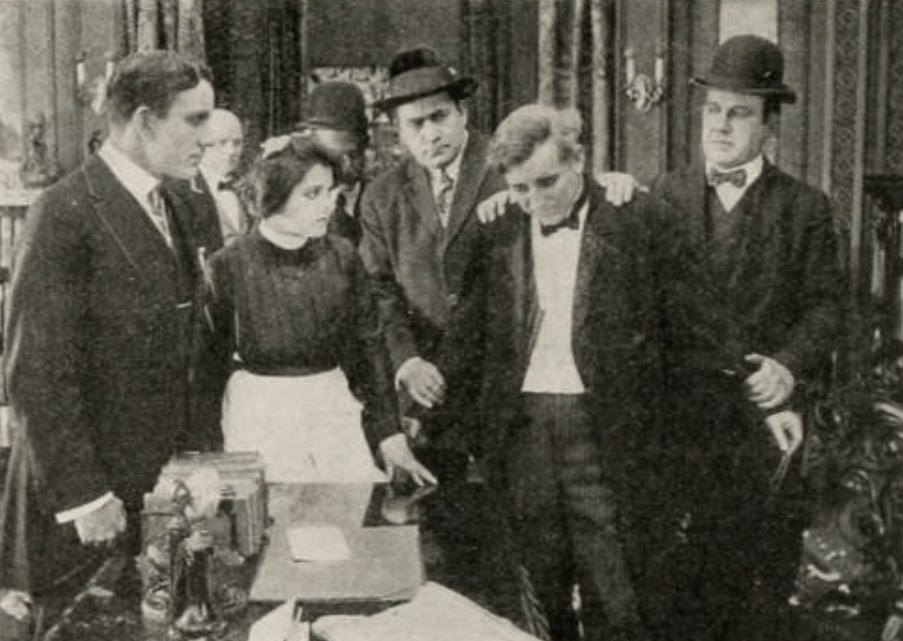
While Sprague pursues the truth, Benson, the man whose inaction condemned an innocent, is slowly being consumed by his own guilty conscience. His once-composed demeanor crumbles, replaced by a nervous wreck. Visions of Grant haunt him, a specter of his complicity. In a moment of sheer psychological torment, he fires his revolver at one such apparition, a desperate act that reveals the depth of his internal suffering. His servants rush in, the butler administering a stimulating drink, a futile attempt to quell the storm raging within. This portrayal of psychological breakdown is remarkably nuanced for its era, delving into the corrosive power of guilt with an intensity that might be compared to the internal struggles hinted at in films like Az éjszaka rabja, where characters grapple with their inner demons.
Sprague, now armed with a theory, consults Detective Doyle, who initially clung to the 'revenge murder' theory. The seasoned criminologist's insights, coupled with the emerging reports of Benson's erratic behavior, begin to shift Doyle's perspective. Sprague, a master of psychological manipulation, devises an elaborate plan. Under the guise of a business contract, he infiltrates Benson's household. He bribes the existing butler and maid, orchestrating their dismissal, and installs his own trusted operatives, including his wife, as the new domestic staff. This intricate setup, reminiscent of a stage play, highlights Sprague's ingenuity and commitment to uncovering the truth.
The new servants, abetted by another detective, embark on a campaign of psychological warfare against Benson. Their strange actions, their subtle prodding, push Benson to the brink of hysteria. When Sprague finally calls on him to 'close the contract,' Benson's paranoia is at its peak. He suspects espionage, a feeling intensified when Sprague pointedly asks about his interest in the abolition of capital punishment – a cruel irony given Dave's fate. Sprague then recounts the peculiar case of Dave Wilson, meticulously detailing the details of Grant's murder, further exacerbating Benson's unraveling composure. This slow, deliberate torture of a guilty mind is excruciating to watch, a testament to the film's understanding of human psychology.
The climax is orchestrated with a chilling precision. Detective Doyle, positioned in the yard, fires a revolver at a signal from Sprague, mimicking the original murder. The sound shatters Benson's already fragile psyche. He descends into full-blown hysteria, the dam of his suppressed guilt finally bursting. In a torrent of confession, he admits to the murder, a cathartic release for him, and a tragic vindication for Dave Wilson. The film concludes with Benson, now clad in prison stripes, a powerful visual statement. This final image underscores the film's profound message: while Dave Wilson, an innocent man, was denied any chance of redemption by the brutal finality of capital punishment, Benson, the true culprit, is afforded that possibility due to its abolition. It's a poignant, if bittersweet, resolution, highlighting the moral imperative of a justice system that values life and the possibility of atonement.
Conscience is more than just a silent film; it's a timeless philosophical treatise on justice, guilt, and the inherent flaws in human institutions. Joseph W. Girard as Grant, though his screen time is limited, establishes the catalyst for the entire drama with a dignified presence. Curtis Benton's portrayal of Dave Wilson is heartbreakingly convincing, eliciting profound empathy for his character's unjust plight. Allen Holubar delivers a truly unsettling performance as Benson, capturing the slow descent into madness with a chilling authenticity that anchors the film's psychological depth. Howard Crampton's James Sprague is the embodiment of intellectual rigor, a beacon of truth in a murky world. The supporting cast, including Frances Nelson and William Bailey, contribute to the film's atmospheric tension and narrative realism.
The direction by Stuart Paton and the writing by Paton and Curtis Benton are remarkably sophisticated for the period. They construct a narrative that is both a gripping mystery and a profound social commentary. The use of parallel storytelling – Dave's swift and brutal conviction versus Sprague's patient and meticulous investigation – creates a powerful dramatic irony that resonates deeply. The film's message about the irreversible nature of capital punishment, and the potential for wrongful conviction, remains as relevant today as it was over a century ago. It challenges viewers to consider the ethical implications of state-sanctioned death and the value of human life, even that of a confessed murderer.
While the visual language of silent cinema might initially seem dated to modern audiences, the sheer emotional force and intellectual depth of Conscience quickly overcome any such perceptions. It demonstrates how powerful storytelling, even without spoken dialogue, can convey complex ideas and evoke profound emotions. The film stands as a testament to the early capabilities of cinema to engage with significant social issues, carving out a space for itself not just as entertainment, but as a vehicle for societal reflection and critique.
In an era where films were often simpler, more focused on spectacle or straightforward melodrama, Conscience dared to tackle weighty themes with a nuanced hand. Its legacy lies not just in its compelling plot, but in its unwavering moral stance and its foresight regarding the evolving discourse around criminal justice. It’s a film that demands to be seen, studied, and remembered for its courageous exploration of a subject that continues to provoke debate and introspection. It reminds us that the quest for justice is an ongoing endeavor, often fraught with human error, but ultimately driven by the persistent, unyielding search for truth. This is a cinematic experience that truly stays with you, prompting reflection long after the final frame.
IMDb 7.1
1931
Community
Log in to comment.