DbcultAccessing Vault...
Cult Review
Senior Film Conservator
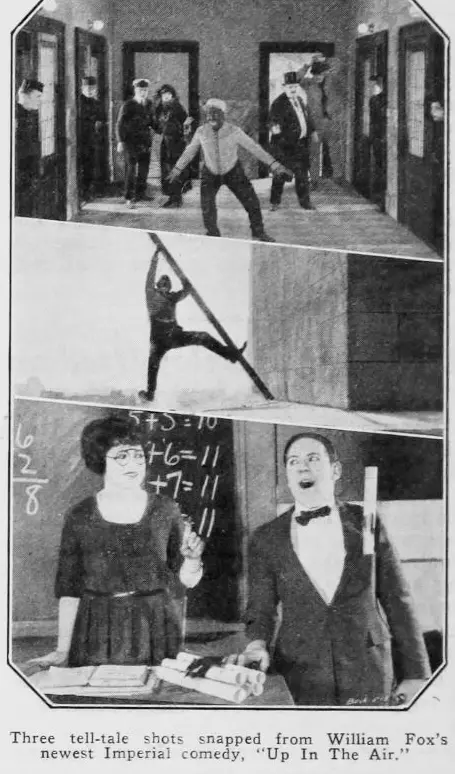
In the grand tapestry of early twentieth-century cinema, 1923 stands as a year of profound transition, a moment where the crude mechanics of the nickelodeon era matured into the sophisticated visual language of the silent feature. Amidst this evolution, Up in the Air emerges not merely as a comedy short, but as a kinetic manifesto on the possibilities of the frame. Directed by and starring the often-underappreciated Harry Sweet, this film captures a specific zeitgeist—one obsessed with the conquest of the skies and the democratization of danger. While contemporaries like The Golem explored the heavy, earthen shadows of German Expressionism, Sweet took his lens in the opposite direction, seeking the blinding clarity of the open sky.
The cinematic landscape of the time was bifurcated between the high-brow aspirations of historical epics and the low-brow energy of the two-reeler. Sweet, however, bridges this gap by infusing his slapstick with a technical precision that rivals the period's most ambitious dramas. Unlike the rigid social hierarchies depicted in The Prince and the Pauper, where class boundaries are the primary obstacle, Up in the Air posits that gravity is the only true equalizer. Whether a man is a king or a clown, the wind treats him with the same capricious indifference.
The casting of Heinie Conklin alongside Sweet provides the film with its necessary emotional and physical anchor. Conklin, with his signature greasepaint mustache and wide-eyed bewilderment, serves as the perfect foil to Sweet’s lithe, almost feline movements. If Sweet represents the frantic impulse to survive, Conklin represents the resigned acceptance of impending doom. This duality creates a comedic friction that propels the narrative forward even when the plot ostensibly stalls in mid-air. Their chemistry is a far cry from the sentimental domesticity found in Wedding Bells; instead, it is a partnership forged in the crucible of shared peril.
Watching the duo navigate the swaying basket of a hot-air balloon is to witness a masterclass in spatial awareness. Every stumble is calculated; every near-fall is a brushstroke in a larger portrait of controlled chaos. The film lacks the patriotic gravity of Allies' Official War Review, No. 27, yet there is a strange sort of heroism in their persistence. They are the Everymen of the jazz age, caught in the gears of a world moving faster than they can comprehend. This sense of being overwhelmed by the modern age is a recurring theme in 1920s art, yet rarely is it expressed with such exuberant levity.
From a technical standpoint, Up in the Air is an audacious undertaking. The cinematography relies on primitive yet effective rigging to simulate the vertiginous heights of the balloon’s ascent. In an era before green screens and digital compositing, the stakes were viscerally real. The audience of 1923 would have felt every lurch of the camera, a sensation of immersion that films like Democracy: The Vision Restored could only hope to achieve through didactic intertitles. Sweet understands that the camera is not just a witness but a participant in the gag.
The use of light in the outdoor sequences is particularly noteworthy. The harsh, unfiltered sun of the California locations creates high-contrast images that emphasize the texture of the ropes, the grain of the wicker basket, and the beads of sweat on the actors' brows. This realism grounds the absurdity. When we see the ground receding below, the fear is palpable. It isn't the stylized, theatrical dread of Please Help Emily; it is the primal, lizard-brain response to height. This commitment to physical reality is what allows the film to transcend its status as a mere comedy short.
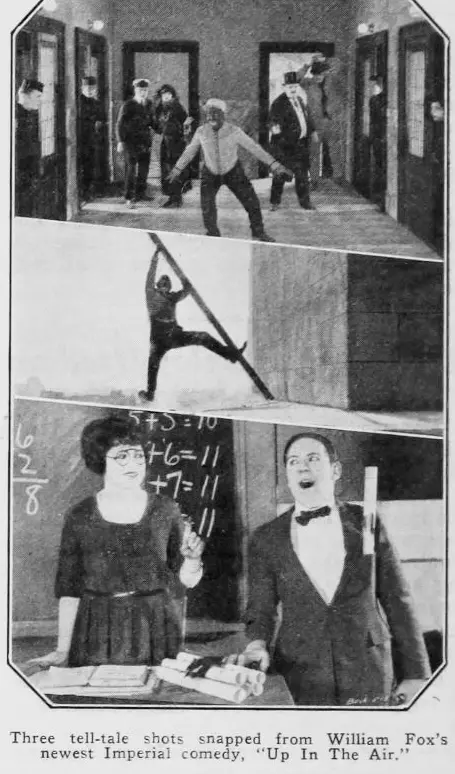
While it may seem reductive to view a balloon-based comedy through a sociological lens, Up in the Air invites such an analysis. The 1920s were a period of intense social mobility and risk-taking, much like The Wager. Sweet’s character is often a man striving for a status just out of his reach, and the balloon serves as a literalization of that upward ambition—and the inevitable fall that follows. The film mocks the pretension of the era. Where A Wife's Romance deals with the intricacies of upper-class infidelity, Sweet deals with the intricacies of not hitting the pavement.
There is a philosophical undercurrent here that mirrors the intellectual debates found in As a Man Thinks. Does man control his destiny, or is he merely a passenger in a basket blown by the winds of fate? Sweet and Conklin argue for the latter, albeit through the medium of falling over. Their struggle is a microcosm of the human experience—trying to maintain dignity while the world spins out of control. This theme resonates far more than the moralizing tone of Hearts of Men, because it is delivered through the universal language of the body.
The editing of Up in the Air is remarkably modern. The cuts are sharp, timed to the beat of the physical action. There is a musicality to the way Sweet builds a sequence: the setup, the complication, the false resolution, and the final, explosive payoff. This rhythmic precision is what separates a great silent comedian from a mediocre one. It requires a level of discipline that is often overlooked in favor of the more 'serious' acting found in Single Handed. In Sweet's world, a well-timed trip is worth more than a thousand lines of dialogue.
Contrast this with the more languid pacing of The Loves of Letty. While that film meanders through its emotional beats, Up in the Air is a relentless machine. It demands the viewer's constant attention, rewarding them with a barrage of visual stimuli. The sequence where Conklin attempts to anchor the balloon while Sweet is dangling from the valve rope is a masterpiece of parallel action. It builds tension not through plot twists, but through the escalating impossibility of the situation. It is the cinematic equivalent of a high-wire act, performed without a net.
To dismiss Up in the Air as a relic of a bygone era is to ignore the foundational DNA of action cinema. Every modern blockbuster that features a hero dangling from a plane or a skyscraper owes a debt to Harry Sweet. He understood, perhaps better than many of his peers, that the essence of cinema is movement. While A Fly in the Ointment might focus on the minutiae of social friction, Sweet focuses on the grand friction of man against nature.
The film’s conclusion, a chaotic descent that mirrors the frantic energy of its opening, leaves the audience breathless. It does not offer the neat, narrative closure of The Road Through the Dark. Instead, it leaves us with the image of two men, battered but unbowed, ready for the next disaster. It is a testament to the resilience of the comedic spirit. Even in a world that seems determined to throw us into the void—much like the domestic mishaps in No Darn Yeast—there is always room for a laugh. Up in the Air remains a towering achievement in the short form, a sky-high tribute to the art of the fall.
IMDb 6.8
1924
Community
Log in to comment.