DbcultAccessing Vault...
Cult Review
Senior Film Conservator
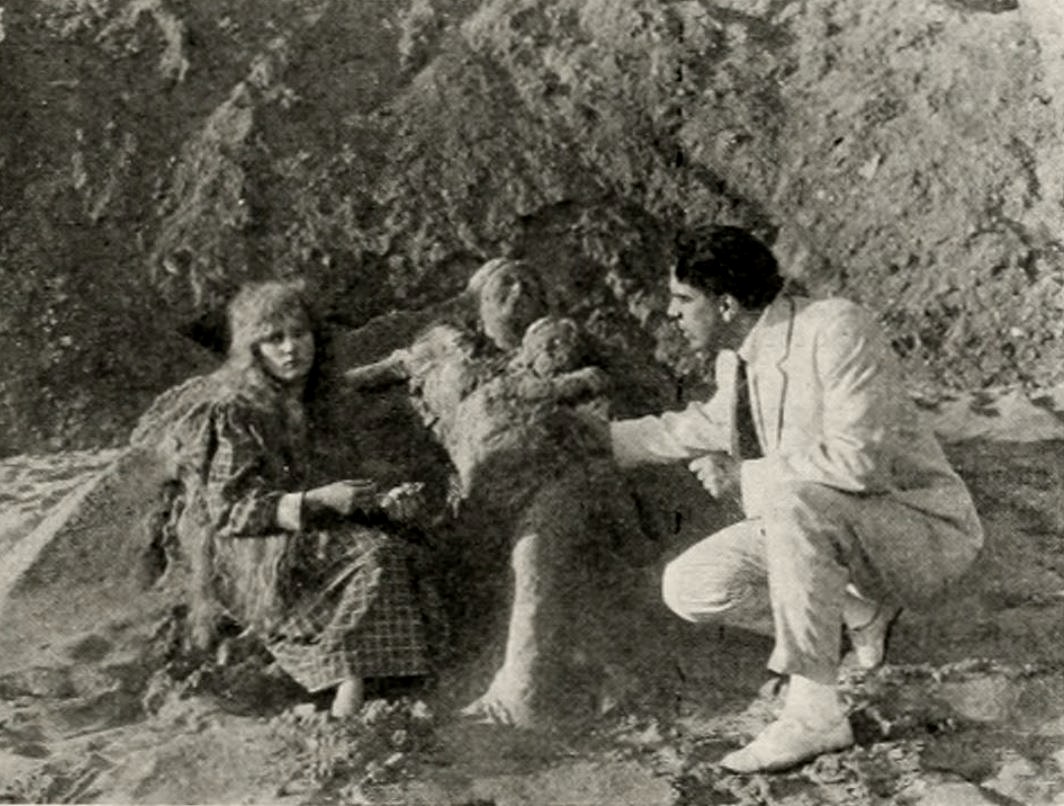
There is a moment—wordless, of course—when Coral’s chisel first kisses the block and the entire screen seems to exhale calcite dust. In that crystalline hush you realize Coral is not merely a silent picture; it is a lithograph of longing, etched by surf and starved for applause.
Olga Printzlau’s screenplay arrives like a bottle set adrift from some other century: part maritime ballad, part sculptural manifesto. Director William Parke stages each reel as though he were turning the pages of a seaweed-stiff diary, letting the ocean itself narrate via double-exposed waves that lap at the edges of every frame. You smell brine; you taste the metallic tang of grief.
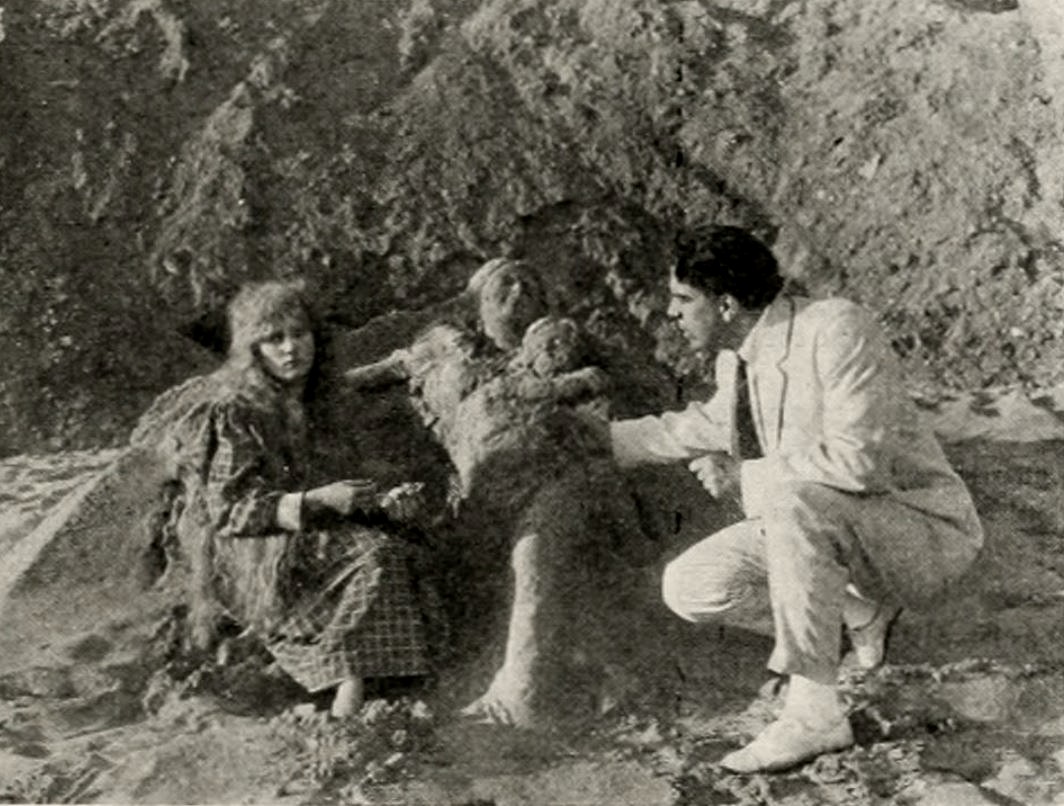
Marie Walcamp’s Coral is never merely lovely; she is luminously other, as though the tides forgot to wash the moonlight off her skin. Watch the way she inhabits negative space—arms half-raised, eyes seaward—long before she ever touches clay. Her cave-studio, lit by a single magnesium flare, becomes a confessional where sand replaces syllables.
Sherman Bainbridge’s Phillip Norton, meanwhile, is all Anglophone languor: the kind of man who can order champagne while his soul hemorrhages. Note the microscopic slump of his shoulders when Helen (Ruby Cox) rebuffs his caress; the camera lingers, and the yacht’s polished rail suddenly looks like prison bars lacquered by Tiffany.
That locket—oval, tarnished, ticking like a tiny heart—functions as both plot detonator and moral barometer. When its hinge finally yields, the close-up is so intimate you can count the pitting on the silver. Inside, two faces, impossibly young, stare out as if to say: Remember who you might have been. It is the silent era’s answer to Chekhov’s gun, only here the bullet is recognition.
Compare it to the diamond that goes missing later: both are small, both are hoarded value, yet one carries blood-memory while the other carries price-tag glitter. The film slyly asks which currency we cherish more—ancestral narrative or market caprice—and answers by letting the gem shatter while the locket survives.
Once the narrative relocates from salt-spray to brownstone, the tonal palette cools from aqueous blues to nicotine sepia. Cinematographer Frank Wheeler employs a diopter filter that turns every chandelier into a spider of light, every ballroom into an ice-cavern. Coral—now swaddled in velvet instead of kelp—walks through these salons like a displaced nereid asked to breathe soot.
The art-school competition subplot could have slid into hoary country-girl-makes-good cliché, but Walcamp sells us the itch in her palm that only a chisel can scratch. When she wins, the medal dangling against her clavicle looks less like triumph than a scar forged of brass.
Ruby Cox’s Helen is a triumph of venal glamour. She enters each scene as though preceded by a perfume atomizer loaded with liquid disdain. Watch her during the diamond-in-the-statue reveal: she doesn’t gasp—she calculates, pupils dilating like a hawk that has spotted a lame rabbit. The performance is so delectably hateful that when the newspaper headline announces her railway demise, you half expect the ink itself to smirk.
The intertitles, sparingly deployed, read like fragments of Sappho recovered from a shipwreck. Example: "The tide remembers what the heart forgets." Each card is hand-lettered to mimic surf foam, a typographic flourish that pulls you deeper into the film’s brackish dream.
And the score—preserved in a 2018 restoration by the University of South Dakota—leverages glass harmonica and bowed vibraphone to conjure the sound of moonlight on water. During the climactic unveiling, the orchestra drops to a single heartbeat-like timpani while the camera dollies toward Coral’s marble Madonna. The effect is ecclesiastical without ever genuflecting toward dogma.
If East Lynne luxuriates in Victorian maternal masochism, Coral offers its pagan opposite: maternity as creative surge rather than sacrificial wound. And where Damon and Pythias sermonizes on male amity, here the central relationship is between a girl and her own gift—Phillip merely the custodian of her audience.
Stack it beside Nell of the Circus and you’ll notice both heroines weaponize spectacle to escape poverty, yet Coral’s arena is the hushed gallery, not the sawdust ring—her tightrope is carved of stone.
Modern viewers may bristle when Phillip effectively adopts Coral after Dan’s death, seeing patriarchal colonization where 1922 audiences likely saw chivalric uplift. Yet the film complicates the power dynamic: Phillip cannot sculpt; he can only curate. Coral, meanwhile, transmutes grief into cultural capital that eventually buys her independence. By the final reel she tips the janitor couple the entire prize purse—an act of wealth redistribution that feels downright Bolshevik for a mainstream feature.
Though shot in black-and-white, the film obsessively invokes color: the emerald flash of a wave crest, the arterial red of Helen’s discarded rose, the prismatic fire of the disputed diamond. These hues exist only in dialogue and intertitles, forcing the spectator to hallucinate chroma the way Coral hallucinates form inside raw stone. The result is a strange synesthetic wash—phantom color that lingers behind the eyelids.
By the time the yacht drops anchor in the cove of Coral’s orphaning, the narrative has come full spiral rather than full circle. The lovers do not return; they reinvent the landscape, turning the scene of abandonment into a bridal bower. Paul Dore kneels over his wife’s ocean-view grave, but the camera forsakes him for the living embrace below—a visual assertion that art outlives both grief and gratitude.
In an era when most silents have ossified into historical footnotes, Coral still bleeds. Its emotional intelligence, its respect for female creativity, and its willingness to let the ocean hold the final word make it a tide worth re-entering. Come for the sculptural melodrama; stay for the metaphysical roar that follows the fade-out.
Verdict: a salt-caked, diamond-lashed fable that carves its initials on your ribcage—high art masquerading as pulp, and the most erotic use of chisel since Pygmalion.
IMDb —
1916
Community
Log in to comment.