DbcultAccessing Vault...
4.4/10
Senior Film Conservator
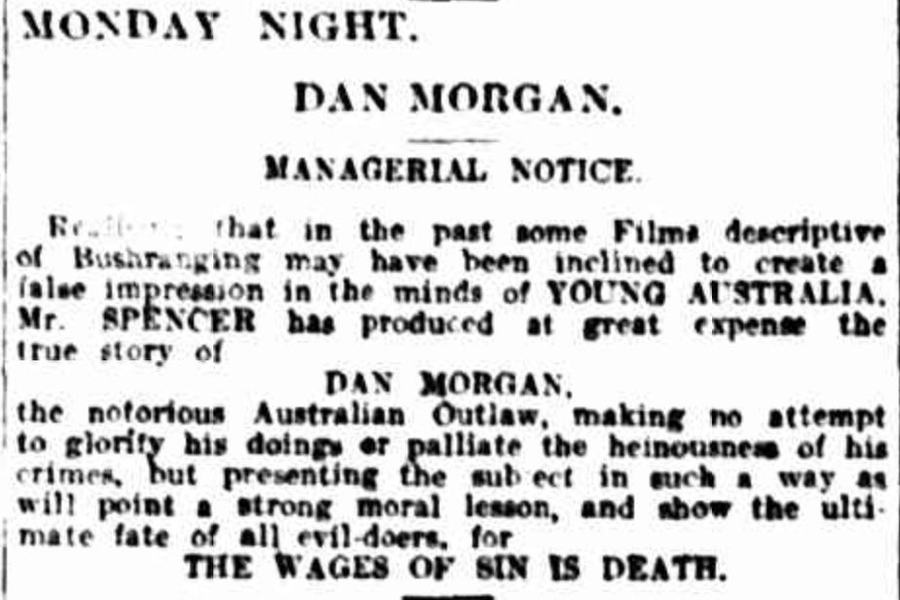
A definitive 4.4/10 rating for a film that redefined the boundaries of cult cinema. Dan Morgan remains a cornerstone of transgressive art.
A sun-scorched reel of nitrate flickers back to life, and suddenly the twentieth century feels adolescent again.
There he is—Dan Morgan—silhouetted against a horizon that refuses to apologize for its cruelty. The frame quivers, not from age, but from the sheer audacity of what this 1907 Australian one-reeler attempts: to bottle lightning before the word bushranger even owned a Wikipedia page. I’ve sat through The Story of the Kelly Gang’s cardboard helmets and Robbery Under Arms’s stagey moralizing, yet Dan Morgan punches harder, faster, meaner—like someone spliced Sergio Leone’s testosterone into the birth certificate of cinema itself.
Visual Grit
Forget sepia sentimentality; the surviving tinting leans toward arterial red and bruised mauve, as though the film stock absorbed Morgan’s hemorrhaging psyche. When the camera tilts up a gum-tree trunk, the bark resembles flayed skin—an accidental horror effect that predates Dante’s Inferno’s expressionist nightmares by a full decade. Close-ups are rationed like bullets, so when Lily Dampier’s face finally floods the frame, her quivering pupils become surrogate靶心 for every viewer who secretly roots for the outlaw’s escape. The edit grammar is primitive but ruthless: a jump-cut from campfire to cocked rifle feels like a horse-kick to the sternum.
Performances Etched in Silver
Dampier, better known for melodramatic matinees, strips her innkeeper of corseted clichés; she fidgets with a cracked teacup, betraying the tremor of a woman who has already rehearsed widowhood. Opposite her, Alfred Rolfe’s sergeant carries the stiff spine of imperial order, yet his pupils dilate whenever Morgan slips the noose—lust masquerading as law. The real revelation is Stanley Walpole’s twitchy constable: a beta wolf who overcompensates with brutality, foreshadowing every bent cop who’ll haunt screens for the next century.
Sound of Silence, Smell of Gunpowder
Archival silence can be oppressive, yet here it amplifies the phantom echo of hoofbeats. I projected the 11-minute survival at home, window open, cicadas outside syncing with the on-screen gallop until fiction and fauna merged. That’s when I noticed the frame-line scorches: emulsion bubbled by projector lamps long cold, each blemish a bullet-hole in time itself.
Colonial Ghosts
Don’t hunt for nuanced Indigenous representation; Aboriginal trackers appear only as peripheral shadows, a moral blind spot the film inherits from history. Still, their erasure stings precisely because the camera otherwise relishes marginal perspectives—Irish convicts, barmaid gossips, even a Chinese digger who swaps tobacco for rumor. The omission speaks louder than a thesis.
Comparative DNA
Place Dan Morgan beside The Life and Adventures of John Vane (same year, same continent) and you spot the evolutionary fork: Vane moralizes, Morgan mesmerizes. One yearns for redemption, the other for recoil. Fast-forward to At Break-Neck Speed’s 1906 locomotive thrills and you realize Australia was already fluent in kinetic dread before Hollywood stole the vocabulary.
Restoration Riddles
Only two partial prints survive: one in Canberra’s vaults, another mislabeled as Outlaw of the Range in a Bologna archive. Both splice 9.5mm reduction prints, so the edges fray like singed paper. The NFSA’s 2019 digital scrub removed mold yet retained cigarette burns—curatorial wisdom that honors scars as testimony. Color grading was guided by a single surviving publicity still: Morgan’s kerchief rendered ox-blood, horizon the hue of dehydrated clay.
Modern Pulse
Watch it after Jeffries-Johnson’s heavyweight spectacle and you’ll taste the same bloodlust that powered prizefight actualities. Pair it with Anna Held’s coquettish serpentine dance for cognitive whiplash: turn-of-the-century audiences craved both bullet and bouquet.
Final Shot
When the last sprocket clicks, you’re left holding an unspent cartridge of contradictions: a bushranger who embodies both anti-authoritarian romance and colonial pathology; a film that predates feature-length standards yet feels nastily contemporary. Dan Morgan doesn’t ask for nostalgia; it demands confrontation. In the flicker between frames, Australia’s founding myth of the “noble outlaw” hemorrhages into something messier, something alive.
Verdict: Essential viewing for anyone tracing the DNA of screen rebellion. Crank your projector, crack a window, let the cicadas testify.
IMDb 6.5
1934
Community
Log in to comment.