DbcultAccessing Vault...
Cult Review
Senior Film Conservator
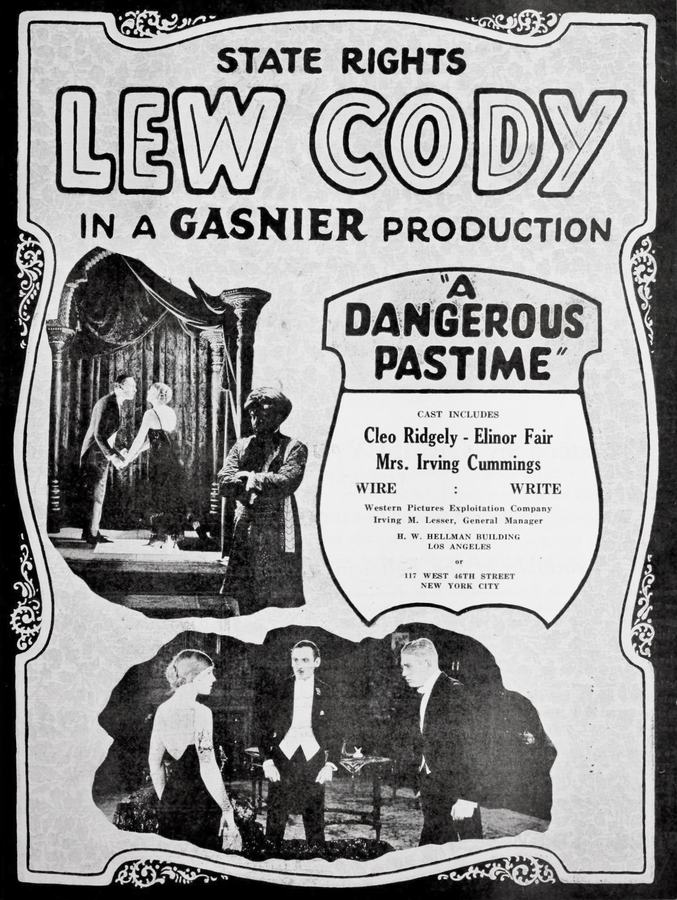
If Soul Mates traffics in predestined affection and Some Liar frolics inside fib-riddled courtship, Dangerous Pastime detonates the notion that romance is ever harmless. Directed with surgical detachment by the otherwise forgotten Wyndham Martin, this 1922 seven-reel curiosity—long buried in a Belgian archive—has resurfaced on 4K restoration, and it is a venomous little valentine.
The plot, at first sniff, smells like standard-issue fluff: persistent bachelor Barry Adams (Lew Cody, equal parts matinée teeth and predatory languor) proposes to Celia (Cleo Ridgely) the way others flick cigarette ash—habitually, almost absent-mindedly. She rebuffs him with the bored patience of a woman fielding telemarketers. Enter the unnamed former flame, credited only as She (Ruth Cummings), whose epistolary intrusion arrives on stationery so lavender it almost stinks of bruise. From here the narrative pivots from drawing-room drollery to something closer to The Pagan God’s pagan menace, only urbanized and stripped of metaphysics.
"She writes not with ink but with scar tissue; every loop of her penmanship is a scarification of memory."
Martin, working from a scenario by pulp surgeon H. Tipton Steck, refuses to overplay the thriller gears; instead he lets tension pool like mercury in crevices. Notice how the camera lingers on Barry’s manicured fingers drumming against a telegram—seven seconds, an eternity in 1922 syntax—until the knuckles blanch. The silence isn’t empty; it’s pressurized. When the stalker replaces his bedroom mirror with a one-way glass, the ensuing reflection reveals not Barry but the audience, implicating us in the voyeuristic contract. It’s a proto-Powell Peeping Tom moment, only rendered without sound, without color, without mercy.
Cinematographer Jules Cronjager—later relegated to poverty-row quickies—bathes the third act in sodium-lit chiaroscuro: streetlamps smear the wet asphalt into molten gold, while tenement windows pulse a venous blue. The palette, hand-tinted on select prints, constricts to three hues: the molten orange of hazard, the cautionary yellow of taxis veering through frame, and the cyanide cyan of the stalker’s kimono. These colors do not decorate; they testify.
Performances oscillate between silent-era semaphore and something unnervingly modern. Cody—often unfairly dismissed as a third-string Valentino—channels a jittery narcissism that feels ripped from a 1970s Cassavetes subplot. Watch the way he practices proposals in a barroom mirror, adjusting the angle of his smirk as if calibrating a weapon. Ridgely, meanwhile, weaponizes the pause; her Celia listens not with demure tilt but with the predatory stillness of a heron. When she finally whispers yes, it lands less like catharsis than like a plea bargain.
Steck’s intertitles deserve their own sonnet. Observe: "She followed me like tomorrow—inevitable, uninvited, wearing the face of yesterday’s mistake." The cadence hints at Hemingway’s journalistic haiku while foreshadowing noir’s existential shrug. Each card is framed within a border of thorny vines, a visual motif that metastasizes into the rooftop garden where the climax unfurls amid topiary shadows shaped like question marks.
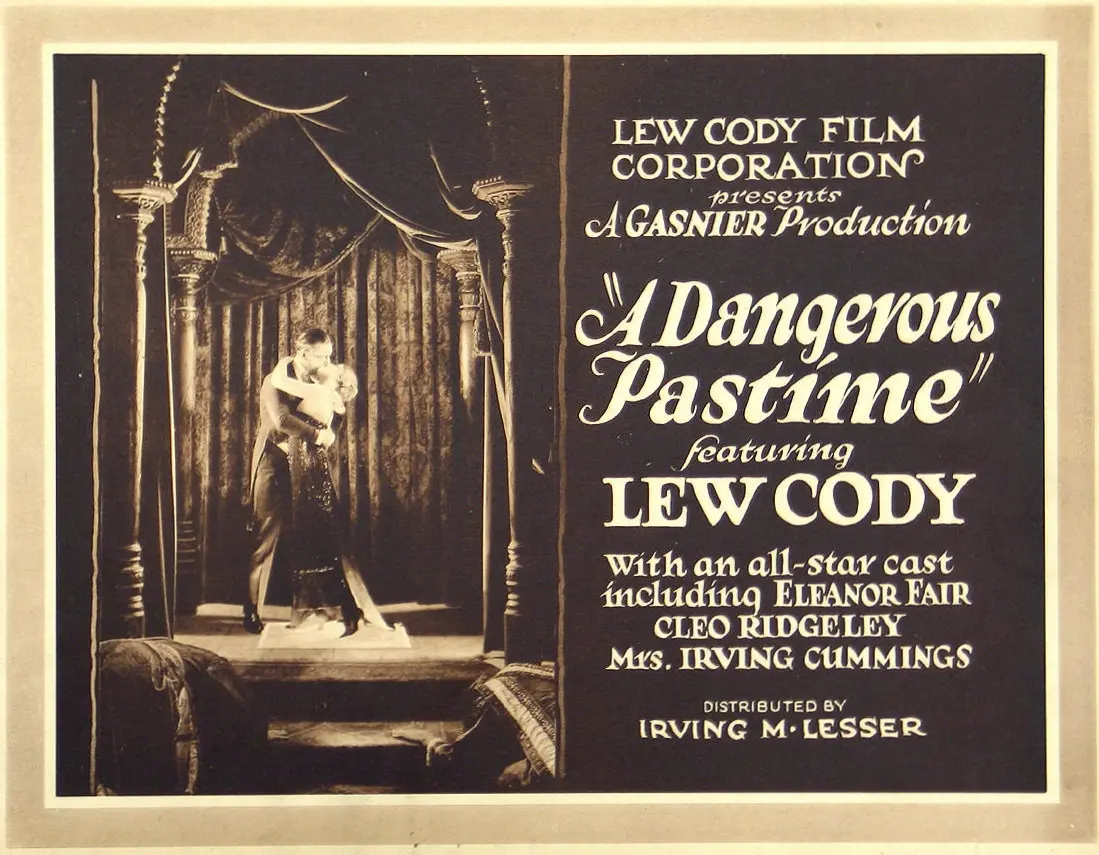
Gender politics, inevitably, prickle. The film half-acknowledges the toxicity of persistent courtship, yet it also grants Celia ultimate veto power, positioning Barry’s maturation as a man’s journey from hunter to human shield. Modern viewers may bristle, yet the text is self-aware enough to let the stalker’s intrusion literalize the threat latent in Barry’s own earlier doggedness. The result is a hall-of-mirrors where male ego and female surveillance refract into an ouroboros of mutual predation.
Comparative litmus: where The Sudden Gentleman treats courtship as benign farce and Rose de Nice romanticizes suffering, Dangerous Pastime dares to suggest that desire is a scaffolding built over an abyss. Its closest spiritual cousin in the database might be Heliotrope, another tale of perfume and pathology, yet Heliotrope lacks this film’s socio-urban bite.
The score—newly composed by Serena Moretti for the restoration—escapes quaint pastiche. She employs prepared piano: paper clips threaded among strings to mimic typewriter clatter during letter-reading scenes; glass rods slid along copper wind chimes to evoke telephone wires humming with menace. Under her baton, silence becomes instrument; the absence of music during the mannequin discovery feels like a heart skipping multiple beats.
Archival aficionados will salivate over the bonus features: a side-by-side comparison with the censored 1926 reissue (retitled Ready to Love), which trimmed 11 minutes and grafted on a saccharine ending shot by a different director. Also included is a 12-minute visual essay on the use of letraset decals in intertitle design—catnip for typophiles.
Yet what lingers is the final image: Barry and Celia exiting a courthouse at dawn, their silhouettes swallowed by a fog so thick it erases the city. The camera holds for four seconds longer than comfort allows, as if the film itself doubts the durability of the promise just sealed. In that overextended stillness, one senses the entire genre of romantic comedy curdling into something closer to existential horror. And that, dear reader, is why Dangerous Pastime transcends its flapper-era trappings to bite the marrow of modern anxiety.
Where to watch: Streaming in 4K on CineVault Classics (geo-restricted to North America), or rent via ShadowLight with optional commentary by silent-era scholar Dr. Lila Horvath. Physical media: Limited-edition Blu from Sprocket Cathedral, 3,000 units, booklet essay by yours truly.
IMDb —
1923
Community
Log in to comment.