DbcultAccessing Vault...
Cult Review
Senior Film Conservator
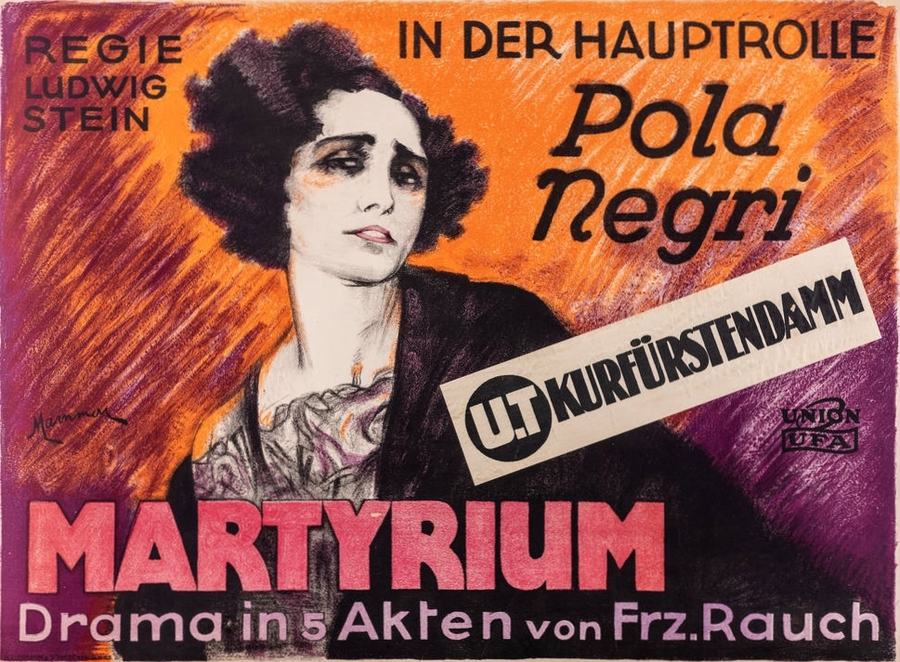
Let us dispense with nostalgia: Das Martyrium is not a museum relic politely asking for indulgence. It is a shard of obsidian lodged in 1919’s throat, coughing up bile-black pearls of masochism that still glint a century later. Paul L. Stein and Franz Rauch have birthed a narrative whose vertebrae are splints of Catholic gilt and Weimar rot, a film that anticipates The Cheat’s voyeuristic chiaroscuro yet outflanks it in moral nihilism.
The camera, handled by an uncredited operator whose breath you can almost hear, slinks through Andreas’s studio like a confession it is ashamed to utter. Marble dust hangs in the air, each particle lit as if by a dying sun, so that every cut feels like a fresco cracking. Compare this to A Virtuous Vamp’s brisk flapper buoyancy and you realize how willingly German silents consented to dwell in gloom the way jazz babies chased gin.
Ernst Stahl-Nachbaur’s Andreas carries palsy not as a gimmick but as ontological graffiti; his hands quake with the same seismic shame that courses through the nation. He is a stand-in for a culture that won a war yet lost its limbs. Watch him grip a chisel the way a penitent clutches a candle—fervor wrestles futility in each knuckle. The film’s intertitles, sparse and mostly German, translate into something like "Form is the only absolution left; flesh declined the sacrament."
Opposite him, Pola Negri’s Elke pirouettes on the precipice between cabaret empress and penitent Magdalene. She enters frame in a tattered tulle skirt, a garment that once billowed like a promise and now clings like a verdict. Notice how cinematographer Willy Gähse lights her clavicles: two crescent bruises under tungsten glare, hinting the Baron’s thumbprints. The performance is all cheekbones and controlled hemorrhage; she exhales exhaustion through nostrils flared like a thoroughbred about to be shot.
If you thought The Man-Eater trafficked in predatory opulence, wait until you savor Eduard von Winterstein’s Baron. He does not merely collect art; he curates agony, catalogues the precise torque at which a soul snaps. In one harrowing sequence, he orders the studio windows blacked out so that the only illumination drips from a skylight shaped like a cruciform. Elke must hold her pose for hours while Andreas carves; the Baron times her muscle spasms with a stopwatch, greedy for the moment her fatigue will bloom into the Virgin’s sorrow. The sequence lasts maybe four minutes on screen, yet the intertitle "Sehen Sie: das ist wahre Kunst—sie blutet" (“Behold: this is true art—it bleeds”) feels branded onto your retina.
There is a subplot that flickers like a match in a morgue: Hans Kuhnert’s consumptive mime sketches a pantomime titled Der letzte Vorhang (“The Final Curtain”). It will be performed on the night of the unveiling, its choreography spelling out the Baron’s crimes in glove-white gestures. Think of it as the inverse of The Broadway Sport’s backstage fizz—here, the backstage is a catacomb, the greasepaint arsenical, the footlights flickering like an ECG. Hans rehearses while shooting morphine into the webbing between his toes, the camera lingering on the needle’s silver as though it were a communion wafer desecrated.
Stein’s montage is a stutter of conscience. He crosscuts between Elke’s tendons locking mid-pose and Andreas’s marble dust cascading like powdered bone. Each cut is a whipcrack; the film runs a mere 78 minutes yet feels carved from a lifetime of insomnia. Soviet contemporaries might call it dialectical, but here dialectics bleed into sado-liturgy. The closest analogue in American silents would be Honor’s Cross, yet that film’s moral ledger ultimately balances. Das Martyrium refuses bookkeeping; it leaves you overdrawn.
The surviving 4K restoration retains the original tinting strategy: candle-amber for studio interiors, chlorine-green for the Baron’s boudoir, cadaver-blue for the morgue where Hans steals a corpse to use as prop. These tints are not quaint curios; they function like the scarlet letter in reverse, branding environments rather than sinners. When the Baron’s green-hued scenes flicker into amber, it is the moment his predation invades the studio sanctuary—a chromatic trespass more unnerving than any dialogue could render.
On the night of the exhibition, the completed Pietà stands beneath a translucent shroud. Guests—industrialists, critics, clergy—murmur like flies circling carrion. The Baron lifts the veil with a theatrical flourish; camera dollies backward to reveal not just marble but Elke herself, blood threading down her shin from the hidden glass shard, her skin powdered alabaster to match the statue. For a heartbeat, viewer and spectator collapse into one another: which is the icon, which the sacrifice? Andreas, trembling, drops his chisel; the clink reverberates like a nail entering flesh. At this precise instant, Hans’s mime troupe storms the atrium, performing the accusatory pantomime. The Baron laughs—until he realizes the corpse in their danse macabre is his own illegitimate son, exhumed and rigged with strings like a marionette. Pandemonium erupts; gunfire stitches the air; the camera spirals skyward toward the cruciform skylight now shattered, moonlight pouring down like mercury.
Order restored is not grace reinstated. Elke limps toward the baptismal font of the Baron’s infant grandson, her bleeding foot poised an inch above the holy water. Will she christen the child or contaminate it? The frame freezes, the iris contracts to a halo, the film ends. No intertitle, no moral postscript—only the whir of the projector gate fluttering like a trapped dove. You exit the screening room tasting iron, half hoping the next feature will be something light like Speed, yet knowing no comic sprint can cauterize this wound.
Milestone’s 4K restoration is streaming on Kino Cult and playing select rep houses. Cinephiles who fetishize East Lynne’s Victorian moral kitsch will find Das Martyrium a palate-scouring antidote. Critics comparing it to Coral or Heir of the Ages miss the point: this film does not champion resilience; it tattoos fragility onto the eyeball.
"To watch Das Martyrium is to volunteer for a scar that will not fade; it is cinema’s answer to stigmata."
Seek it not for cozy cine-nostalgia but for a scalpel to the present: in an era where bodies are still commodified and spectacle feasts on suffering, the Baron’s atelier looks eerily like a certain algorithmic feed. The film whispers that every viewer is complicit, every gaze a bid in the Baron’s auction. And when the lights rise, you realize the true martyrdom is not Elke’s, nor Andreas’s, but yours—perpetual, voluntary, and priced at the cost of a ticket.
Final note: if you need a chaser, By Hook or Crook offers slapstick balm. But expect the laughter to echo hollow, as though something marble-heavy were lodged in your chest, chiseling heartbeat into rubble.
IMDb 6
1919
Community
Log in to comment.