DbcultAccessing Vault...
Cult Review
Senior Film Conservator
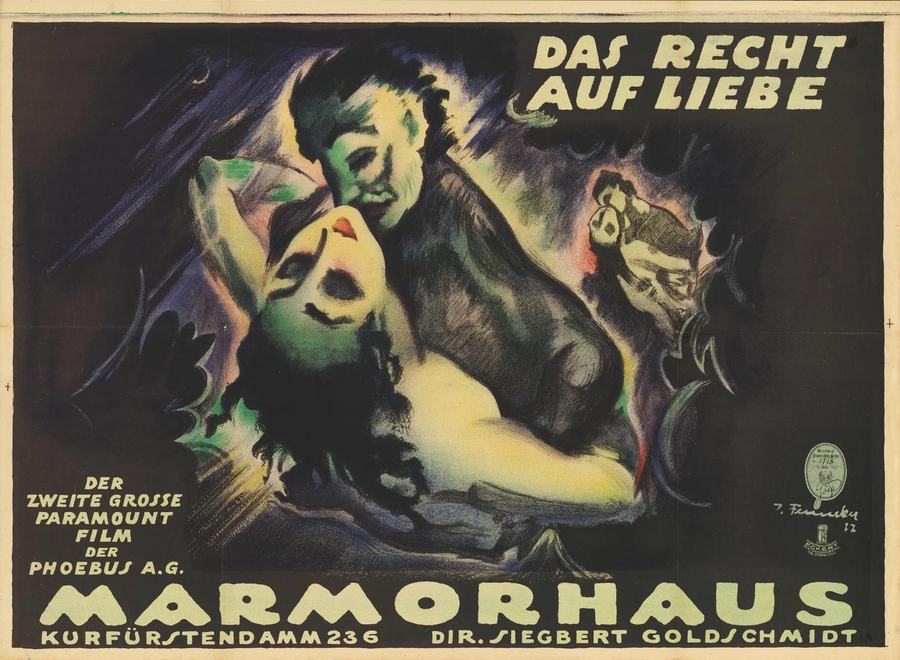
A matrimonial sermon gone rogue
Das Recht der freien Liebe arrives like a sulphur flash in 1919, the year Germany’s empire collapsed and everything that once felt sacred wobbled on its pedestal. Harry Harland’s script, laconic yet venomous, hands us Professor Carlsen—a man who treats marriage the way an entomologist treats a pinned butterfly: admirable under glass, lifeless under touch. Fritz Achterberg plays him with the brittle rectitude of a Sunday pamphlet, eyes forever fixed on the horizon of social propriety while his wife, portrayed by Colette Corder with a combustible mix of ennui and appetite, roams their cavernous apartment like a tigress sniffing the bars.
The first reel is an anatomy of neglect rendered in chiaroscuro corridors and over-exposed windowpanes. Interiors throb with Wilhelmine clutter—porcelain shepherdesses, wilting ferns, antimacassars—yet every object seems to glare at Carlsen, indicting him for crimes of omission. When he pontificates to his students about the sanctity of the marital bond, intertitles snap like ruler slaps: “Marriage is the cornerstone of the State.” Meanwhile Corder’s body language sabotages every word; she lounges in a kimono so diaphanous it might be made of cigarette smoke, staring past the camera as if already plotting her getaway.
Escalation arrives not through histrionic rows but via a single, devastating cut: the wife’s empty wardrobe. The film jump-cuts to a Berlin street at dusk, gas lamps flickering like gossip. She has already taken up with Ernst Hofmann’s character, a sculptor whose studio is a Dionysian tangle of armless torsos and drying clay. Here free love is not theory but texture—hands kneading flesh-toned clay, dust motes swirling in projector-beam sunrays. The sculptor’s creed is simple: possessiveness is the only sin. Their liaison unfolds in a montage of overlapping dissolves—morning coffee, afternoon lovemaking, evening cabaret—each segment dissolving before possessiveness calcifies.
Visual grammar sharper than divorce papers
Cinematographer Arnold Czempin shoots urban hedonism like a fever chart: low-angle shots skew streets into vertiginous slides, while mirrors fracture faces into cubist anxiety. In one bravura sequence the wife’s new apartment becomes a kaleidoscope—she and her lover reflected ad infinitum, suggesting that freedom multiplies selves rather than uniting them. Compare this to the locked-off, frontal compositions of Carlsen’s lecture hall, where rows of male students form a rigid grid. The film’s visual dialectic—anarchic refraction versus stolid symmetry—argues that monogamy and open love are not moral positions but optical philosophies.
Yet Harland refuses easy triumph. As winter stains the city grey, the free union cools. The sculptor accepts a commission in Paris; the wife, now pregnant, must decide whether to follow or confront the husband whose name still stains her passport. The finale, infamous among archivists for surviving only in a tattered 35mm print, transpires on a fog-drenched canal bridge. Carlsen appears like a revenant, begging restitution. Corder’s hesitation—filmed in an extreme close-up that maps every capillary in her widened eyes—lasts a single intertitle: “I am not yours, nor his, nor my own.” She turns toward the camera, the lens holding her gaze until the image whites out, as if the film itself cannot adjudicate her sovereignty.
Performances that bruise the screen
Fritz Achterberg’s Carlsen is a marvel of tight-buttoned repression; watch the way his fingers flutter to his necktie whenever conversation veers toward affection, as if the cravat were a tourniquet against emotional hemorrhage. Colette Corder counters with feral physicality—she moves like someone who has memorized every exit. In cabaret scenes she dons a gold-sequined sheath, shimmying to a tinny piano riff, yet her eyes stay cold, calculating. The erotic charge lies not in exposed skin but in her refusal to be consumed. Ernst Hofmann, all rangy limbs and insinuating smile, embodies the libertine as craftsman: when he wipes clay from his palms before caressing her, the gesture feels both reverent and predatory.
Supporting players orbit like minor planets. Gertrude Welcker surfaces as a cigar-chomching dowager who hosts salons on “the future of gender,” while Bruno Eichgrün plays a smitten journalist whose feverish declarations provide sardonic counterpoint to the central duo’s laconic exchanges. Their subplot, though truncated in existing prints, furnishes comic oxygen: the journalist pens breathless editorials titled “The Death of Jealousy,” only to retch with envy when his mistress flirts with a Bolshevik poet.
Sound of silence, roar of ideas
Though silent, the film pulses with aural suggestion. Intertitles adopt typographic swagger—nouns in oversized gothic, verbs in jittery kinesis—so that dialogue vibrates in the mind’s ear. A recurring motif is the off-screen clatter of typewriter keys, implying that every romantic rupture is being archived, adjudicated, commodified. When the wife finally signs divorce papers, the intertitle simply reads “Taktaktaktak” in ever-shrinking font, a sonic afterimage of stenographic finality.
Modern spectators often retrofit their own playlists, yet I recommend the 2018 restoration score by Monokl: electronic drones threaded with Weimar-era chansons sampled at half-speed. The dissonance mirrors the film’s thesis—old vows stretched until they snap.
Context: a nation shedding its corset
Released mere weeks after the Weimar Republic’s founding, Das Recht der freien Liebe channels national vertigo. The Spartacist uprising still smolders in newspaper memory; women’s suffrage is freshly inked. The film’s obsession with contractual versus corporeal bonds speaks to a society rewriting every ledger. Compare it to The Amazing Wife, an American melodrama of the same year that punishes female ambition with social death; Harland’s heroine suffers no such cosmic comeuppance. Or set it beside The Devil’s Wheel, where sexual transgression ends in Siberian frost—Berlin’s answer is a shrug in chiaroscuro.
Even within German cinema, the film exists in dialectical tension with Tsar Ivan Vasilevich Groznyy, whose tyrant clings to autarchy as if to a matrimonial vow with the nation. Carlsen’s obsession with marital law is a micro-politics echoing Ivan’s macro-tyranny, yet both men founder on the shoals of human appetite.
Conservation calamity, resurrection hope
For decades the picture slumbered in Moscow’s Gosfilmofond, mislabeled as “bourgeois pornography,” its nitrate curls bubbling toward dust. The 2018 restoration salvaged roughly 72% of the original runtime; missing scenes survive only in censorship cards stored at the Bundesarchiv. Those lacunae, rather than hobble the narrative, intensify its modernist fracture. Viewers supply the ruptures, becoming co-authors—a participatory anarchy the film itself would applaud.
Streamers beware: several YouTube uploads splice in soft-core loops from 1970s swinger loops to “pad” reels. Stick to the Deutsches Filminstitut DCP or the Criterion channel’s 2K scan. Anything less and you’re watching a doppelgänger.
Final verdict: still too hot for 2024
Das Recht der freien Liebe refuses to fossilize into academic footnote. Its questions—can possession coexist with passion? does sovereignty require solitude?—feel algorithmically tailored for a generation navigating polyamory apps and prenup podcasts. Harland offers no manifesto, only a mirror streaked with fingerprints. The courage lies in that refusal to moralize: freedom glows, but it also blinds. Monogamy comforts, yet it asphyxiates. The film’s closing white-out is not resolution but perpetual present tense—a dare to keep deciding, daily, whom we choose to become.
Seek it out, argue with it, maybe break up over it—because any artwork that still snags the nerves after a century is less a relic than a live wire. And this one? Still crackling.
IMDb 5.9
1924
Community
Log in to comment.