DbcultAccessing Vault...
Cult Review
Senior Film Conservator
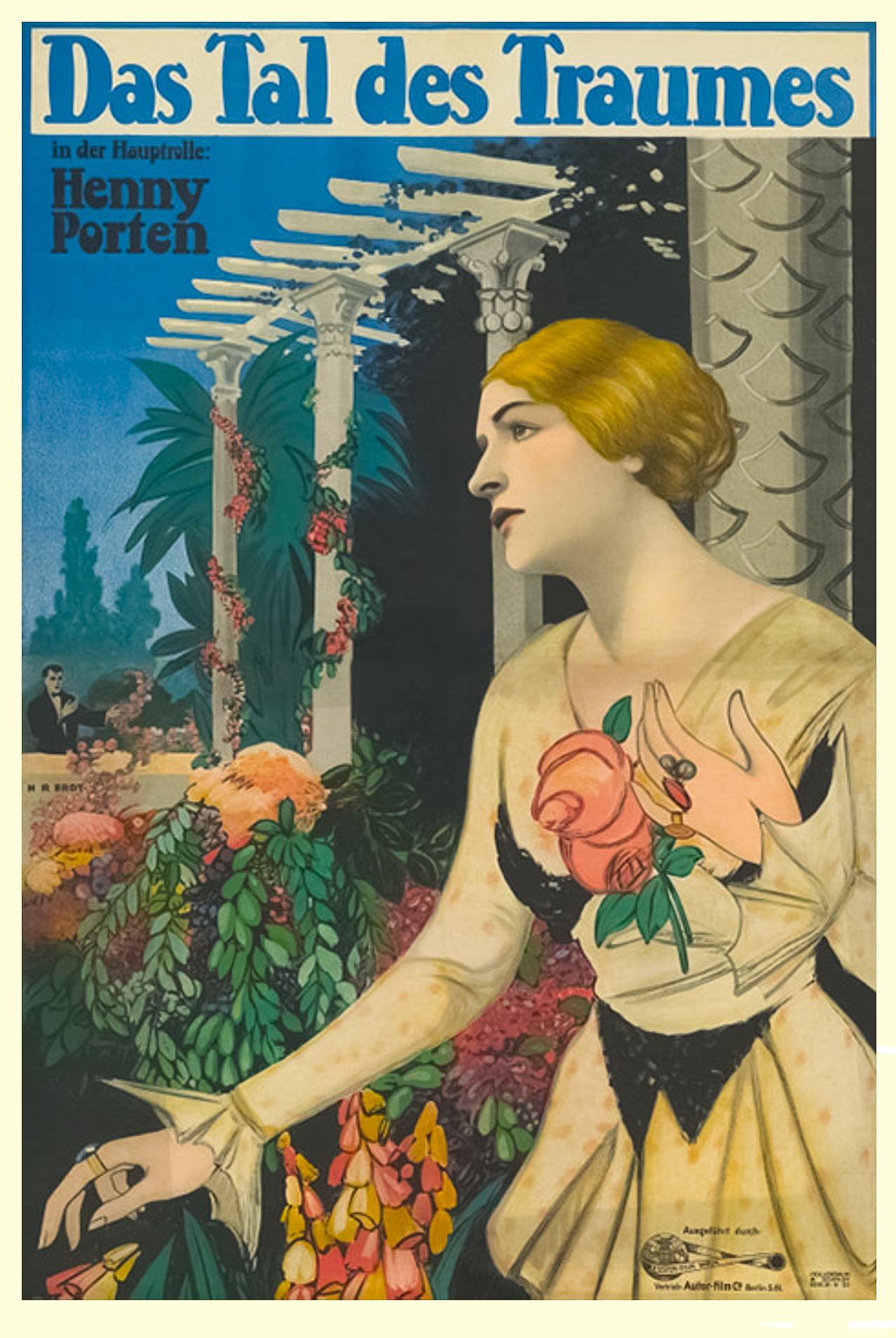
Stepping into the ethereal realm of 'Das Tal des Traumes' (The Valley of Dreams), one is immediately enveloped by a cinematic tapestry woven with the threads of romanticism, societal critique, and the timeless human quest for authenticity. This silent masterpiece, featuring the luminous Henny Porten, transcends mere narrative to become a profound meditation on the conflict between external expectation and internal yearning. It's a film that resonates with an almost melancholic beauty, drawing the viewer into its meticulously crafted world where dreams and reality dance a delicate, often heart-wrenching, waltz.
At the heart of 'Das Tal des Traumes' lies Henny Porten's utterly captivating portrayal of Eleonora. Porten, a titan of early German cinema, delivers a performance that is nothing short of a masterclass in silent acting. Her Eleonora is not merely a character; she is a vessel for universal disquiet, a woman whose every gesture, every subtle shift in facial expression, conveys a universe of unspoken longing. The film opens with her trapped in a life of opulent desolation, a prisoner of societal conventions and a looming, loveless marriage to the formidable Baron von Hardenberg. Porten’s initial scenes are a study in restrained anguish, her eyes, often downcast or gazing wistfully into the middle distance, eloquently articulate a soul suffocating under the weight of expectation. It’s this profound sense of internal struggle that makes her eventual flight to the titular valley so cathartic, not just for the character, but for the audience. Her transformation upon encountering the idyllic landscape and the enigmatic artist Julian (Curt A. Stark) is palpable. The rigid lines of her posture soften, her gaze brightens, and a nascent joy begins to bloom across her features. Porten's ability to convey such a seismic emotional shift without a single spoken word is a testament to her unparalleled artistry. She embodies the very essence of the dream, making Eleonora's journey a deeply personal and universally resonant experience.
Curt A. Stark, as Julian, provides the perfect foil to Porten's Eleonora. His presence is one of untamed magnetism, a stark contrast to the rigid formality from which Eleonora escapes. Julian is the embodiment of the dream itself – free-spirited, artistic, and deeply connected to the natural world. Their initial encounters are handled with a delicate grace, building a romance that feels organic and inevitable, fueled by shared sensibilities rather than societal decree. Stark’s performance is less about overt dramatics and more about an understated charisma, a quiet intensity that draws Eleonora, and indeed the viewer, into his orbit. The chemistry between Porten and Stark is undeniable, lending an authentic emotional weight to their burgeoning love story. The valley itself, exquisitely captured by the cinematography, becomes a character in its own right—a sanctuary, a canvas for their love, and ultimately, a crucible where their dreams are tested. The visual storytelling here is paramount; long shots of rolling hills, sun-dappled glades, and shimmering waters evoke a sense of profound peace and boundless possibility, making the valley not just a location, but a state of mind. It’s a masterful use of setting to amplify thematic concerns, much like the evocative landscapes found in contemporaneous European silent films that sought to capture the spirit of romantic escapism.
The idyllic peace of 'Das Tal des Traumes' is, inevitably, short-lived. The arrival of Baron von Hardenberg, played with a chilling gravitas by August Weigert, shatters the pastoral fantasy. Weigert’s Baron is not a caricature of villainy, but rather a chillingly effective representation of the societal forces that seek to reclaim Eleonora. His stern demeanor and unyielding sense of entitlement underscore the suffocating pressures of duty and convention that Eleonora had sought to escape. The tension between the Baron's rigid world and Julian's liberated existence forms the central conflict, brilliantly externalizing Eleonora's internal struggle. Furthermore, the narrative is enriched by the gradual revelation of Julian's own shadowed past. This element adds a layer of complexity, preventing the story from devolving into a simplistic good-versus-evil dichotomy. It forces Eleonora, and the audience, to confront the idea that even in a 'valley of dreams,' imperfections and unresolved histories persist. This nuanced approach to character motivation and plot development elevates the film beyond a standard melodrama, positioning it closer to psychological drama. One might find parallels in the tragic misunderstandings and societal pressures explored in Bristede Strenge, though 'Das Tal des Traumes' leans more heavily into the romantic ideal before its inevitable confrontation with reality.
While the director's credit for 'Das Tal des Traumes' often gets conflated or is less prominently documented than the star power, the collective vision brought forth by writers El Correi and Walter Turszinsky, alongside the interpretive genius of the cast, is undeniable. The storytelling is remarkably fluid, a testament to the sophisticated understanding of visual narrative prevalent in German cinema of the era. The pacing is deliberate, allowing emotional beats to fully resonate, while clever use of cross-cutting builds suspense as the two worlds—Eleonora's past and her present—inevitably collide. The framing is often exquisite, utilizing natural light and expansive outdoor settings to reinforce the themes of freedom and confinement. One can discern a directorial hand that understood the power of symbolism, employing visual metaphors to convey complex ideas. For instance, shots of Eleonora framed by restrictive doorways or windows in the city contrast sharply with the open vistas of the valley, visually reinforcing her journey from captivity to liberation, however fleeting. The contributions of actors like Erich Kaiser-Titz and Rudolf Biebrach, even in supporting roles, add depth and texture to the ensemble, grounding the fantastical elements of the 'dream' in a believable human context. Biebrach, a prolific actor and director of the period, likely brought a seasoned understanding of dramatic structure and character nuance to his role, enhancing the film's overall integrity.
The thematic richness of 'Das Tal des Traumes' is perhaps its most compelling aspect. At its core, it is a profound exploration of escapism—the human desire to flee from an unsatisfactory reality into a world of one's own making. Eleonora's journey is a literal manifestation of this, but the film delves deeper, questioning whether such an escape can ever be truly sustainable or if reality, in its myriad forms, will always intrude. It asks: Is the 'valley of dreams' a genuine haven or merely an elaborate illusion? The film deftly navigates the fine line between hope and delusion, between authentic passion and fleeting fantasy. This interrogation of illusion versus reality is a recurring motif in cinema, but here it feels particularly poignant, amplified by the silent medium which often relies on visual metaphor to convey inner states. Eleonora’s ultimate choice is not a simple one, nor is it presented as unequivocally right or wrong. Instead, it’s a deeply personal decision, fraught with sacrifice and self-discovery. Her journey is less about finding a perfect ending and more about understanding her own desires and the limitations of both her world and her dreams. This nuanced approach to character development and thematic complexity sets 'Das Tal des Traumes' apart, inviting viewers to reflect on their own aspirations and compromises. The film's philosophical underpinnings resonate with the existential angst explored in later works, showcasing a surprising depth for its era. It's a testament to the power of early cinema to tackle complex psychological landscapes with grace and subtlety, a quality that can also be appreciated in the introspective narratives of films like Prestuplenie i nakazanie, though in a drastically different thematic context.
'Das Tal des Traumes' stands as a significant artifact of German silent cinema, a period renowned for its artistic innovation and profound psychological depth. This era, particularly the years leading up to and immediately following World War I, saw German filmmakers experimenting with narrative structures, visual styles, and thematic complexity in ways that profoundly influenced global cinema. Films like this one, with their emphasis on emotional interiority and symbolic landscapes, paved the way for the Expressionist movement that would soon define a significant portion of German film history. The film’s preservation, even in fragments, is crucial for understanding the evolution of cinematic storytelling and the enduring appeal of its stars like Henny Porten, whose presence alone guaranteed a level of quality and emotional resonance. Her unique blend of vulnerability and strength made her a relatable figure for audiences grappling with rapid social change. The film's exploration of individual freedom against societal pressure remains remarkably relevant, speaking to contemporary audiences just as it did to those over a century ago. Its aesthetic beauty, from the detailed sets to the sweeping outdoor photography, ensures its place as a visually arresting work. Comparing its romantic melodrama to something like Love Everlasting, one can appreciate the distinct cultural inflections and narrative approaches to similar themes, yet 'Das Tal des Traumes' maintains a uniquely German romanticism that feels both grand and intimately personal. It's a reminder of a bygone era when cinema was pure visual poetry, relying solely on image and emotion to convey its powerful messages.
In its final moments, 'Das Tal des Traumes' refuses to offer a simplistic, saccharine resolution. Instead, it leaves the viewer with a sense of poignant ambiguity, a lingering question about the true cost of dreams and the compromises inherent in forging one's path. Eleonora's journey, whether it leads to enduring happiness or a bittersweet understanding, is one of profound growth. She emerges not necessarily triumphant in the conventional sense, but undeniably transformed, having gazed into the heart of her own desires and confronted the formidable barriers, both external and internal, that stand in their way. The film is a powerful testament to the artistry of silent cinema, demonstrating its capacity for complex storytelling, deep emotional resonance, and stunning visual poetry. It invites repeated viewings, each time revealing new layers of meaning and nuance in Porten's masterful performance and the carefully constructed world around her. For those seeking to understand the foundational elements of European cinema, or simply to immerse themselves in a narrative of timeless human struggle and aspiration, 'Das Tal des Traumes' remains an essential and deeply rewarding cinematic experience. Its echoes of romantic yearning and the stark confrontation with reality continue to reverberate, long after the final frame has faded to black.

IMDb 4.8
1929
Community
Log in to comment.