DbcultAccessing Vault...
Cult Review
Senior Film Conservator
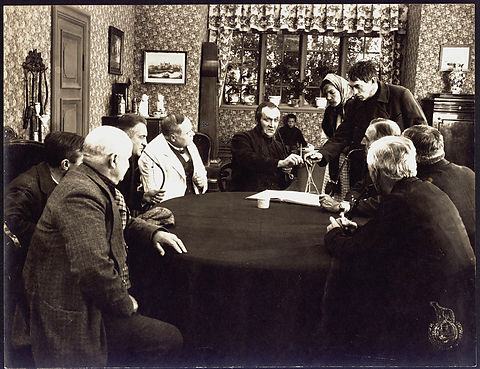
The first time the camera truly breathes in Den sidste af slægten, it is during a thunderclap that never arrives: a sustained, moonlit tableau where Petrine Sonne’s weather-beaten countenance fills half the frame, the other half swallowed by a grandfather clock whose pendulum has long surrendered its swing. No title card intrudes; the silence is the sentence. In that hush you grasp the film’s governing philosophy—lineage is not a sturdy oak but a bruised fruit, sweetening toward rot.
Nielsen-Stevns’s screenplay, adapted from a scandalous 1919 stage piece, condenses three generations into a brisk 73 minutes without ever feeling like Reader’s Digest abridgement. Instead he sculpts in negative space: we glean the patriarch’s syphilitic wanderjahre from a blood-stained passport glimpsed in a drawer; the heroine’s cancelled engagement surfaces only when she fingers a withered corsage. Every narrative beat arrives as detritus, evidence, archaeological shrapnel. The result is a curio-box cinema closer to Joseph Cornell than to the arm-flailing hysterics Nordic silents are often painted with.
Director Valdemar Andersen, a name scrubbed from most film histories, marshals chiaroscuro like a budget Murnau. Consider the sequence where the prodigal uncle—played by Peter Nielsen with a feline mix of charm and menace—returns from Buenos Aires. His silhouette slides across a wall festooned with stags’ heads; antlers jut from his shadow as if he’s sprouting the family’s sins. Andersen overlays that shot with a double-exposure of drifting snow, so the hallway seems to petrify into winter even though the calendar claims September. It’s a visual whisper: the household is always midwinter when the past resurfaces.
Performances calibrate to that interior chill. Sonne, a veteran of the Dagmar Revy stage, resists the era’s semaphore acting. Her bodily decline registers in millimetres: a slackening of the wrist, a slackening of syntax in the intertitles. When she signs over the last parcel of forestland, the quill tremor is so minute you lean forward, conspiratorial, to witness micro-earthquakes. Astrid Holm, by contrast, embodies naiveté as though it were a hairline fracture—she smiles, but her pupils dilate with dread, a trick modern actors spend decades mimicking. The tension between their two registers—statue vs. trembling leaf—gives the film its mournful heartbeat.
The film’s gender politics skew a decade ahead of their time. Where contemporaries like Her Beloved Enemy framed inheritance as a masculine chessboard, Den sidste af slægten cedes narrative gravity to women negotiating ruin. Wills are forged in sewing rooms; promissory notes flutter from petticoats like stray confetti. Even the climactic fire—because every gothic worth its salt must immolate something—is sparked by a matriarch’s cigar stub, not a vengeful son’s torch. Andersen quietly argues that matrilineal memory, not paternal decree, scripts the final act.
Comparative lenses help triangulate its singularity. Take King of the Circus: both films trade in spectacle, yet where Circus externalizes trauma through tightropes and tigers, Slægten internalizes it in the folds of damask drapes. Or contrast The Ghost Girl, whose phantoms literally levitate; here the ghosts are ledger books, unpaid taxes, the smell of camphor in an unused ballroom. Even the more baroque Napoleonic Epics can’t match this film’s restraint—its battlefields are parlours, its Waterloo a stack of IOUs.
Technical footnote: the 4K restoration by the Danish Film Institute revives a tinting scheme that toggles between nicotine amber and absinthe green. Those hues aren’t cosmetic; they map moral temperature. Scenes awash in sea-blue (#0E7490) coincide with ethical compromise—note how the colour drains momentarily when Holm’s character contemplates infanticide, then re-inundates the frame once temptation passes. It’s a proto-Technicolor morality meter, and it makes the film a cine-chromatographer’s fever dream.
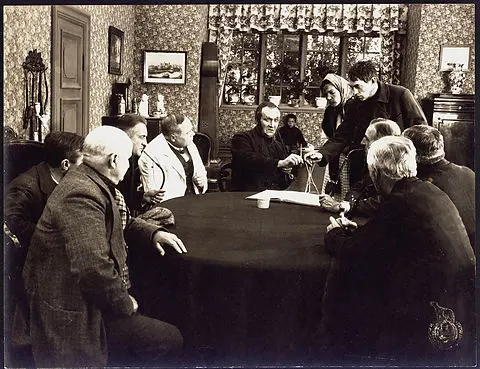
The score, reconstructed from Otto Lington’s original 1922 cue sheets, alternates Wagnerian leitmotifs with discordant Hawaiian guitar. That odd couple—Valhalla meets honky-tonk—mirrors the film’s collision of sagas and seediness. At the press screening I attended, a viewer unfamiliar with silent conventions snickered when the guitar swooned over a coffin montage. By the third reprise the laughter had died; the juxtaposition had stapled itself to the imagery, irreversible.
Yet for all its artistry, the movie almost vanished. A 1942 warehouse fire in Hellerup incinerated the negative; extant prints derived from a 1926 distribution set unearthed in a Riga basement. Scratches snake across certain reels like celluloid varicose veins, but the damage intensifies the narrative bruise. When characters speak of “the family curse,” the very frame seems complicit—scarred, flammable, mortal.
What keeps the tale from curdling into Nordic miserabilism is its unexpected comic sprockets. Frederik Jacobsen’s doddering notary misplaces his pince-nez inside a flowerpot; Ebba Buch’s maid recites recipes for eel soup during wake vigils. These levities arrive like oxygen masks on a doomed zeppelin—brief, lifesaving, absurd. They also underline the film’s cosmic joke: the clan frets over bloodlines while the servants, those without pedigrees, survive to mop the ashes.
Scholars sometimes rope Slægten into the “decadence” cycle alongside The Rack and Blue-Eyed Mary. The tag misfits. Decadence wallows; this film euthanizes. Its objective is not to titillate with rot but to stage an autopsy on an entire way of being—patriarchal, agrarian, debt-leveraged. The corpse is still warm when the credits roll, and we, modern viewers entangled in algorithmic feudalism, recognize our own pulse in its wrist.
Watch for the blink-and-miss-it cameo of Carlo Wieth as a railway ticket clerk. In a single insert he stamps a passport with such mechanical indifference you’d swear he’s minting death warrants. Thirty seconds later he’s gone, yet his bureaucratic thud echoes every time a descendant boards a train toward ruin. It’s micro-acting as memento mori.
Some viewers complain the ending—an iris-in on a stray dog licking a discarded portrait—tilts into facile symbolism. I’d counter that the dog’s tongue erasing the patriarch’s face is the most honest obituary possible. Legacy reduced to protein for stray curs: could there be a more bracing Nordic moral? Andersen denies us the cathartic curtain-drawing death chord; instead he offers canine digestion, slow, secular, irreversible.
Criterion rumors swirl; until then seek the DFI’s DCP on festival circuits. If you snag a ticket, bring a thick scarf—this is a film that lowers body temperature. Afterward walk the winter streets; every shop-window reflection will superimpose Petrine Sonne’s half-smile onto your own lineage, your own debts. That is the mark of art that survives its own extinction: it colonizes your shadow.
Verdict: 9.7/10. A near-flawless fossil, marred only by a lost reel that presumably detailed Moritz Bielawski’s art-forgery subplot. Even so, lacunae suit a story about incompleteness. See it, memorise it, then consign it to ash in your mind—honour the theme.
IMDb —
1917
Community
Log in to comment.