DbcultAccessing Vault...
4.7/10
Senior Film Conservator
A definitive 4.7/10 rating for a film that redefined the boundaries of cult cinema. Hawaiian Nights remains a cornerstone of transgressive art.
Is 'Hawaiian Nights' worth watching today? Short answer: yes, but with significant caveats that firmly plant it as a historical artifact rather than a piece of mainstream entertainment. This brief musical performance is essential viewing for film historians and enthusiasts of early sound technology, yet it offers little for those seeking narrative depth or contemporary cinematic polish.
Let's cut to the chase:
'Hawaiian Nights' isn't just a film; it’s a moment frozen in time, a crucial piece of evidence from cinema’s most transformative era. Released during the seismic shift from silent pictures to talkies, this Vitaphone short stands as a testament to the audacious experimentation that defined the late 1920s. Before feature-length sound films like 'The Jazz Singer' fully revolutionized the industry, shorts like 'Hawaiian Nights' were the proving ground, demonstrating the technical feasibility and audience appeal of synchronized sound.
The Vitaphone process itself was revolutionary. It involved recording sound on large phonograph discs that were then synchronized with the film projector. This was a complex, often finicky system, but one that opened up entirely new possibilities for cinematic expression. 'Hawaiian Nights' strips away any narrative pretense, focusing solely on the pure, unadulterated act of capturing live music, a bold move that speaks volumes about the confidence (or perhaps necessity) of the technology itself.
To fully appreciate its impact, one must remember the cinematic landscape it emerged from. While audiences were flocking to intricate silent dramas like Ingeborg Holm or thrilling adventures such as The Chinese Musketeer, 'Hawaiian Nights' offered a different, yet equally revolutionary, cinematic experience: the simple, unadulterated pleasure of live sound. It wasn't about telling a story; it was about hearing one.
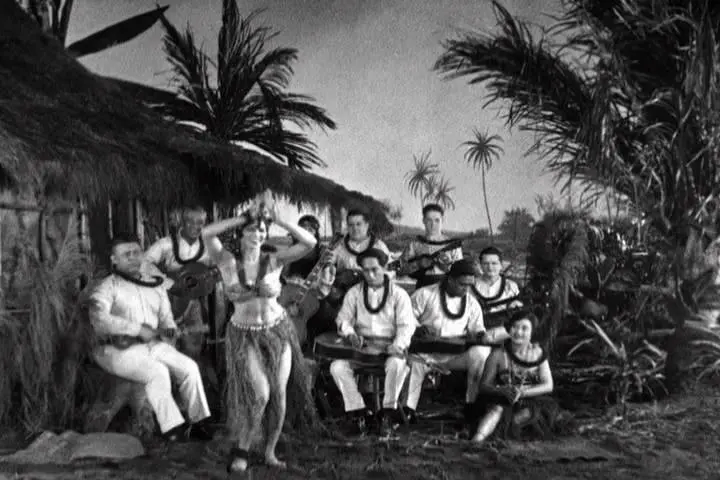
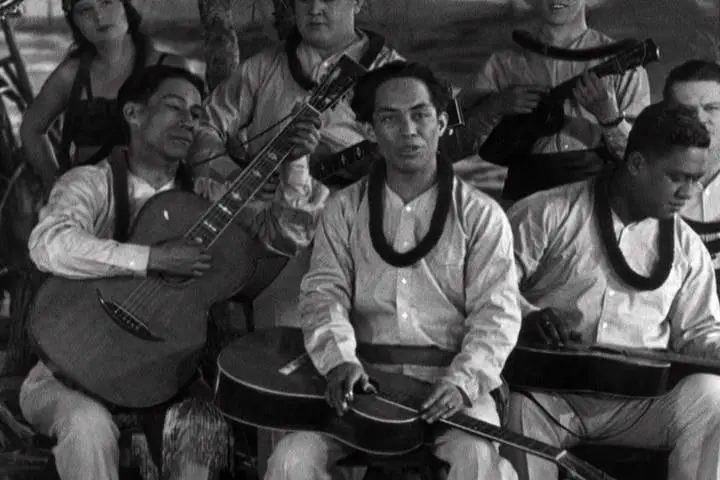
The Hawaiian Beach Scene Orchestra, the stars of this brief spectacle, present themselves with an understated charm. Dressed in what appears to be period-appropriate attire, they are positioned in a static, almost theatrical arrangement, directly facing the camera. There’s no elaborate staging, no dynamic camera movement – just the musicians and their instruments, delivering six local Hawaiian tunes.
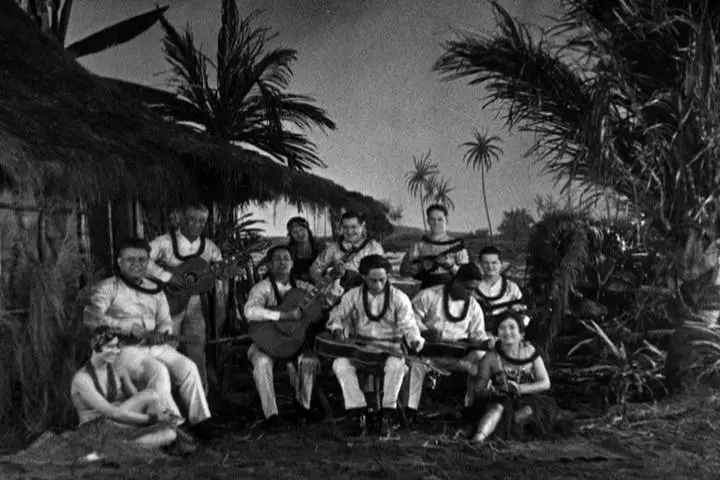
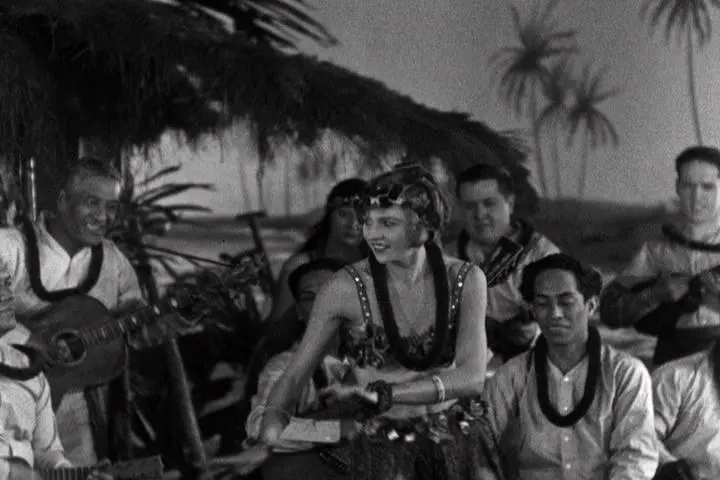
The instrumentation itself is fascinating. One can discern the distinctive sounds of ukuleles, a steel guitar (a relatively new and exotic instrument at the time), and other traditional Hawaiian string instruments. The performance, while technically simple, carries an authentic energy. The musicians, though aware of the camera, seem focused on their craft, their movements subtle, their expressions earnest. It’s a snapshot of a live performance, unpolished and genuine, a stark contrast to the meticulously choreographed and edited musical numbers that would come to define Hollywood musicals later.
This unvarnished presentation is both a strength and a limitation. It provides an honest record of a musical style and a performance aesthetic from a bygone era. However, for a modern viewer accustomed to dynamic visuals, the lack of cinematic flair can feel, frankly, dull. It works. But it’s flawed. The value here is less in the 'showmanship' and more in the 'documentation.' It reminds us that cinema, in its infancy, was also a powerful archival tool.
Analyzing 'Hawaiian Nights' through a modern lens of cinematography or directing is largely an exercise in futility. The 'direction' is minimal, largely confined to setting up the camera and pressing record. The camera remains fixed throughout, offering a medium-long shot of the entire orchestra. There are no cuts, no close-ups, no tracking shots – elements that would become standard cinematic grammar within a few years.
This static presentation wasn't necessarily an artistic choice as much as a technological necessity. Early sound recording required performers to stay close to hidden microphones, limiting movement and dictating camera placement. The visual flatness, therefore, serves as a stark reminder of the technical hurdles faced by early sound filmmakers. The lighting is functional, illuminating the performers sufficiently but doing little to create mood or atmosphere.
The sound quality itself is, predictably, rudimentary. There's a certain boxiness, a lack of fidelity that modern ears might find jarring. Yet, within this limitation lies its charm. The crackle and slight distortion are part of its authenticity, a sonic fingerprint of early 20th-century recording. You hear the instruments, you hear the voices, and crucially, you hear them in sync with the moving image – a true marvel for its time, even if it sounds quaint today.
Absolutely, but with a clear understanding of its context and purpose. 'Hawaiian Nights' is not a film to be enjoyed in the same way one enjoys a contemporary blockbuster or even a classic narrative film. Its appeal is almost entirely intellectual and historical. It's an educational experience, a vital lesson in the evolution of cinema.
For anyone studying film history, the transition to sound, or even the cultural impact of Hawaiian music in the early 20th century, this short is indispensable. It offers a direct, unmediated look at how sound was integrated into film, long before sophisticated mixing boards and multi-track recording became commonplace. It's a foundational text, a primary source document for understanding the birth of the talkies.
However, for the casual viewer seeking entertainment, 'Hawaiian Nights' will likely feel slow, visually unengaging, and sonically challenging. It demands patience and a willingness to appreciate it for what it is: a pioneering experiment, not a polished piece of art. It’s a film that asks you to step back in time, not to be swept away by a story.
There’s an undeniable, almost accidental artistry in the stark simplicity of 'Hawaiian Nights.' Stripped of all the narrative and visual complexities that define most cinema, it forces the viewer to confront the raw power of sound itself. The lack of distraction makes the act of hearing, in sync with an image, profoundly impactful, even today. It’s a testament to how revolutionary this concept truly was.
My unconventional observation about 'Hawaiian Nights' is this: its very 'failures' by modern cinematic standards are precisely what make it so compelling. The static camera, the simple staging, the unembellished performance – these aren't just limitations; they are a window into the core ambition of early sound film. It wasn't trying to be 'The Bolted Door' with sound; it was trying to prove sound worked, period.
This short isn't attempting to weave a complex tale or create intricate characters. Its 'story' is the story of technology meeting art, of a culture being preserved through a brand-new medium. It challenges our preconceived notions of what a 'film' should be, reminding us that cinema's definition has always been fluid, evolving from mere moving photographs to complex narrative tapestries and everything in between.
'Hawaiian Nights' is not a film you 'enjoy' in the traditional sense, but it is one you absolutely 'appreciate.' It’s a crucial historical document, a raw demonstration of a technological leap that forever changed the course of entertainment. Its value is less in its artistic merit (by contemporary standards) and more in its historical significance. It is a time capsule, preserving not just a musical performance, but the very moment cinema found its voice.
For those with an academic interest or a deep curiosity about the origins of film, it's an indispensable watch. For everyone else, approach it with an open mind and a historian's perspective, and you'll find a surprising amount of insight tucked into its brief runtime. It reminds us that sometimes, the simplest experiments yield the most profound revolutions.
IMDb 6.1
1919
Community
Log in to comment.