DbcultAccessing Vault...
Cult Review
Senior Film Conservator
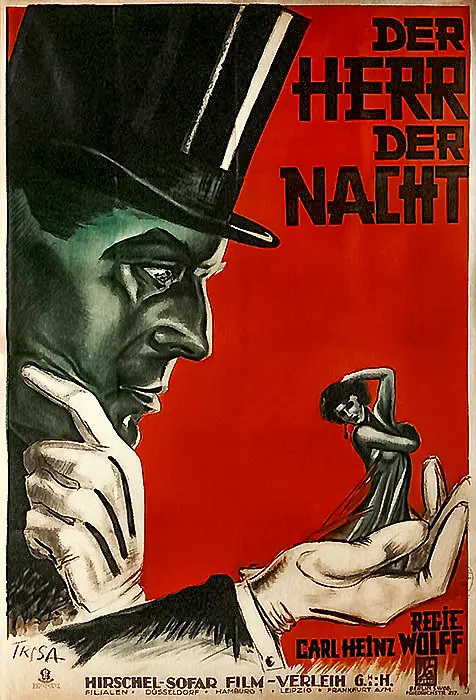
Is Der Herr der Nacht worth your time in the modern era? Short answer: yes, but only if you appreciate the calculated pacing of Weimar-era crime procedurals over the frenetic energy of contemporary thrillers.
This film is a mandatory watch for fans of Rudolf Klein-Rogge and those interested in the evolution of the 'master criminal' archetype in German cinema. However, it is certainly not for viewers who demand high-speed action or the narrative clarity of the Hollywood Golden Age.
1) This film works because the visual hierarchy established by director Carl Boese creates a genuine sense of urban dread that predates the American noir movement by over a decade.
2) This film fails because the second act suffers from a repetitive structure that feels like it is padding for time rather than building tension.
3) You should watch it if you want to see the bridge between the expressionism of the early 20s and the hard-boiled realism that would eventually define 1930s crime cinema.
To discuss Der Herr der Nacht without centering on Rudolf Klein-Rogge would be a critical malpractice. Fresh off his legendary roles in Fritz Lang's epics, Klein-Rogge brings a specific, heavy-lidded intensity to this production. He doesn't just play a criminal; he inhabits a force of nature. In the scene where he first appears in the dimly lit office of his rival, he doesn't move so much as he manifests. It is a masterclass in stillness.
Compare this to his work in Sein letzter Trick, and you see a more grounded, perhaps more cynical version of his screen persona. Here, he is the 'Lord' of the night, and he carries that title with a frightening arrogance. His performance is the anchor that prevents the somewhat thin script from floating into irrelevance.
The rest of the cast, including Theodor Loos and Aud Egede-Nissen, provide a competent, if slightly theatrical, backdrop. Loos, in particular, plays the detective with a rigidity that borders on the robotic. It works. It highlights the contrast between the fluid, adaptive nature of the criminal element and the stiff, outmoded structures of the law.
Visually, the film is a fascinating specimen. By 1927, the jagged, distorted sets of 'Caligari' had given way to 'Neue Sachlichkeit' or New Objectivity. The cinematography in Der Herr der Nacht reflects this shift. The shadows are still there, but they are cast by real buildings and actual streetlamps. There is a tangible grit to the world.
The use of light in the vault sequence is particularly striking. The camera remains static, but the shifting beams of flashlights create a rhythmic, almost percussive visual experience. It is simple. It is effective. It avoids the over-the-top stylization that often makes silent films feel like filmed stage plays.
However, the pacing is where the film shows its age. Unlike the animated energy of El apóstol, which relied on innovative techniques to keep the eye moving, Der Herr der Nacht often lingers on mundane transitions. We see every door opened, every hat removed, and every cigarette lit. For a modern audience, this can feel like wading through molasses.
Yes, Der Herr der Nacht is worth watching for anyone interested in the roots of the noir genre. While it lacks the philosophical depth of Lang's 'M', it offers a fascinating look at how German cinema was transitioning toward realism. It provides a blueprint for the urban thriller that Hollywood would later perfect.
If you are looking for a historical curiosity that still manages to generate genuine suspense in its final act, this is it. It is a moody, atmospheric piece that rewards the patient viewer with a truly haunting performance by its lead.
The screenplay by Ernst Fiedler-Spies and Paul Rosenhayn is a double-edged sword. On one hand, it avoids the melodramatic pitfalls of many contemporary silents like Nobody's Wife. It stays focused on the crime and the hunt. On the other hand, it lacks a strong emotional core. We aren't really rooting for the detective, and we aren't entirely seduced by the criminal.
There is a coldness to the script. It feels like a chess match where the pieces are moved with logic but no passion. This isn't necessarily a bad thing—it fits the 'New Objectivity' style—but it does make the film feel more like an intellectual exercise than a gripping human drama. The stakes are high, but they feel theoretical.
One surprising observation: the film’s treatment of technology. The way the 'Master' uses gadgets and communication to stay ahead of the law is remarkably forward-thinking. It echoes the themes of surveillance and control found in The Splendid Crime, but with a distinctly German preoccupation with order and chaos.
Der Herr der Nacht is a sturdy, well-crafted piece of genre cinema that deserves more than its current status as a footnote. It works. But it’s flawed. It doesn't have the soul-shattering impact of the era's greatest works, but it possesses a quiet, brooding power that is hard to ignore.
"A film that breathes the cold air of the Weimar streets, proving that shadows are often more articulate than words."
If you can get past the initial hurdle of its deliberate speed, you will find a film that is surprisingly modern in its cynicism. It is a reminder that the fascination with the 'gentleman thief' and the 'brilliant criminal' is as old as the medium itself. While it may not be a masterpiece, it is a significant and stylish entry in the history of the thriller.
IMDb —
1914
Community
Log in to comment.