DbcultAccessing Vault...
Cult Review
Senior Film Conservator
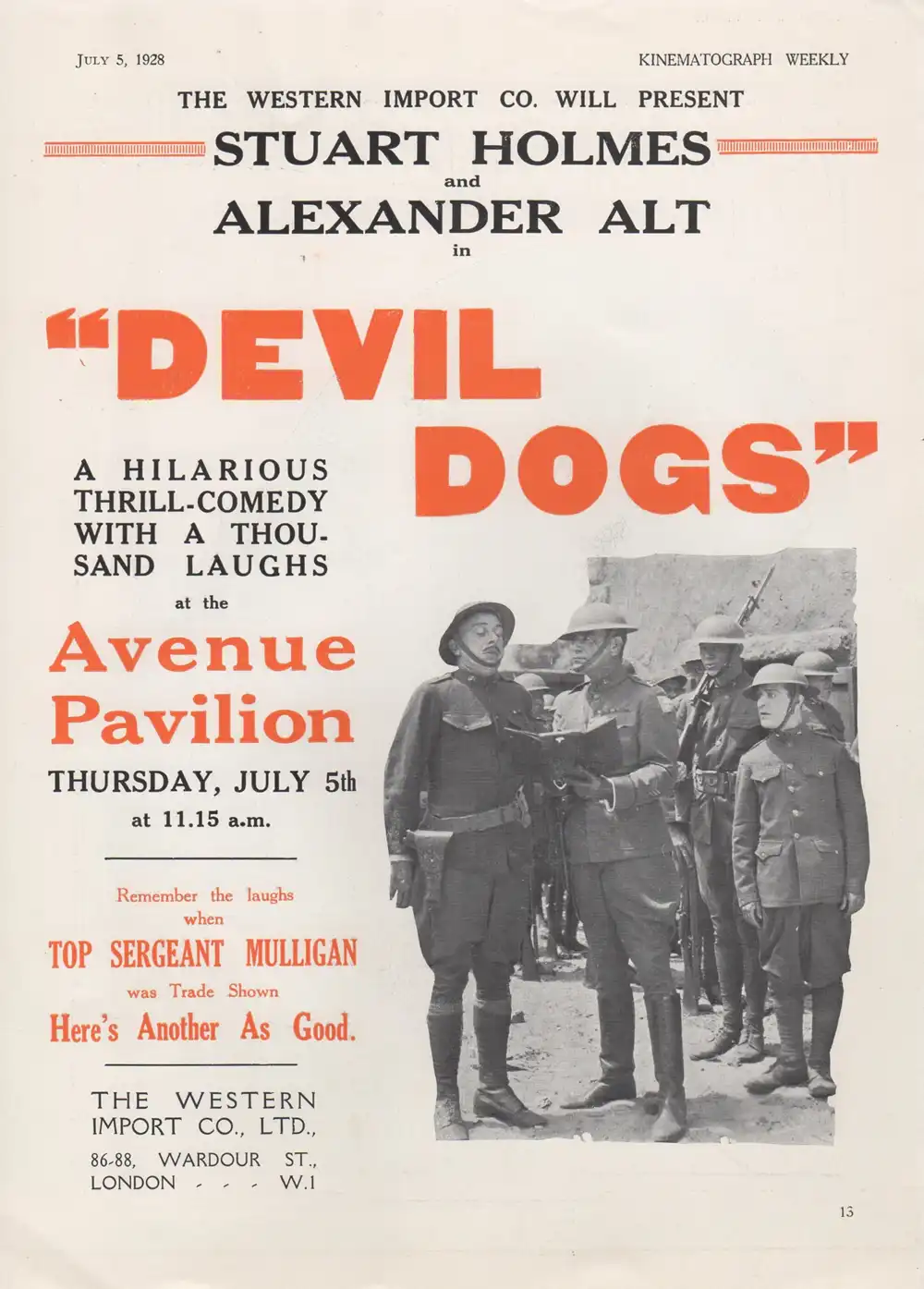
If you have a deep, inexplicable craving to watch men in high-waisted 1920s military trousers march in formation for minutes at a time, Devil Dogs is exactly your thing. For everyone else, it’s a bit of a slog. It’s the kind of movie you watch because you’re interested in the history of the U.S. Marine Corps on film, or because you're a silent film completist who has already exhausted the greats and is now digging through the bins. It’s not a masterpiece, and honestly, it barely holds together as a narrative.
Ernest Hilliard is the lead here, and he has this way of standing that makes him look like he’s swallowed a yardstick. I know, it’s a military movie, and posture is the point, but there’s a difference between military bearing and looking like you’re afraid to move your neck. He spends a lot of the movie looking intensely at things just off-camera, and I couldn't tell if he was supposed to be deep in thought or just trying to remember his next mark. It’s a very different energy than what you see in something like The Man Who Played God, where the silence actually feels heavy with meaning.
The plot is paper-thin. It’s the classic 'tough sergeant vs. rebellious recruit' setup, but without the bite. J.P. McGowan, who also directed this, plays the sergeant. He’s got a great face for it—craggy and impatient—but the script doesn't give him much to do other than look annoyed. There’s a scene early on where they’re in the barracks, and the lighting is so flat it looks like it was shot in a high school gymnasium. You can see the shadows of the equipment on the back wall if you look closely enough during the wide shots.
Pauline Curley shows up as the love interest, and she does that very specific 1920s thing where her entire range of emotion is communicated through how wide she can open her eyes. She’s fine, but the chemistry with Hilliard is non-existent. There is a moment where they’re sitting on a porch, and the edit cuts to a close-up of her hand touching his arm, and it feels so clinical. It’s like the director shouted 'Touch him now!' and she complied because she wanted to go to lunch. It lacks the natural charm you find in some of the lighter films from the same period, like Hot Heels.
What really kills the momentum are the training montages. I get it—it’s 1928, and the audience probably found the sight of real military maneuvers impressive. But it goes on forever. There’s a sequence of the men cleaning their rifles that feels like it’s happening in real-time. My mind started wandering to the background extras. There’s one guy in the third row who keeps glancing at the camera and then looking away really fast, like he’s worried he’s going to get fired. He’s the most interesting person in the frame for about ten minutes.
The titles are a bit much, too. They try to inject this sense of grand patriotism and 'Esprit de Corps,' but it feels forced when the actual scenes are just guys tripping over each other in the dirt. It’s not as visually inventive as Stage Struck, which at least had some flair to its composition. Here, the camera just sits there, watching people walk in and out of the frame like it’s a security camera.
There is one weirdly effective moment near the end, involving a confrontation in the rain. The film stock is grainy, and the way the water catches the light makes everything look suddenly grim and real. For about two minutes, the movie stops being a recruitment poster and starts feeling like a drama. But then it snaps back to the usual heroics, and the feeling is gone.
It’s also worth noting the costumes. The uniforms are great, but the civilian clothes in the early scenes look like they were pulled out of a trunk five minutes before the cameras rolled. Hilliard’s suit in the opening scene is slightly too big in the shoulders, making him look like a kid playing dress-up. It’s a small thing, but once you notice it, it’s hard to take his 'tough guy' persona seriously.
Is it worth it? Only if you’re a student of the era. It’s a functional piece of filmmaking that doesn't have a single poetic bone in its body. It’s the cinematic equivalent of a dry piece of toast. It does the job, but you won't remember it an hour later.
IMDb —
1920
Community
Log in to comment.