DbcultAccessing Vault...
6.2/10
Senior Film Conservator
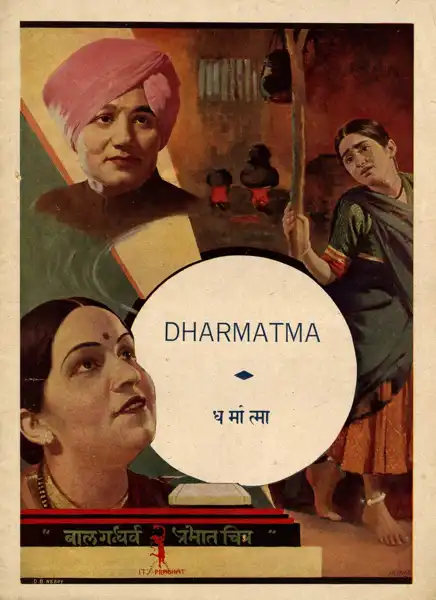
A definitive 6.2/10 rating for a film that redefined the boundaries of cult cinema. Dharmatma remains a cornerstone of transgressive art.
If you have two hours and want to see where Indian social cinema basically started, then yes, Dharmatma is absolutely worth your time. 🎥 But look, if you hate scratchy 1930s audio and actors who gesture like they are trying to signal a ship at sea, you will probably turn this off in five minutes.
It is a movie for patient people who like history. Or maybe just people who want to see a legendary stage actor do something totally unexpected.
The big deal here is Bal Gandharva playing Sant Eknath. Now, if you know your Indian theatre history, Gandharva was famous for playing women on stage.
So seeing him here with a mustache, playing a 16th-century poet-saint, must of been a trip for audiences back in 1935. 😮 He has this incredibly soft, gentle presence that actually works really well for a saint.
The whole plot is about Eknath fighting the caste system. Specifically, he feeds lower-caste people before the Brahmins get their food at a prayer meeting.
This makes the local high-caste priest, played by Chandra Mohan, completely lose his mind with anger. Chandra Mohan has these giant, intense eyes that look like they are about to pop out of his skull.
He plays the villain, Mahant, with so much theatrical menace. Every time he is on screen, the movie gets twice as loud. 🗣️
There is a really awkward but sweet scene where Eknath goes to eat at a lower-caste home. The camera just sort of sits there, watching them eat in silence for what feels like an eternity.
It is not edited like modern movies at all. It is slow, and you can hear the hiss of the old optical track running in the background.
If you are used to the snappy pace of something like Murder on the Blackboard from around the same era, this will feel like it is running in slow motion. But there is a weird, hypnotic rhythm to it if you let yourself sink in.
Then Eknath's own son, Hari Pandit, turns against him. Talk about family drama! 🙄
The son joins the bad guys because he wants to keep his high-society status. The actor playing the son, K. Narayan Kale, looks so incredibly stiff and grumpy the whole time.
He looks like a teenager who was forced to clean his room, not a religious scholar. It is pretty funny, honestly.
The movie really relies on the songs to do the heavy lifting. Eknath sings these abhangas (devotional poems) and that is how he expresses his philosophy.
Even with the terrible sound quality of the surviving prints, the music has this haunting, raw quality. You can feel the weight of the harmonium. 🎹
The climax is basically Eknath defending his life's work by reading poems to a big scholar from Kashi.
It is a very "talky" way to end a movie, but somehow it feels earned. The film doesn't need big action, just a guy reading poetry.
I did notice that the lighting in some of the indoor scenes is surprisingly good. Like, they used real sunlight bouncing off mirrors because early studios did not have great electric lights yet.
It gives the faces this warm, slightly overexposed glow. It makes everyone look a bit ghostly, which I guess fits a saint movie. 👻
Is it a perfect film? Oh, definitely not.
The pacing drags in the middle when the priests are just standing around complaining. And some of the side characters, like the disciples, just sort of blend into the background like furniture.
But Dharmatma has a soul. You can tell V. Shantaram really cared about the message of equality.
It is a piece of history that still has some teeth today. Just make sure you turn the volume up to hear past the static. 🔊
IMDb —
1929
Community
Log in to comment.