DbcultAccessing Vault...
Cult Review
Senior Film Conservator

In the vast, flickering archives of silent cinema, few genres possess the visceral, immediate charm of the domestic comedy, and even fewer manage to elevate the 'animal actor' to the status of a legitimate narrative pivot. Sic 'Em Brownie, directed with a deft hand by Alfred J. Goulding, is a fascinating artifact that bridges the gap between pure slapstick and the more structured 'home defense' subgenre that would later become a Hollywood staple. The film operates on a frequency of pure kinetic energy, utilizing its limited setting—the uncle’s house—as a laboratory for physical experimentation. Much like the tonal shifts found in Little Miss Optimist, Goulding’s work here balances the saccharine qualities of its child stars with a surprisingly sharp-edged sense of mischief.
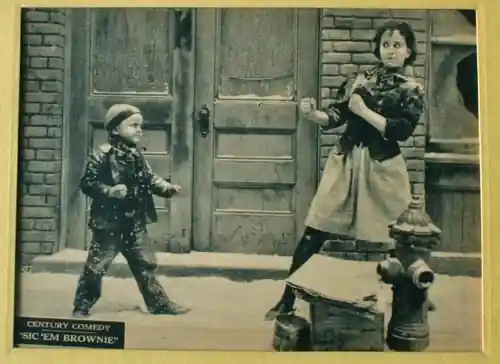
The narrative architecture of Sic 'Em Brownie is deceptively simple, yet its execution reveals a profound understanding of comedic pacing. The first act is dedicated entirely to the 'prank'—a series of escalating vignettes where Jackie and Alberta (the radiant Alberta Vaughn) dismantle the dignity of their uncle’s household. These aren't merely random acts of defiance; they are choreographed disruptions of bourgeois order. While contemporary audiences might find the pacing of early comedies like The Slim Princess to be more leisurely, Goulding opts for a rapid-fire delivery of gags that keeps the viewer in a state of constant anticipation.
Alberta Vaughn, even at this nascent stage of her career, exhibits a screen presence that is both luminous and mischievous. Unlike the more restrained performances in The Saleslady, Vaughn’s energy here is explosive. She navigates the uncle’s home not as a guest, but as a guerrilla operative of the nursery. The chemistry between her and Jack Morgan provides the film with its human heart, though it is the canine element that truly steals the spotlight.
Animal actors in the 1920s were often relegated to background texture or singular, repetitive tricks. Brownie, however, is integrated into the plot with a level of sophistication that rivals the canine leads of later decades. He is not merely a pet; he is the tactical overseer of the household’s defense. When the burglars—played with a wonderful, bumbling menace by the supporting cast—begin their nocturnal plunder, Brownie’s transition from a participant in pranks to a guardian of the hearth is seamless. The way Goulding frames Brownie, often in mid-shot to capture his expressive reactions, suggests a level of intelligence that challenges the human characters' dominance.
This interplay between animal and child is far more dynamic than the somewhat static character beats in Boots. In Sic 'Em Brownie, the dog is the bridge between the children's world of play and the adults' world of consequence. When the burglars start packing their bags, the film shifts into a proto-thriller mode, albeit one filtered through the lens of a funhouse mirror. The use of shadows and the specific geography of the house create a sense of genuine stakes, a technical feat that reminds one of the atmospheric work in The Light at Dusk.
Alfred J. Goulding is a name that deserves more recognition in the pantheon of silent comedy directors. His ability to manage multiple moving parts—children, a dog, and a group of burglars—within a single sequence is nothing short of virtuosic. The climax of the film, where the criminals are trapped through a combination of Brownie’s tenacity and the kids' earlier prank-inspired setups, is a masterclass in narrative payoff. Every bucket of water, every tripwire, and every misplaced item from the first act finds its purpose in the final confrontation.
Compared to the more surreal or poetic approaches seen in European cinema of the time, such as Pan or Pigen fra Palls, Sic 'Em Brownie is unapologetically American in its pragmatism and its celebration of youthful ingenuity. It lacks the brooding existentialism of Der Graf von Cagliostro, opting instead for a populist, high-energy entertainment that prioritizes the 'gag' as the ultimate unit of currency.
Visually, the film utilizes the high-contrast lighting typical of the era to emphasize the 'nighttime' setting. The burglars’ entrance is punctuated by deep blacks and sharp whites, creating a silhouette-heavy aesthetic that enhances the slapstick. There is a specific rhythm to their movements—a rhythmic tiptoeing that feels almost musical, reminiscent of the physical comedy in His Musical Sneeze. However, where that film relies on a singular physiological quirk, Sic 'Em Brownie builds its tension through the accumulation of environmental hazards.
The burglars themselves are an interesting study in the 'gentleman thief' trope gone wrong. They are not the sophisticated villains of The Unapproachable Woman; they are blue-collar bunglers who are fundamentally outmatched by a terrier and two toddlers. This subversion of the criminal threat is what makes the film so enduringly palatable; it reinforces a world where innocence is not just a state of being, but a weaponized force against the corruptions of the adult world.
To view Sic 'Em Brownie today is to witness the birth of a specific comedic template. The trope of the 'invaded home' being defended by its smallest inhabitants would eventually lead to global blockbusters decades later, but the DNA is all here in Goulding’s 1922 short. It possesses a raw, unpolished charm that is often missing from the more refined features like A Szeszély or the atmospheric Sotto i ponti di Parigi. There is no pretension here; the film knows exactly what it is—a vehicle for Alberta Vaughn's charisma and Brownie’s undeniable talent.
The supporting cast, including the formidable Frederick Peters and the reliably funny Bynunsky Hyman, provide the necessary friction for the children to spark against. Hyman, in particular, brings a physicality that complements the frantic energy of the plot. While not as narratively complex as Torchy Comes Through, the film excels in its singular focus. It doesn't attempt to be a sprawling epic; it is a contained, explosive burst of creativity that respects the intelligence of its audience—and its dog.
In the final analysis, Sic 'Em Brownie stands as a vibrant example of the 'Kid and Dog' comedies that dominated the silent era. It eschews the pathos of A Daughter of the Poor in favor of a joyous, chaotic rebellion. The film’s success lies in its refusal to talk down to its younger characters. Jackie and Alberta are the masters of their domain, and Brownie is their loyal, highly capable enforcer.
For those interested in the evolution of physical comedy, this film is essential viewing. It showcases a moment in time when cinema was still discovering the limits of its own kineticism. Whether it’s the perfectly timed trip-up of a burglar or the expressive tilt of Brownie’s head, the film communicates through a universal language of movement and reaction. It is a reminder that sometimes, the most effective cinematic tools aren't elaborate sets or complex dialogue, but a clever child, a bag of tricks, and a very good dog. While it may not have the high-society glamour of A Game Lady, it possesses a grit and a wit that make it far more memorable in the long run. Sic 'Em Brownie is a bite-sized masterpiece of silent slapstick that remains as punchy and delightful today as it was a century ago.

IMDb —
1924
Community
Log in to comment.