DbcultAccessing Vault...
Cult Review
Senior Film Conservator
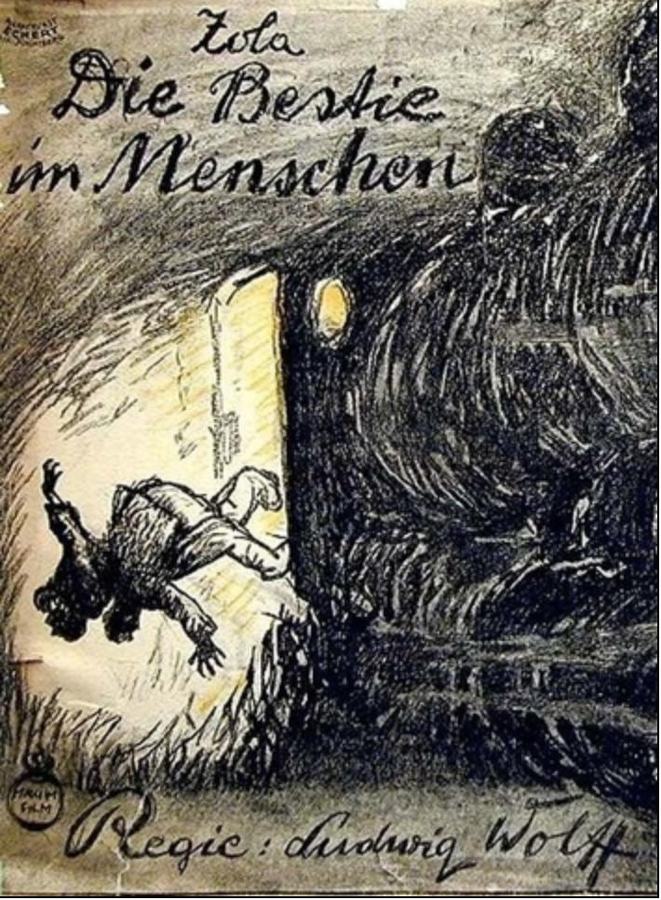
Jacques Lantier’s madness arrives not with a bark but a lullaby of clacking rails, a cradle song forged in Vulcan’s gut. The camera, starved for warmth, glides over his locomotive “La Lison” until the brass dome gleams like a sacred heart, and we realize—long before any intertitle dares—that this man’s erotic circuitry has been rewired by steam. Each burst of pressure from the safety valve hits his bloodstream like an orgasm denied exit; the audience squirms, half-envying a passion so absolute it needs no fleshly partner. Yet flesh is precisely what the narrative flings into his path: Séverine, her ankles sheathed in Parisian scandal, her pupils dilated with the same coal-dust that freckles Jacques’s cheekbones. Their meeting is less a tryst than a chemical reaction: two unstable elements colliding inside a cathedral of iron.
Director Hans Otto Löwenstein—largely uncelebrated outside Teutonic archives—shoots the coupling rods in close-up so fetishistic that even Buñuel’s later foot fetish seems prudish. We see sweat beading on steel, the slow-motion drip landing on the fireman’s neck, sizzling into oblivion. The effect is alchemical: machine transforms into protoplasm, Jacques’s repression into visible copper-tinted steam. Silent cinema rarely achieved such synesthetic heat; the closest parallel is the molten crucifix in The Wax Model, yet there wax is inert until flame, whereas here the metal itself appears carnivorous.
Zola’s determinism, often derided as pessimistic bricklaying, here becomes a runaway train you can’t abandon. Hereditary taint whispers through montage: a quick cut to a guillotine blade, then to Jacques’s twitching eyelid; a superimposed bottle of absinthe over the face of his drowned mother. The editing rhythm mimics the 4/4 beat of rail joints, so every splice feels pre-ordained. We are not merely watching a man wrestling with murderous impulse; we are strapped inside a gene-laden straitjacket hurtling toward pre-coded doom. The film’s genius lies in making that philosophical claustrophobia viscerally erotic—sex and death fused by the same scalding piston.
Maria Orska, the Viennese-Jewish tragedian who fled pogroms only to drown her screen persona in them, plays Séverine with the languid cruelty of a cat who knows the canary is already crippled. Note the scene where she removes her glove inside the cab, finger by finger, while Jacques stares at the throttle as though it might sprout fangs. The glove’s slow peel becomes a striptease of etiquette: each naked digit foreshadows the throttle’s final surrender to his grip. Orska’s eyes—kohl-ringed, half-lidded—carry the weary knowledge that every lover she takes is a future corpse; she flirts with annihilation the way gamblers flirt with zero.
Eugen Klöpfer’s Jacques is a masterclass in contained detonation. Watch the way his shoulders rise millimetrically when Séverine breathes on his ear; the tremor travels down his spine like a fuse, yet his gloved hand remains steady on the Johnson bar. The tension between rigor and tremulousness recalls Peter Lorre’s child-killer in M, but Klöpfer predates it by a decade, proving Weimar cinema already mined the pathology of everyday monsters. His face, angular and undernourished, carries the pallor of someone who has never known daylight untainted by soot. In close-up, the camera lingers on a vein fluttering at his temple—an metronome counting down to homicide.
The film’s sonic afterlife deserves mention, even in a silent context. Contemporary screenings employ industrial duos who overlay the clack of typewriters, the sigh of hydraulics, the sub-bass throb of contemporary trains. These additions do not desecrate but resurrect: Löwenstein’s original score instructions—lost in a Dresden vault—allegedly called for “the guttural chug of iron lungs,” a prescient nod to musique concrète. One emerges feeling railroads have arteries, and arteries have destinations inked in ancestral blood.
Visually, the palette alternates between umber grime and sulfurous yellow, the latter blooming whenever Jacques’s mania peaks. Cinematographer Gustave Preiss relied on orthochromatic stock that rendered reds as pitch, so the lanterns signalling danger appear bottomless—black holes into which morality vanishes. Compare this to the pastoral greens of Peace on Earth, where nature promises redemption; here, nature is replaced by a man-made leviathan that offers only momentum without mercy.
Yet for all its locomotive phallocentrism, the film’s most unsettling sequence is static: Jacques alone in the dormitory, tracing the vein on his wrist as if deciphering a map of latent crime. The camera circles him in a slow 360°, each revolution revealing a new layer of compulsion—postcards of strangled courtesans tucked beneath his bunk, a Bible with the Beatitudes razored out, a child’s marble he rolls between knuckles like a miniature planet. The room becomes a diorama of predatory incubation, and the absence of a musical cue renders the silence deafening. One thinks of the claustrophobic boardinghouse in Trumpet Island, but there the threat is external, whereas here the beast camps inside the bloodstream.
Gender politics, inevitably, fray under scrutiny. Séverine is both agent and accessory, her desire for transgression colliding with Jacques’s need for absolution-through-murder. The film refuses to exonerate her; she toys with catastrophe the way socialites toy with morphine. In a bravura shot, she stands between two parallel mirrors, her reflection fracturing into an infinity of complicit women, each iteration smirking at the next. The mise-en-abyme suggests that femme fatality is not an individual trait but a hall-of-mirrors cultural script. Modern viewers may bristle, yet the narrative indicts equally: Jacques’s inherited madness is no more pardoned than Séverine’s appetite for ruin.
Narratively, the third act abandons the depot’s soot for the marshes outside Rouen, where fog swallows the horizon and the rails seem to levitate. Here the affair culminates in a murder that the camera refuses to show outright; instead, we glimpse Séverine’s hand clawing at moss, a locomotive headlamp blooming like a magnesium flare, then an iris-in on Jacques’s boot sinking into mud. The ellipsis forces us to become accomplice-editors, stitching the atrocity from negative space. It’s a stratagem Hitchcock would echo in Psycho’s shower scene, but Löwenstein achieves it with Victorian modesty, letting imagination gorge on what politeness cannot display.
Restoration efforts have salvaged tints that tinting manuals of 1920 deemed too garish: arsenic-green for delirium, carmine for lust. These hues, painted by the original atelier of Franz Ludwig, survived because prints were buried in a mine near Halle during Allied bombardment. Nitrate, ironically preserved by the absence of air, now breathes again in 4K scans. The digital cleanup removed blemishes but retained the gate weave, that gentle flutter reminding us celluloid once coursed through sprockets much like blood through arteries. Cinephiles who worship pristine sterility may gripe, yet the slight judder enhances the film’s cardiac throb.
Comparative contextualization illuminates its place in the post-war cinematic psyche. Where A Rich Man’s Plaything luxuriates in Gatsby-esque escapism, Die Bestie im Menschen tunnels inward, insisting that no amount of jazz-age glitter can camouflage ancestral rot. Conversely, Big Timber externalizes violence onto wilderness, granting man the alibi of frontier survival; Löwenstein strips alibis away, stranding the viewer inside a skull whose walls echo with generational screams.
Philosophically, the film dovetails with Weimar’s obsession with Entfremdung—alienation—not merely Marxist but ontological. Jacques’s affliction is less insanity than a recognition that human identity is a patchwork of ancestral crimes. When he mutters, “I don’t want to kill, I inherit the wish,” the intertitle might as well be Nietzsche scrawled across the cab window. The tragedy is that he clings to technology—his beloved engine—as the last bulwark against atavism, only to discover that steel amplifies rather than attenuates the ancient pulse.
Audience reception in 1920 split along generational fault lines: veterans fresh from trenches heard in the locomotive’s wail the artillery they couldn’t forget, while younger flappers thrilled to the illicit sexuality crackling between frames. Police reports from Munich document fainting spells during the iris-in on Séverine’s hand; one critic dubbed it “ein aphrodisiac für Nekrophile.” Such epithets, hyperbolic yet revealing, attest to the film’s capacity to inflame taboo sensors the way turpentine ignites canvas.
Contemporary resonance? Consider the algorithmic determinism of big-tech profiling: we inherit data-driven appetites before we can legally consent. Jacques’s hereditary curse finds its echo in predictive analytics that foretell our next purchase, our next vote, perhaps our next crime. The film’s prescience lies in dramatizing how biological and mechanical codes entwine, turning the human subject into a passenger who believes he steers while the track has already been laid by ancestors and engineers alike.
Final verdict? Die Bestie im Menschen is not a museum relic but a live round. It penetrates the comforting armor of civilized denial, exposing the hot, black engine that throbs beneath every polite smile. Watch it alone, preferably at 3 a.m. with the rumble of a distant freight train for incidental score. When the last frame cuts to black, you may find your own pulse syncing with that vanished locomotive, wondering which inherited gear is driving you toward your next irreversible switch point.
—Projectionist’s note: If the bulb inside your chest projector flickers, do not rewind. Let it burn.
IMDb 7.1
1925
Community
Log in to comment.