DbcultAccessing Vault...
Cult Review
Senior Film Conservator
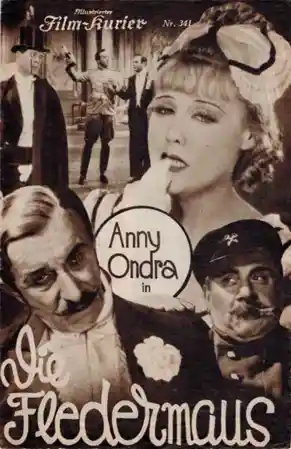
If you like old movies where everyone seems to be vibrating with too much energy, then yeah, give it a look. It’s perfect for a rainy afternoon when you want to see people in 1930s formal wear making terrible life choices.
You will probably hate this if you can't stand operettas or if high-pitched singing makes your ears itch. It’s very loud for a movie that’s almost a hundred years old.
I went into this expecting something stiff and boring because it's based on a stage play from 1874. I was wrong, mostly because Anny Ondra is a total firecracker who doesn't seem to know how to stand still.
The movie starts with a lot of shouting about a legal case and a jail sentence. It’s supposed to be funny, but mostly it just feels like everyone needs a nap.
Then we get to the actual plot, which is basically a giant prank. Dr. Falke wants revenge because Gabriel Eisenstein once left him passed out in a park while dressed as a bat.
That is a specific kind of grudge to hold for years. I respect the dedication to the bit.
Most of the movie takes place at this huge party thrown by Prince Orlofsky. The set looks like it was made of cardboard and glitter, but in a charming way that you don't see anymore.
I noticed that the Prince looks bored out of his mind for the first twenty minutes. He just sits there with this heavy-lidded stare while people dance around him like maniacs.
Ivan Petrovich plays Gabriel, and he has this mustache that looks like it was drawn on with a very expensive marker. He spends most of the party trying to flirt with his own wife because she’s wearing a tiny mask.
It’s one of those movie tropes where a two-inch piece of lace makes a person completely unrecognizable to their own spouse. It’s ridiculous, but the movie leans into it so hard you just have to go along for the ride.
The singing is... a lot. It’s that early sound era recording where everything has a slight hiss in the background.
Sometimes the actors are clearly just mouth-flapping while the music plays over them. It reminded me of some scenes in A Damsel in Distress where the timing feels just a second off.
There is a scene with a clock that goes on for way too long. Gabriel is trying to use the clock to impress a girl, and I swear they showed the same three reactions shots five times.
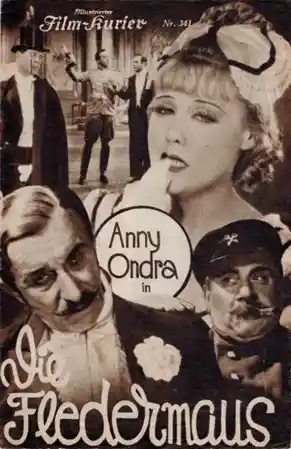
Anny Ondra plays Adele, the maid who steals her boss’s dress to go to the party. She has this manic laugh that is actually kind of infectious.
Every time she’s on screen, the movie feels alive. When she’s not, it feels a bit like a museum exhibit about how people used to dress for dinner.
The jailer character in the final act is clearly there for the 'funny drunk' archetype. He stumbles around and talks to himself, and it’s the kind of physical comedy that was probably hilarious in 1931 but feels a bit clunky now.
I found myself looking at the background extras more than the main actors sometimes. There is one guy in the ballroom who looks like he’s trying to remember if he left the stove on back at his apartment.
The pacing is weirdly fast at the start and then just stops dead once they get to the prison. It’s like the movie forgot it had to end and just started looping the same jokes.
If you’ve seen Soft Shoes, you know how these early comedies can feel a bit disjointed. *Die Fledermaus* has that same problem where scenes don't really transition; they just happen.
One thing I really liked was the costume design. The dresses are so heavy with beads that you can almost hear them clinking through the speakers.
It’s a very 'theatrical' film, meaning they didn't try to make it look like real life. It feels like you are sitting in the front row of a theater, which is either great or annoying depending on your mood.
I did notice a weird shadow on the wall during the big 'Champagne' song. It looks like a boom mic or maybe just a very tall extra standing in the wrong place.
Is it better than Ham and Eggs at the Front? Absolutely. It has a lot more class, even if it is just as silly.
The ending is a bit of a letdown because everything just gets resolved by people saying 'Oh, it was just the champagne!' as if that excuses everything. I guess that’s just how things worked back then.
Overall, I'm glad I watched it. It’s not a masterpiece, but it’s got a weird soul to it that makes modern musicals feel a bit too polished and fake.
Go for it if you want to see Anny Ondra be a legend and some guys in tuxedos act like toddlers. Just don't expect the plot to make any sense after the second bottle of fake wine appears on screen.
"Glücklich ist, wer vergisst, was doch nicht zu ändern ist!" (Happy is he who forgets what cannot be changed!)
That’s basically the motto of the whole movie. And honestly? Not a bad way to live for ninety minutes.
IMDb —
1928
Community
Log in to comment.