DbcultAccessing Vault...
Cult Review
Senior Film Conservator
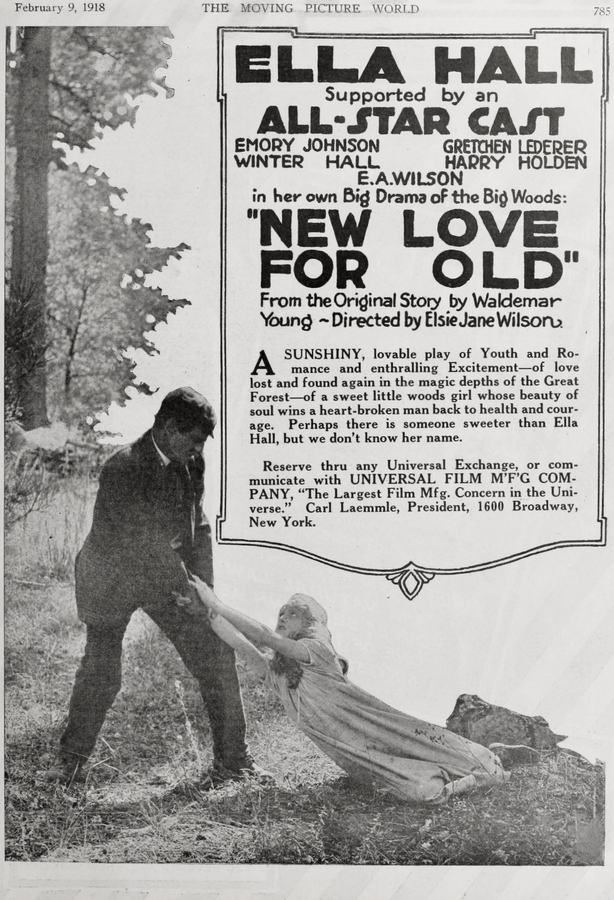
A Landscape of Emptiness and Renewal
Waldemar Young’s New Love for Old (1920) is a masterclass in visual storytelling, where alpine ridgelines and forest canopies become metaphors for emotional ascents and descents. The film’s opening sequence—a close-up of Kenneth Scott’s (Emory Johnson) trembling hands releasing a love letter into a mountain stream—establishes a motif of relinquishment that reverberates through the narrative. Marie Beauchamp (Ella Hall), with her fox-like eyes and languid gestures, embodies the archetype of the dangerous older woman, yet Young resists reducing her to mere villainy. Her abandonment of Kenneth isn’t portrayed as cruelty, but as a tragic disconnection between a man seeking permanence and a woman addicted to transience.
The Poet as Moral Compass
Doc Podden (E. Alyn Warren), the wandering poet, serves as both narrative bridge and ethical anchor. His recitations of Tennyson’s In Memoriam while trudging through snowdrifts provide a lyrical counterpoint to Kenneth’s growing despair. The interplay between Podden’s stoic wisdom and Kenneth’s romantic idealism recalls similar dualities in The Weakness of Man, though Young’s approach is less didactic. When Podden advises Kenneth, “The heart is a compass that points north, but the soul must find its latitude,” the dialogue transcends cliché, offering a nuanced meditation on agency in love.
Daphne Sawyer: The Illusion of Salvation
Gretchen Lederer’s Daphne is a character of exquisite contradictions—her apron-clad practicality masks a vulnerability that mirrors Kenneth’s. Their courtship unfolds in a series of meticulously composed tableaux: a shared mug of coffee by the hearth, a hesitant touch on a plow’s handle during a blizzard. Yet Young deliberately withholds the viewer’s full sympathy, hinting through subtle glances that Daphne’s affection is as much about rescuing Kenneth as it is about self-preservation. This ambiguity reaches its apex when Louis Bracchi’s (Harry Holden) harassment of Daphne becomes less a plot device than a catalyst for Kenneth’s self-realization.
“Love is not a rescue mission,” Lederer’s character seems to whisper in a deleted scene’s shadow—their final confrontation in the film’s climax a silent scream of recognition that her ‘savior’ is merely another projection of his wounded ego.
The Architecture of Betrayal
The revelation that Daphne is Marie’s sister—delivered with a single, lingering glance between the two women—is the film’s most audacious twist. Young avoids melodrama by framing this disclosure through the lens of Kenneth’s perspective: the world tilts as he processes this truth, the camera swirling in a disorienting 360-degree shot that echoes the psychological vertigo of his disillusionment. This narrative pivot invites comparisons to The Iron Ring, yet Young’s treatment remains more introspective, focusing on the protagonist’s internal unraveling rather than external conflict.
Cinematic Alchemy: Light and Shadow
The film’s visual style is a triumph of silent cinema’s unspoken language. In the roadhouse sequence, flickering kerosene lamps cast Marie in a golden glow, her silhouette a ghostly echo of temptation. By contrast, the forest village is bathed in cool, unadorned light—Daphne’s cottage windows frame her in sharp, almost clinical clarity, symbolizing the starkness of her familial truth. Cinematographer Otto Hagius’ use of negative space in these scenes is nothing short of revolutionary; Kenneth is often shot alone in vast landscapes, his isolation literalized through composition.
Echoes in the Genre Landscape
While Young’s work shares thematic DNA with A Girl of Yesterday—both explore the tension between youthful idealism and adult pragmatism—New Love for Old distinguishes itself through its structural daring. The absence of intertitles in the final act, replaced by a wordless duet between Kenneth and Daphne as they pack their belongings, is a radical choice that prioritizes emotional resonance over exposition. This stylistic risk pays dividends, creating a universal language of heartbreak that transcends the film’s 1920s origins.
The Unresolved Question of Redemption
The film’s closing image—Kenneth walking away from the village, Podden’s hat billowing in the wind—refuses to offer solace. Unlike Rip Van Winkle, which concludes with a return to normalcy, New Love for Old leaves its protagonist in a state of perpetual transition. The final shot of the mountain resort, now shuttered and overgrown, serves as a stark reminder of impermanence. Young’s message is clear: love is not a destination, but a series of departures and arrivals, each carrying the weight of the last.
In this light, the film’s title acquires a double meaning—not merely a trade of one affection for another, but the inevitable erosion of all attachments by time and truth.
Legacy in the Silent Film Pantheon
Despite its 1920s release date, New Love for Old feels startlingly modern in its psychological complexity. The film’s treatment of familial secrets predates the narrative techniques of Mixed Blood by a decade, and its exploration of emotional dislocation anticipates themes in The Trail of the Shadow. Yet what sets Young’s work apart is its refusal to villainize its female characters—a progressive stance for the era that invites comparison to the more reductive portrayals in At the Cross Roads.
Performances That Transcend the Medium
Ella Hall’s Marie is a revelation, her performance balancing charm and detachment with a precision rarely seen in silent film acting. Her final scene—where she watches Kenneth’s departure from a distant ridge—uses minimal facial expressions to convey maximal regret. Winter Hall, as the poet, delivers a performance of quiet intensity, his physicality conveying a wisdom that words could not. But it is Emory Johnson who anchors the film; his portrayal of Kenneth’s emotional evolution is a masterclass in physical acting, from the stiff, overcorrecting posture of the jilted lover to the more fluid, grounded movements of a man finding peace in impermanence.
A Timeless Meditation on Love’s Illusion
In an age where cinema often reduces love to a transactional equation, New Love for Old offers a more nuanced perspective. Young’s film suggests that love is not a binary state but a spectrum of experiences—each relationship a color in a larger mosaic of human connection. The film’s enduring power lies in its ability to make us question not just the objects of our affection, but the very nature of desire itself. As the final credits roll over the sound of a lone violin, one is left not with answers, but with a profound appreciation for the beauty of the question.
IMDb —
1926
Community
Log in to comment.