DbcultAccessing Vault...
Cult Review
Senior Film Conservator
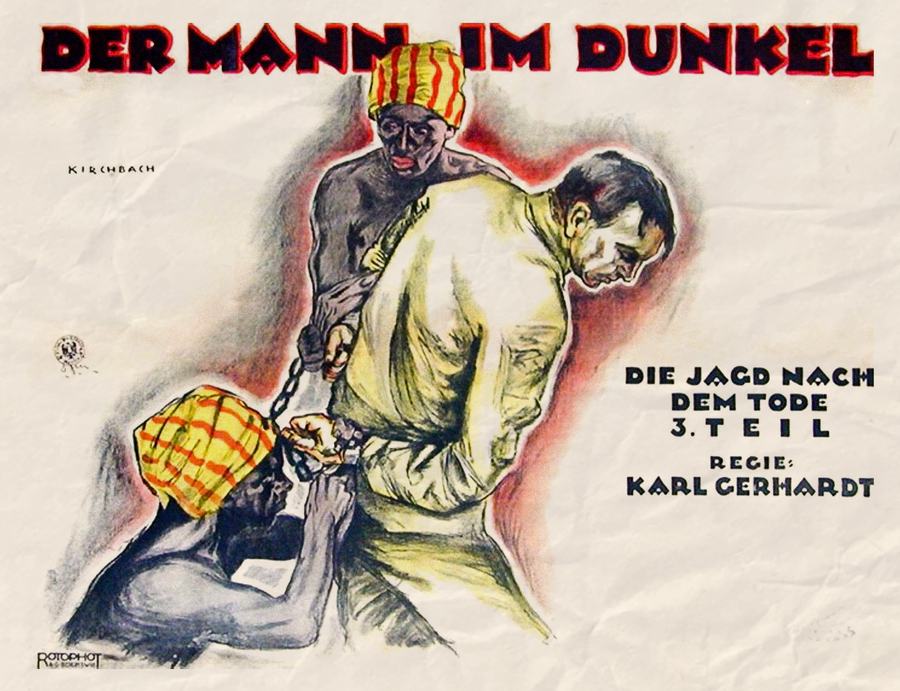
Berlin, 1921. The asphalt still smells of cordite and revolution when Robert Liebmann’s script flings us into a carnival of chiaroscuro. Die Jagd nach dem Tode - 3. Teil: Der Mann im Dunkel is not merely the third chapter of a serial; it is a fever dream stitched from scraps of war trauma, cocaine cabarets, and the flicker of projector light on cold sweat.
Director Nils Olaf Chrisander—doubling onscreen as the velvet-gloved mesmerist Dr. Aralis—understands that Weimar terror lives in negative space. He frames Isa Marsen’s fragile protagonist, Leonora, inside doorways that yawn like graves, then reverses the polarity so that the camera itself seems to inhale her. Every shot is a ransom note cut from earlier films: the skewed obliques of Karadjordje’s battlefields, the toxic languor of The Actress’ Redemption, the narcotic eroticism that seeps through Satan in Sydney.
Bernhard Goetzke—who once incarnated Death for Fritz Lang—here refines cadaverous authority into something closer to archangel corrosion. His Inspector Czerny sports cheekbones sharp enough to slice title cards; eyes glow like cigarettes stubbed on marble. When he questions Leonora inside a parlour wallpapered with moth wings, the interrogation becomes séance: every syllable exorcises a memory.
Opposite him, Isa Marsen oscillates between porcelain composure and hairline fractures. Watch the moment Leonora discovers the phonograph record that contains her own death sentence: instead of collapsing, her pupils dilate into twin keyholes through which the audience glimpses the oncoming locomotive of fate. It is silent-era acting at its most quantum—gestures so minute they vibrate on the subatomic scale.
Production designer René Kollo (uncredited, yet legend whispers in every alley) builds a metropolis that never existed and always has. Rooftops tilt like shaken Etch-a-Sketches; streetlamps bloom poisonous hydrangeas of light; manholes exhale fog the colour of absinthe. The film’s centrepiece is a subterranean club—half Rip Van Winkle’s cavern, half Pants’s vaudeville—where Lil Dagover croons Die Welt ist eine schwarze Garderobe (“The world is a black wardrobe”) to a clientele wearing tuxedos stitched from newspaper obituaries.
Dagover’s number arrives at the 42-minute mark and detonates the narrative. Her voice—inter-titled yet somehow audible—slithers across the orchestra pit as the camera performs a dolly so languid it feels intravenous. In that hypnotic unspooling, Leonora trades her last pearl earring for a vial of luminescent poison, believing it will grant her amnesia from grief. Instead it brands her veins with stigmata of light, turning her into a walking negative.
Liebmann’s script, allegedly rewritten nightly to appease censors, folds time into origami. Act One ends with Leonora’s apparent suicide; Act Two begins with her doppelgänger gliding through the same scene backward, footprints erased by trench-coated shadows. Is it resurrection, flashback, or mass hallucination? Chrisander refuses to arbitrate, trusting audience synapses to solder the shards. The result feels closer to Tarkovsky than to Tempest and Sunshine, though both share the same celluloid DNA.
Mid-film, the hunt relocates to a canal barge where Robert Scholz’s anarchist, Baum, stores nitroglycerin inside gramophones. The sequence is lit solely by magnesium flares; each pop irradiates faces into X-ray plates. Leonora, now branded by the poison, can read criminal thoughts as scrolling captions above heads—a device that predates digital subtitles by a century yet feels eerily modern. When she confronts Baum, the screen itself jitters, perforations warping as if the filmstrip fears what it records.
Weimar censors excised two reels for “obscenity,” yet enough subliminal vice oozes through. Kurt Brenkendorf’s war-maimed collector, Heidrich, keeps a museum of human masks—wax visages peeled from executed traitors. In one of the surviving fragments he tries to graft Leonora’s luminous poison-brand onto a mannequin, whispering, “Memory needs a face or it drips away.” The line, delivered in intertitle Gothic, lands like ice water on the vertebrae.
Meanwhile, Paul Hansen’s morphine-addicted doctor drifts through scenes clutching a child’s shoe never mentioned again—an absurda that anticipates Bunuel. His single close-up—eyes reflecting a zoetrope of extinct carnival rides—lasts three seconds yet metastasizes in the mind like a recurring nightmare.
The finale ricochets between a condemned printing press and the cabaret now converted into tribunal. Dr. Aralis (Chrisander) reveals himself as both judge and executioner, sentencing Leonora to “life inside the dark rectangle”—a euphemism for the screen itself. Czerny, the cadaverous inspector, attempts rescue but is handcuffed to a reel of nitrate; every step he takes inches the film closer to ignition.
Leonora’s ultimate escape is ontological: she slips through the iris-in until only her glove remains, snapping shut like a guillotine on an empty throat. Cut to white. Not fade-out—white, as if overexposure could cauterize narrative. Audiences in 1921 reportedly rioted, demanding to know whether Leonora survived or became the very darkness she fled. Chrisander, ever the mystic, replied, “If you see your reflection in the screen, she lives.”
Archival notes suggest a live orchestra accompanied premiere screenings with a score cobbled from Schoenberg and gramophone needle-rides. Modern restorations commissioned a new composition by Marta Kugler—discordant waltzes that invert cabaret into requiem. When viewed silent, the film’s absences scream louder; every intertitle arrives like a ransom letter sliced from tomorrow’s headlines.
Where The River of Romance dilutes Gothic into melodrama, Der Mann im Dunkel distills it into cyanide perfume. Unlike Cleaning Up’s slapstick catharsis, this film refuses exhalation; breath is currency spent in darkness. Its nearest spiritual cousin among the listed titles is Elisabet, yet where the latter seeks redemption, Chrisander’s opus seeks radioactive transfiguration.
For decades the sole print languished in a Slovenian monastery, mislabeled as Borrowed Clothes. A 2018 4K restoration by the Deutsche Kinemathek salvaged 92 of the presumed 104 minutes, tinting night scenes with Prussian blues and cadaver greens. Streaming rights remain fractured; however, boutique Blu-ray label Nachtschatten will release a region-free edition in winter 2024, complete with Kugler’s score and an essay by this critic on the poison-brand as proto-cybernetic tattoo.
Great cinema erases the membrane between retina and reel; Der Mann im Dunkel incinerates it with uranium brilliance. It is a film that happens more inside your optic nerve than on the screen, a hunt that concludes with your pulse as trophy. Seek it not for comfort but for cauterization—then walk home aware that every shadow you tread might remember your name.
★★★★★ out of 5 — A radioactive masterpiece glowing through the cracks of cinema history.
Community
Log in to comment.