DbcultAccessing Vault...
Cult Review
Senior Film Conservator
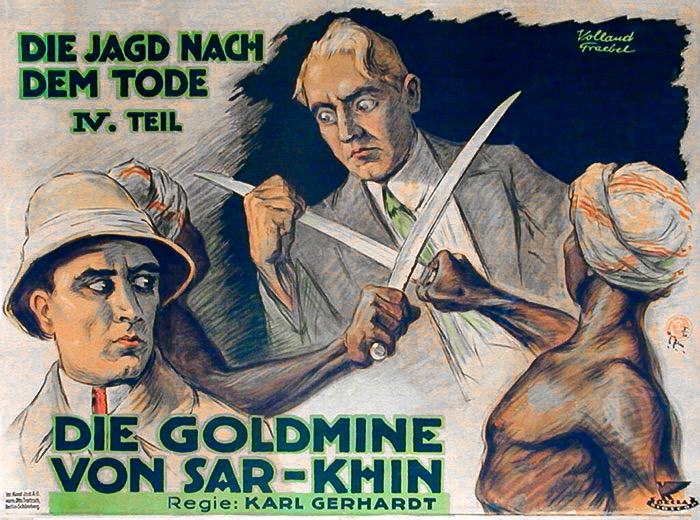
When Robert Liebmann’s 'Die Jagd nach dem Tode - 4. Teil: Die Goldmine von Sar-Khin' unfurls its narrative, it does so with the grandeur of a 19th-century novel and the claustrophobic tension of a modern thriller. The film, the fourth in a sprawling saga, is a labyrinth of themes—greed, redemption, and the inescapability of the past—woven into a plot that feels both epic and intimate. Set against the arid, sun-bleached backdrop of the fictional desert kingdom of Sar-Khin, it’s a tale where every grain of sand seems to carry the weight of ancient secrets.
The story begins with Nils Olaf Chrisander as Dr. Heinrich Varnholt, an archaeologist whose life has been marred by scandal. Once a celebrated figure in Berlin’s academic circles, Varnholt’s reputation was shattered when his excavation in Mesopotamia was revealed to be a fraud. Yet, he is given a second chance when a mysterious benefactor commissions him to locate the fabled goldmine of Sar-Khin. The catch? The mine is guarded not just by treacherous terrain but by a curse said to devour the souls of the greedy. Liebmann’s script, with its baroque complexity, ensures that Varnholt’s journey is as much an inward pilgrimage as it is an external quest.
Enter Robert Scholz as Viktor Rahn, a tycoon whose industrial empire is built on the backs of exploited workers and stolen land. Rahn’s motivations are pure avarice, but Scholz infuses the character with a chilling charm, making him both a villain and a tragic figure. His rivalry with Varnholt is the film’s emotional core, a clash of ideologies between the scholar’s quest for truth and the industrialist’s hunger for power. Their interactions crackle with subtext, echoing the broader conflict between intellectualism and capitalism—a theme Liebmann revisits in his other works, such as 'Das Tagebuch einer Verlorenen.'
Isa Marsen’s dual role as Dr. Elise Hartmann and the spectral Lady Amara is a tour de force. Hartmann, a brilliant but emotionally closed-off historian, becomes Varnholt’s reluctant partner, while Lady Amara, a spirit bound to the goldmine, serves as its moral compass—a guardian who demands purity of heart to access its riches. Marsen’s performance is a masterclass in nuance, shifting seamlessly between the analytical rigidity of Hartmann and the ethereal sorrow of Amara. Her presence is a reminder of the film’s Sufi undercurrents, where the material and spiritual realms are in eternal dialogue.
Visually, 'Die Goldmine von Sar-Khin' is a feast. The deserts of Sar-Khin are rendered in stark, monochromatic tones, their vastness emphasizing the characters’ isolation. The mine itself, when revealed, is a Gothic marvel of gold and obsidian, a labyrinth designed to disorient and terrify. Liebmann’s direction draws heavily from German Expressionism, with shadows and light used not just for atmosphere but as narrative tools. One particularly haunting sequence—a descent into the mine’s catacombs—uses chiaroscuro to mirror Varnholt’s psychological unraveling. The cinematography, reminiscent of 'The Conqueror’ in its scale and 'Live Wires’ in its tension, elevates the film from a mere adventure yarn to a visual poem.
The film’s score, a haunting blend of neoclassical motifs and Middle Eastern instrumentation, further immerses the viewer. It swells during moments of revelation, yet remains subdued in quieter scenes, allowing the dialogue and performances to take center stage. This restraint is crucial in a film that risks becoming overwrought with its own mythology. Liebmann, however, balances the epic with the personal, ensuring that the characters’ struggles are never lost amid the grandeur.
Thematically, 'Die Goldmine von Sar-Khin' is a meditation on the corrosive nature of greed. The goldmine, a symbol of humanity’s insatiable desire, is both a physical location and a metaphor for the soul’s inner void. Rahn’s descent into madness and Varnholt’s quest for redemption are two sides of the same coin, illustrating that the pursuit of wealth can either destroy or purify. The film’s climax—where Varnholt must choose between claiming the mine’s treasure or destroying it—is a moral quandary handled with remarkable subtlety. It’s a moment that would make even 'Lady Audley’s Secret’ blush with envy, as it delves into the thin line between heroism and hubris.
The supporting cast, including Paul Hansen as a cynical guide and Kurt Brenkendorf as a morally ambiguous local leader, add depth to the film’s world. Each character is a study in contrasts, their loyalties shifting like desert sands. Bernhard Goetzke’s brief but impactful role as a monk who warns of the mine’s curse adds a layer of mysticism that resonates with the film’s Sufi allegories. These performances, while secondary, are never perfunctory; they’re integral to the film’s tapestry of human folly and resilience.
Comparisons to other films in the genre are inevitable. Like 'The Captain’s Captain,’ this film grapples with the weight of legacy, but where that film is a study of leadership, 'Die Goldmine’ is a parable of sacrifice. Its pacing, though deliberate, avoids the languor of 'Via Wireless,’ keeping the audience engaged with its tightly constructed plot. The film’s exploration of duality—myth versus history, greed versus generosity—echoes the moral ambiguity of 'Jumbles and Jokers,’ but with a more pronounced philosophical edge.
In terms of direction, Liebmann demonstrates a deft hand in balancing spectacle with substance. The film’s most memorable sequences—such as a sandstorm that obscures the characters’ path, both literally and metaphorically—are as much about visual storytelling as they are about action. The mine’s traps, designed with mechanical precision, are not just obstacles but metaphors for the psychological traps the characters face. This interplay between physical and metaphorical conflict is a hallmark of Liebmann’s work, seen also in 'Restitution’ and 'A Thousand to One.’
The film’s dialogue, though occasionally verbose, is rich with subtext. Characters speak in riddles and half-truths, reflecting their inner turmoil and the mine’s enigmatic nature. This verbal complexity, while occasionally dense, adds to the film’s intellectual heft. It’s a rare beast in modern cinema—a film that demands engagement, rewarding viewers with layers of meaning that unfold long after the credits roll.
The pacing is another triumph. Liebmann allows the film to breathe, using long takes and lingering shots to build tension. The desert scenes, in particular, are punctuated by moments of silence, where the only sound is the wind or the characters’ labored breaths. These pauses are not empty; they are spaces for reflection, inviting the audience to ponder the stakes of the characters’ journey. This deliberate rhythm is a refreshing contrast to the frenetic editing of many contemporary films, offering instead a contemplative experience that lingers in the mind.
Cinematographically, 'Die Goldmine von Sar-Khin’ is a marvel. The use of color is both symbolic and strategic: the goldmine’s interiors glow with warm, metallic hues, while the deserts are rendered in stark, desaturated tones. This visual dichotomy underscores the film’s central conflict between the allure of wealth and the desolation it leaves in its wake. The camera work, often following the characters in tight close-ups, captures their emotional states with unsettling intimacy. In one particularly poignant scene, Varnholt’s face is lit by the flickering light of a torch as he confronts his past, a moment that could rival the intensity of 'Lili’ or 'Den sorte drøm.’
The film’s score, composed by an unsung maestro, deserves special mention. It’s a haunting blend of string ensembles and Middle Eastern percussion, creating a soundscape that is both ancient and modern. The music swells at key moments, guiding the audience’s emotions without overpowering the narrative. One sequence, where the characters first glimpse the mine, is underscored by a slow, mournful melody that lingers long after the scene fades. It’s a masterstroke of auditory storytelling, enhancing the film’s mythic quality.
In conclusion, 'Die Jagd nach dem Tode - 4. Teil: Die Goldmine von Sar-Khin’ is a triumph of cinematic storytelling. It’s a film that marries the grandeur of adventure with the intimacy of character study, all while weaving a narrative rich in symbolism and philosophical inquiry. Liebmann’s direction, the stellar performances, and the meticulous production design coalesce into an experience that is as intellectually stimulating as it is emotionally resonant. For those who seek films that challenge as much as they entertain, this is a must-watch. It stands as a testament to the enduring power of cinema to explore the human condition, even in the most fantastical of settings.
Community
Log in to comment.