DbcultAccessing Vault...
5/10
Senior Film Conservator
A definitive 5/10 rating for a film that redefined the boundaries of cult cinema. God and the Man remains a cornerstone of transgressive art.
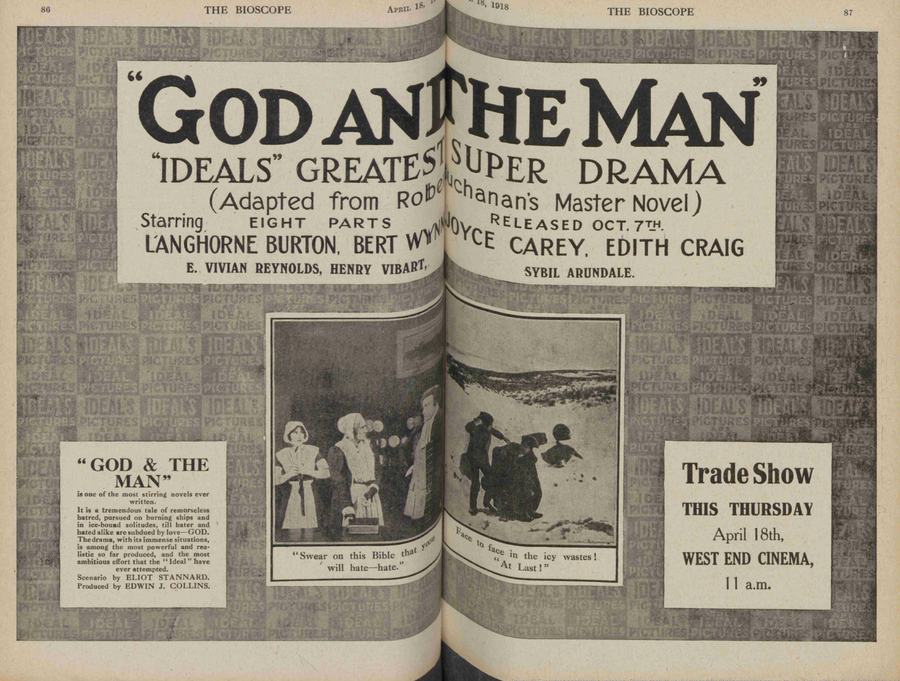
In the pantheon of British silent cinema, few works attempt the sheer thematic gravity found in the 1918 adaptation of Robert Buchanan’s novel, God and the Man. Scripted by the prolific Eliot Stannard, a man whose pen shaped much of the early British filmic identity, this production is a staggering instance of how early cinema grappled with the heavy weight of Victorian morality while simultaneously pushing the boundaries of location-based storytelling. To watch this film today is to step into a time capsule of visceral emotion, where the silence is not an absence of sound, but a presence of heightened visual rhetoric.
The narrative begins in the lush, albeit socially stratified, landscapes of the English countryside. We are introduced to a world of squires and ancient lineages, a setting that feels as rigid as the laws of the Old Testament. The central conflict—a blood feud that has fermented over generations—finds its catalyst in the seduction of the protagonist’s sister. This act of violation is not merely a personal affront but a symbolic shattering of the Christianson family’s honor. Langhorn Burton, portraying the squire's son, delivers a performance of simmering intensity, his face a canvas of escalating obsession. Much like the vengeful spirits found in The Merchant of Venice, his pursuit of justice quickly curdles into a thirst for retribution that threatens to consume his very humanity.
What distinguishes God and the Man from contemporary domestic dramas like The Hope Chest or the whimsical innocence of Little Lord Fauntleroy is its sudden, jarring shift in geography. The pursuit leads our protagonist away from the comforting greenery of England to the terrifying, achromatic expanse of Labrador. This transition is handled with a surprising degree of cinematic fluidity for 1918. The Labrador sequences, though likely filmed in less exotic locales, effectively utilize the stark contrast of light and shadow to evoke a sense of cosmic isolation. Here, the film sheds its societal trappings and becomes a survivalist nightmare.
The casting is particularly noteworthy. Sybil Arundale and Edith Craig bring a grounded, almost theatrical gravitas to their roles, ensuring that the domestic stakes remain palpable even as the film ventures into the wilderness. Joyce Carey, as the wronged sister, provides the emotional core, her performance avoiding the overly stylized gesticulations that often plague silent-era melodramas like Smerch lyubovnyy. Instead, there is a quiet dignity to her suffering that fuels the protagonist's fire.
The middle act of the film is where the direction truly shines. The pursuit through the snow is not merely a physical chase but a spiritual deconstruction. As the characters move further from civilization, the distinctions between "God" and "Man"—as suggested by the title—begin to blur. Are we witnessing a divine punishment, or the simple, cruel mechanics of nature? The cinematography captures the vastness of the ice with a sense of dread that predates the psychological horrors of later decades. In this regard, it shares a certain rugged DNA with The Trail of the Lonesome Pine, though it replaces the Appalachian folk-feud with a more existential, maritime coldness.
Stannard’s screenplay understands the power of the visual metaphor. The ice is not just ice; it is the frozen heart of the protagonist. The seducer, played with a slippery, aristocratic menace by Nelson Ramsey, becomes a mirror for the protagonist’s own failings. By the time the two men are isolated in the frozen wastes, the film has transcended its plot of revenge and entered the realm of the morality play. Unlike the lighter fare of Audrey or the urban grit of Rafaela, God and the Man demands a profound engagement with the concept of forgiveness.
Technically, the film is a marvel of its era. The use of tinting and toning—though often lost in degraded prints—would have originally provided a psychological landscape for the viewer: warm ambers for the English hearth and chilling blues for the Labrador nights. The editing rhythm is deliberate, allowing the tension to mount as slowly as a glacier. There is a palpable sense of weight to every frame, a stark contrast to the kinetic, almost frenetic energy found in early slapstick or action-oriented shorts like Balgaran e galant.
The supporting cast, including Henry Vibart and E. Vivian Reynolds, anchors the film in a believable social reality. They represent the world that the protagonist has left behind, a world of rules and expectations that mean nothing in the face of a blizzard. This juxtaposition between the "civilized" man and the "natural" man is a recurring theme in Buchanan’s work, and the film captures it with surprising nuance. It avoids the simplistic moralizing of The Poor Little Rich Girl, opting instead for a grey area where the line between hero and villain becomes dangerously thin.
One cannot discuss God and the Man without acknowledging its place in the evolution of the British screen narrative. During a period where British cinema was often overshadowed by the burgeoning spectacle of Hollywood—exemplified by films like The Forbidden City—this production stood its ground as a uniquely European endeavor. It possesses a literary soul, a depth of character that feels distinctly Dickensian yet infused with a more modern, bleak sensibility. It lacks the fairytale artifice of Dick Whittington and his Cat, choosing instead to wallow in the mud and the slush of human experience.
The film’s climax is a masterclass in silent tension. Without the aid of dialogue, the actors must convey a total shift in worldview—from hatred to a reluctant, shared humanity. It is a moment of profound catharsis that feels earned. This isn't the easy resolution of Der Lumpenbaron; it is a hard-won peace that leaves the characters, and the audience, forever changed. The final shots linger on the landscape, suggesting that while the men may have found a resolution, the earth remains as cold and indifferent as ever.
While God and the Man may not enjoy the same household recognition as the works of Griffith or Murnau, it remains a vital piece of the cinematic puzzle. It bridges the gap between the theatrical traditions of the 19th century and the visual storytelling of the 20th. It explores the dark recesses of the human psyche with a boldness that is still striking over a century later. For those interested in the roots of the psychological thriller or the survival drama, this film is essential viewing. It is as raw and unvarnished as A Naked Soul and as culturally specific as The Red Woman, yet it speaks to universal truths about the corrosive nature of hate.
In the end, the film asks us: what is left of a man once he has achieved his revenge? The answer provided by the icy shores of Labrador is a haunting silence. It is a film that demands to be seen not as a relic, but as a living, breathing document of human struggle. It captures a moment in time when cinema was discovering its power to not just show us the world, but to show us the interiority of the soul. Much like the documentary realism of The Pendleton, Oregon, Round-Up, there is an authenticity here that cannot be manufactured—a sense that the actors and the crew were truly wrestling with the elements, both physical and emotional.
God and the Man stands as a testament to the power of the silent image. It is a harrowing, beautiful, and ultimately redemptive journey that proves that even in the coldest of climates, the human spirit—for better or worse—remains a fire that cannot be easily extinguished.
IMDb 6.1
1923
Community
Log in to comment.