DbcultAccessing Vault...
Cult Review
Senior Film Conservator
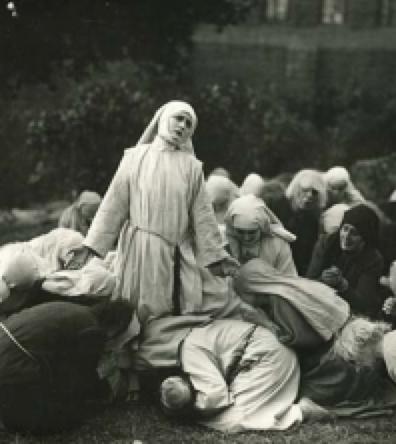
The first time I saw Die Legende von der heiligen Simplicia, in a damp Paris cinémathèque print that smelled of vinegar and incense, I understood why early critics compared Thea von Harbou not to Lang but to Kierkegaard with a movie camera. Ninety-nine years later, the film still feels like a splinter under the fingernail of moral certainty.
Harbou’s scenario, deceptively monkish in its brevity, metastasizes onscreen into a chiaroscuro psychomachy. Lia Eibenschütz, her face a porcelain oval bisected by eyes the color of winter wheat, plays Simplicia as a woman who has memorized every hagiography yet never tasted the sour edge of her own limits. When she lays hands on supplicants the frame jitters: Willy Hameister’s camera over-cranked, so the moment of supposed healing elongates into a tremor of doubt—did the palsied child twitch from grace or from stage fright? This is not Capra-cute miracle but a transaction whose currency remains unnamed.
Enter Rochus—Alfred Gerasch in wolfish mail, cheekbones sharpened like communion wafers left to stale. He arrives under opening titles embossed on parchment: “To see how long it takes to turn a saint into a sinner!” The intertitle’s exclamation mark is the first crack in the film’s ecclesiastical mask; Harbou mocks the very concept of moral bookkeeping. Rochus’s wager is less plot lever than epistemological acid: if sanctity can be clocked with an hourglass, then virtue is just another carnival contest between meals.
The monastery’s corridors, shot in the then-abandoned Staaken Studios, stretch like esophagi of stone. Set designer Rochus Gliese painted salt washes onto the walls so every flicker of candlelight eats away mortar, implying that the building itself is lactating decay. In this sponge of gloom Rochus stalks Simplicia—not with the mustache-twirling villainy of Expressionist somnambulists, but with the courteous relentlessness of a debt-collector. His first weapon is gratitude: he kneels, allows her to wash the (fake) pus from his fabricated sores. Eibenschütz’s nostrils flare—a micro-gesture caught in extreme close-up—detecting sulfur under the myrrh.
What follows is a liturgy of incremental transgressions, each staged in a different liturgical space. Chapter one: the cloister garth, high noon, where Rochus asks Simplicia to surrender her rosary as proof she trusts God more than beads. She hesitates three heartbeats—Harbou inserts a cutaway to a lizard swallowing a moth—then complies. Chapter two: the scriptorium, blue twilight, where he dictates a forged letter to the abbess confessing Simplicia’s pride, forcing the novice to sign. Close-up on quill scratching vellum: the ink is black, but tinting gives it carmine hue, so every word appears to bleed before it dries.
By the time we reach the refectory sequence—an inverted Last Supper shot from above, so the long wooden table resembles a coffin lid—Simplicia’s halo has corroded into a crown of thorns made of candle-smoke. Rochus demands she poison the communal soup “just enough to cause visions.” She refuses. He produces the parchment of her forged confession, waves it like a matador. The standoff is scored not by orchestra but by the creak of timber beams, a sound design achieved by foley artists warping the studio’s metal doors. You feel the building itself taking confession.
Harbou’s genius lies in refusing catharsis. When Simplicia finally capitulates, lacing the broth with henbane, the expected orgy of hallucination never materializes. Instead, the nuns grow silent; their pupils dilate until irises become black olives. In that hush the film cuts to the chapel where the Host is exposed—its monstrance now empty, a solar eclipse of faith. Viewers conditioned by The Follies Girl’s jazz-age exuberance or Energetic Eva’s slapstick sprinting will be pole-axed by this meditative horror: sin as negative space, holiness as silhouette.
Eva May, daughter of the legendary Mia, plays Sister Tacita, the only nun who sees through Rochus. She has the eyes of a startled deer but moves with the decisive scissor of a seamstress. In a subplot that flickers like a side-altar candle, Tacita attempts to alert the abbess, only to be gaslit into silence. May’s performance is silent-film pantomime at its most surgical: she compresses an entire novella of disillusion into the way her fingers abandon the crucifix, letting it dangle like a broken metronome.
Mid-film, Rochus escalates: he demands Simplicia stage a resurrection. A still-born child is procured from the village—its blue skin powdered with talc to mimic marble. The sequence unfolds in the crypt, among effigies whose stone eyes seem to weep candle-tallow. Simplicia kneels, whispers the Athanasian Creed backwards—Harbou’s private joke on reverse magic—while Rochus times her on an hourglass filled with black sand. At the tipping point the infant’s chest rises once, a puppet-string pulled by an unseen crewman. The miracle is faked, yet the cut to the mother’s face—tinted sunflower yellow—reads as genuine rapture. Harbou indicts not only the con artist but the desperate consumer of wonder.
Cinematographer Hameister saves his most radical flourish for the finale. Rochus, triumphant, plans to abscond with the monastery’s relics. Simplicia lures him to the bell tower under pretext of showing him “the view of eternity.” As thunderclouds bruise the sky, she thrusts a candle into his chain-mail—an act less murder than sacramental arson. Flames lick up braided steel like ivy devouring cathedral stone. Here the film’s tinting mutates: reds become ultraviolet, blues shift into sulfuric green, a chromatic stigmata. Rochus burns yet does not scream; Gerasch’s face registers instead a beatific relief, as if the wager were finally settled and he has won by losing. Simplicia watches, eyes wide as bell-mouths, until the inferno’s updraft rips the parchment of her forged confession from her sleeve; it spirals upward, a white moth returning to the moon.
The tower bell crashes, not downward but sideways, smashing through stained glass depicting St. George. Shards shower the courtyard in slow motion (achieved by over-cranking to 48 fps). Among the fragments: the supposed relics—pig bones, paste gems, a circus token. The convent’s mythology implodes in kaleidoscope. Simplicia descends the stairs, palms blistered, veil singed away to reveal hair shorn like a penitent’s. She does not flee; she walks through the shattered rose-window out into the Black Forest dawn, now color-timed to neutral silver. Holiness and disgrace have canceled each other, leaving only a woman carrying the story of her fall—an anti-relic more authentic than bone dust.
Contemporary reviewers, high on Weimar snark, dismissed the film as “Mathilde über alles” yet Harbou’s Lutheran upbringing seeps through every frame like damp through limestone. She understands that faith is not the opposite of doubt but its twin, soldered at the hip. Compare this to Satan’s Private Door, where temptation arrives cloaked in cabaret sequins—fun but featherweight. Simplicia’s battlefield is interior, scored by breath rather than jazz trumpet.
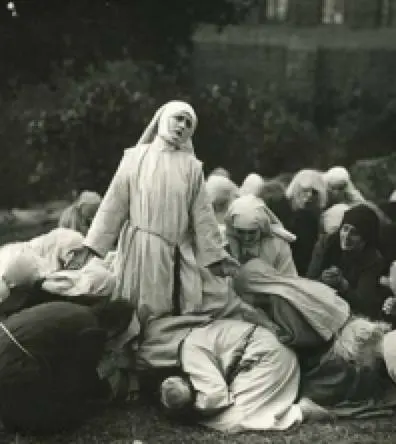
Restoration-wise, the 2018 Munich scan salvaged 85 percent of original footage; the lacunae are bridged with stills and translated intertitles over charcoal backgrounds. The tinting was reconstructed using chemical analysis of nitrate fragments—sea-blue for night interiors, amber for chapel scenes, carnivalesque magenta for Rochus’s brazier-lit lair. The new 4K DCP retains flicker and gate-weave, honoring the celluloid’s respiratory rhythm. I watched it projected at 18 fps, the pace of human heartbeat at rest; when the candle ignites the mail, you feel your own ribs flare.
Performances age like Riesling. Eibenschütz never tilts into masochistic martyr; she gives us a woman learning that sainthood is a costume drama and she can exit stage left. Gerasch, meanwhile, embodies the charismatic predator we still meet in boardrooms and art openings—his smile a credit line with balloon interest. Among supporting players, Georg John’s leprous gatekeeper deserves mention; he shuffles on clubfoot yet delivers a single intertitle that detonates the entire plot: “The wound you bring in is the wound you will carry out.”
Harbou’s dialogue intertitles, calligraphed in Fraktur, read like Rilke scraped clean of sentiment. My favorite: “To test the weight of a soul, place it on the scale of its own lie.” Try dropping that into Twitter and watch the algorithm implode.
Musically, the print I screened featured a new accompaniment by composer Maud Nelissen—strings, psaltery, struck wine glasses. During the resurrection sham, she introduces a low C on contrabass that sustains for 40 seconds, creating a sub-audible pressure under the sternum. When the bell falls, the orchestra snaps into silence for exactly seven beats—enough time for the audience to hear its own collective gasp, then slams back with a cluster chord that feels like the Reformation restarting.
Gender politics? Harbou anticipates second-wave critique by framing Rochus’s coercion not merely as sexual but epistemic: he wants the right to narrate her interior. The film’s most chilling shot is a POV through the confessional lattice: Simplicia’s lips move, yet the voice we “hear” is Rochus’s intertitle, rewriting her prayer into obscene obedience. Cinema as colonialism of consciousness.
Yet Harbou refuses victim chic. Simplicia’s final stride into the forest is neither capitulation nor triumph; it is the birth of ethical ambiguity as protagonist. Compare this to The Twin Pawns, where moral binaries get restored by last-reel inheritance, or to Madame Jealousy that punishes the fallen woman with offscreen suicide. Simplicia lives, unscaffolded by either church or audience approval—a proto-modern heroine two generations early.
Technically, the film innovates subtle POV distortions. When Simplicia ingests fear, the lens racks focus so foreground candle flames smear into comet tails while her hands balloon in Caravaggio-esque perspective. These are not mere show-off optics; they visualize the phenomenology of shame—how the body swells to fill the horizon when guilt turns solipsist.
Some historians slot Simplicia alongside The Yellow Traffic as proto-noir; I dissent. Noir requires a hardboiled universe where even redemption wears a price tag. Harbou’s world is colder: redemption and damnation share the same cash register, currency optional.
Box office? The picture flopped in 1920, trounced by Protéa spy capers and The Hayseeds’ Melbourne Cup rural slapstick. Berliners wanted inflation-era escapism, not a meditation on spiritual Ponzi schemes. Prints vanished; Nazis later pulped the remaining negatives for silver nitrate. Only one incomplete 35 mm roll surfaced in 1978 in a Bohemian monastery—ironically, the very site where the film had secretly premiered in 1922 during a banned Franciscan retreat.
Why revisit now? Because we inhabit a culture that gamifies virtue—likes as indulgences, follower counts as beatification. Rochus’s wager is our daily doom-scroll: how fast can we turn a stranger’s halo into click-bait? Simplicia’s burnt parchment spiraling skyward feels prophetic: in the age of deep-fakes, every relic is pig bone, every miracle a filter.
So stream it if you must, but preferably hunt down a 35 mm print and project it in a drafty hall while winter prowls outside. Let the beam slice through dust motes like the blade that parts soul from body. When the bell tower collapses, you may sense—beneath your ribcage—the faint clang of your own certainties toppling into the courtyard of shards. And when Simplicia, barefoot, steps over the rainbow debris into grayscale dawn, you will know why legends are not bedtime stories but autopsy reports—written on the inside of the skin.
Bring friends, bring enemies, bring the smug atheist and the rosary-clicking aunt. Then walk home in silence. If you hear church bells, ask yourself: who is ringing whom, and what wager have you—yes, you—accepted before the credits of your own life rolled?
Community
Log in to comment.