DbcultAccessing Vault...
Cult Review
Senior Film Conservator
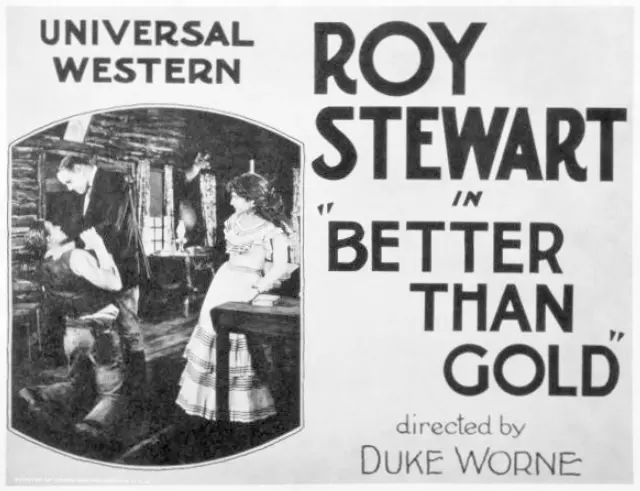
Better Than Gold, a 1925 silent Western starring Gertrude Olmstead and Roy Stewart, unfurls a narrative that transcends its modest runtime, probing the corrosive allure of wealth and the fragile ethics of frontier commerce. The film opens on the bleak tableau of Deer Point, a mining settlement whose hopes have been eroded by a barren landscape. Mr. Norris (Stewart), the stoic owner of the town’s general store, confronts dwindling sales with a hard‑hearted policy: cash‑only transactions, a stark departure from the credit‑friendly norms that once sustained the community.
Enter John Kingdon (a charismatic confidence‑man whose smile masks a calculating mind), who purchases a half‑interest in Norris’s shop. Kingdon’s partnership is not born of altruism; rather, it is a calculated gambit designed to resurrect the store’s fortunes. He enlists the aid of a Native American ally—an unnamed but pivotal figure—who helps disseminate a fabricated bulletin proclaiming a lucrative gold vein nearby. The rumor spreads like wildfire, and the once‑desolate main street erupts into a bustling market, the general store’s shelves emptied in a frenzy of credit‑driven purchases that contradict Norris’s own edicts.
The film’s emotional core rests upon the intertwined fates of three characters: Norris’s daughter (Olmstead), the earnest Phil Barton (the store’s clerk and Norris’s son‑in‑law), and the unscrupulous Kingdon. The daughter, a portrait of frontier grace, rebuffs Kingdon’s overtures, prompting the antagonist to retaliate by accusing Norris of orchestrating the hoax. This accusation becomes a catalyst for the town’s moral crisis, as miners and townsfolk alike turn against the once‑respected storekeeper.
Phil Barton, meanwhile, embodies the archetypal hero of silent Westerns—a steadfast, morally upright figure whose love for the daughter fuels his resolve. His past—a daring rescue of the Indian ally from a lynch mob—adds a layer of reciprocal loyalty that later proves crucial. When Kingdon’s deceit threatens to destroy Norris’s reputation, Barton’s steadfastness becomes the anchor that steadies the narrative.
The Indigenous character, though scarcely given a name, functions as the film’s moral compass. His memory of Barton’s intervention during a lynching episode creates a bond that transcends the racial tensions typical of the era’s cinema. When Kingdon’s lies threaten to ruin Norris, the Indian steps forward, testifying to Barton’s past heroism and, by extension, exonerating Norris. This moment not only resolves the plot’s central conflict but also subtly challenges the period’s stereotypical portrayals, offering a glimpse of mutual respect.
Visually, Better Than Gold capitalises on the stark chiaroscuro of the Western landscape. Cinematographer unknown (records are sparse) employs high‑contrast lighting to accentuate the tension between the sun‑baked streets of Deer Point and the looming shadows of deceit. The use of long shots captures the expanse of the barren terrain, reinforcing the desperation that fuels the townspeople’s gullibility.
The film’s editing rhythm mirrors the escalating panic of the gold rush. Rapid cross‑cuts between frantic shoppers, Kingdon’s scheming glances, and the Indian’s solemn contemplation create a kinetic energy that propels the narrative forward. Intertitles are sparingly used, each line delivering essential exposition while preserving the visual storytelling that silent cinema demands.
At its heart, Better Than Gold interrogates the intoxicating power of false hope. The fabricated gold strike functions as a metaphor for the American Dream’s illusory promise—a promise that can be weaponised by those with charisma and cunning. The film also critiques the commodification of credit, illustrating how financial instruments can become tools of manipulation when untethered from ethical oversight.
The motif of redemption is threaded through the Indian ally’s testimony. His willingness to speak truthfully, despite the risk of alienating his own community, underscores a moral imperative that transcends personal gain. This act of redemption not only restores Norris’s standing but also reasserts the primacy of integrity over profit.
While Better Than Gold stands apart, it shares narrative DNA with contemporaneous works such as Madame Spy, where deception and espionage intertwine, and The Last of the Mohicans, which also features a Native ally whose loyalty reshapes the plot’s outcome. Unlike the melodramatic excesses of It’s No Laughing Matter, Better Than Gold maintains a measured tone, allowing its moral quandaries to breathe without melodramatic hyperbole.
Gertrude Olmstead delivers a nuanced performance, conveying resilience through subtle facial expressions—a skill essential in silent cinema. Her eyes, often the sole conduit of emotion, flicker between defiance and vulnerability, especially in the scene where she rebuffs Kingdon’s advances. Roy Stewart’s portrayal of Norris is a study in stoic endurance; his measured gestures and the occasional clenched fist reveal a man grappling with both economic desperation and paternal protectiveness.
The supporting cast, though less heralded, contributes layers of authenticity. The Indian ally’s stoic presence, rendered with dignity, avoids caricature—a rare achievement for the era. Kingdon’s actor (uncredited) employs a blend of charm and menace, his smirk a visual shorthand for duplicity.
The screenplay follows a classic three‑act structure: exposition (the failing store), inciting incident (the false gold report), and climax (the revelation of truth). The pacing accelerates during the gold rush sequence, with quick intercutting that mirrors the townsfolk’s frenzied buying sprees. The denouement slows, allowing the audience to absorb the moral resolution and the restoration of social order.
Notably, the film refrains from a conventional “happy ending” in the romantic sense; instead, it offers a restorative equilibrium. The store reopens on credit, but now under a renewed ethical framework, and the relationship between Phil and the daughter is implied to continue, underscoring the theme that trust, once rebuilt, can sustain community.
Better Than Gold emerges at a time when the American West was mythologised on screen, yet it distinguishes itself by interrogating the very myths it portrays. Its critique of speculative greed anticipates later Westerns such as Broken Fetters, which similarly dissect the moral vacuity of frontier capitalism.
The film’s preservation status remains precarious; few prints survive, making contemporary analysis reliant on secondary sources and period reviews. Nevertheless, its thematic resonance endures, offering modern audiences a window into early cinematic explorations of ethics, economics, and cross‑cultural solidarity.
Better Than Gold is a compact yet richly textured work that rewards attentive viewing. Its narrative economy does not sacrifice depth; instead, it concentrates emotional stakes, allowing each character’s arc to illuminate broader societal concerns. The film’s visual palette—contrasting sun‑bleached exteriors with shadowy interiors—mirrors the dichotomy between truth and deception.
For scholars of silent cinema, the film offers a case study in how genre conventions can be subverted to deliver moral commentary. For casual viewers, it provides an engaging story of love, betrayal, and redemption set against the rugged backdrop of the American frontier. The interplay of performances, direction, and thematic ambition positions Better Than Gold as a noteworthy entry in the silent Western canon.
In an era saturated with gold‑rush narratives, this film distinguishes itself by foregrounding the human cost of false promises and celebrating the quiet heroism of those who, against all odds, choose truth over profit.
IMDb 6.8
1932
Community
Log in to comment.