DbcultAccessing Vault...
5.3/10
Senior Film Conservator
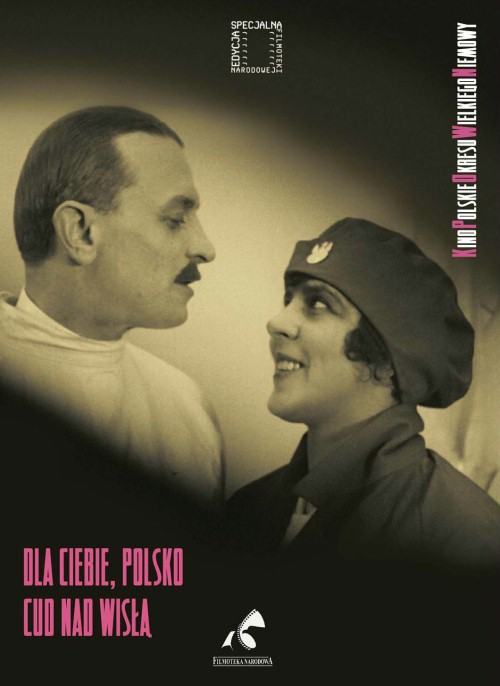
A definitive 5.3/10 rating for a film that redefined the boundaries of cult cinema. Dla ciebie, Polsko remains a cornerstone of transgressive art.
There are films you watch; then there are films that watch you—films that crawl behind your corneas and rewire the optic nerve so every sunset thereafter looks like a warning flare.
Dla ciebie, Polsko belongs to the latter tribe. Shot in the cratered summer of 1920 while the real Red Army licked its wounds outside Warsaw, this politically scalding fresco feels less like narrative cinema than like someone drilling a borehole into the collective unconscious of a nation still smoldering from 123 years of foreign rule.
Marian Józefowicz and his cameraman Stanislaw Jasienski treat celluloid like tinder. They splice stock so overexposed that whites implode into solar flares, while blacks sink into tarry abysses. Faces are carved with shadows sharp enough to shave skin; eyes become cavernous sockets lit only by the orange glow of burning barns. The palette is deliberately toxic: chromium greens for Bolshevik banners, arsenic reds for Polish kepis, and bruise-purple horizons that herald neither dusk nor dawn but historical blackout.
The Vilnius of this film is not a city but a wound shaped like a city. Catholic spires bend like snapped femurs; Orthodox onion domes implode into themselves, forming iron-maiden husks. In one bravura sequence, a cavalry charge is filmed entirely via reflections in shattered church windows—horses multiplied into a ghostly herd, their riders headless, torsos flickering like faulty newsreel. You feel the crunch of broken stained glass underhoof even though the camera never once tilts downward.
Technically a silent, the picture weaponized intertitles as shrapnel. Words slam on-screen in fractured German, Russian, Lithuanian, and Polish—languages fighting for the same oxygen. Fonts mutate: Bolshevik proclamations appear in Constructivist blockhouse sans-serif; Polish prayers arrive in Baroque curls dripping faux candlewax. One intertitle, flashed for perhaps eight frames, reads: „The map of Europe is a palimpsest written in blood that never fully dries.” Blink and you will miss it; sleep and it will find you anyway.
Stanislaw Jasienski (doubling as lead) has the hollowed stare of a man who has already seen his own death certificate but keeps breathing out of spite. His body moves like a marionette with half its strings cut—jerky, gravity-averse, yet capable of sudden stillness that silences the frame. Watch the moment he learns his childhood observatory has been converted into an execution ground: the news arrives via a scrap of star chart smeared with boot prints. Jasienski does not flinch; instead the camera dollies into his pupil until the entire war collapses into that single black hole.
Antoni Rózanski’s Voronov is a study in theatrical nihilism. With a voice supplied by on-screen text that blooms like malignant flowers, he preaches history as Grand Guignol. In a scene destined for anthologies, he forces prisoners to reenact the partition treaties of 1772–95 using their own intestines as cartographic markers. The horror is less the gore than the bureaucratic precision—he times the disembowelment with a metronome.
Jadwiga Doliwa’s Elena subverts the saint-whore binary by being both and neither. She trades Polish verse for Russian bullets, then uses those bullets as quills to scratch new verses onto birch bark. In a haunting nighttime tableau, she braids the hair of a dying soldier while humming a lullaby; the braid becomes a rosary, the lullaby a chronicle of vanished shtetls. The film refuses to sexualize her suffering—when rape looms, the screen goes entirely white for exactly four seconds, the cinematic equivalent of a scream swallowed by snow.
Context matters: Poland had just re-emerged after vanishing from maps for over a century, squeezed between a Germany smarting from Versailles and a Russia hemorrhaging from revolution. The film’s vilification of Bolsheviks is rabid, yet it spares no pity for the Polish landlords who once chained serfs to debt. In a hallucinated courtroom, a Polish count and a Russian commissar stand accused; their verdict is delivered by a child soldier who cannot read, underscoring the cyclical illiteracy of violence.
For contrast, glance at The Majesty of the Law—an Irish parable where legal procedure becomes sacrament. Both films weaponize jurisprudence, yet while the Irish story seeks reconciliation, Dla ciebie, Polsko sees justice as a Molotov cocktail hurled backward through time.
Today, as borders ossify anew and digital propaganda weaponizes nostalgia, this 1920 howl feels prophetic. The river of ice that swallows identities at the climax anticipates Europe’s contemporary refugee crises: people forced to carry invisible homelands in their pockets, passports dissolving faster than snow on tongues. When a modern viewer sees villagers nailing language primers to doors before fleeing, the parallel to Ukrainian families packing Harry Potter books alongside iodine pills becomes unbearable.
Most prints were torched by both Nazis and Soviets for opposite reasons. The surviving 35 mm negative—discovered in 1998 in a Lithuanian monastery latrine—was water-stained, riddled with fungus blooming like corpse flowers. Digital cleanup removed scratches but kept the emulsion’s chemical tears. Purists complain about the tinting: night scenes dipped in arsenic blue, day battles drenched in potassium ferricyanide. Yet those hues do not prettify; they cauterize, reminding us that restoration is another word for scarring.
Compare it to La Gioconda—another 1920s silent mining myth for political dynamite. Where the Italian film aestheticizes treachery through sculptural lighting, Józefowicz opts for scorched earth. Or weigh it against Les Misérables, Part 1: Jean Valjean: both center on law versus mercy, yet Victor Hugo’s Paris offers redemption whereas this Polish nightmare offers only a choice between two amnesias—imperial or revolutionary.
Watching Dla ciebie, Polsko is akin to swallowing a burning coal: it illuminates the gut while cauterizing the throat. You exit the theater tasting smoke, convinced that history is not a river but a pendulum forged from teeth. The film refuses catharsis; instead it gifts contamination—every frame a spore that settles into your synapses and sprouts nightmares where your mother tongue is outlawed and your hometown exists only as a postage stamp on a parcel returned to sender.
Essential viewing for anyone who still believes nations are drawn in ink rather than carved in scar tissue.
IMDb 6.1
1934
Community
Log in to comment.