DbcultAccessing Vault...
Cult Review
Senior Film Conservator
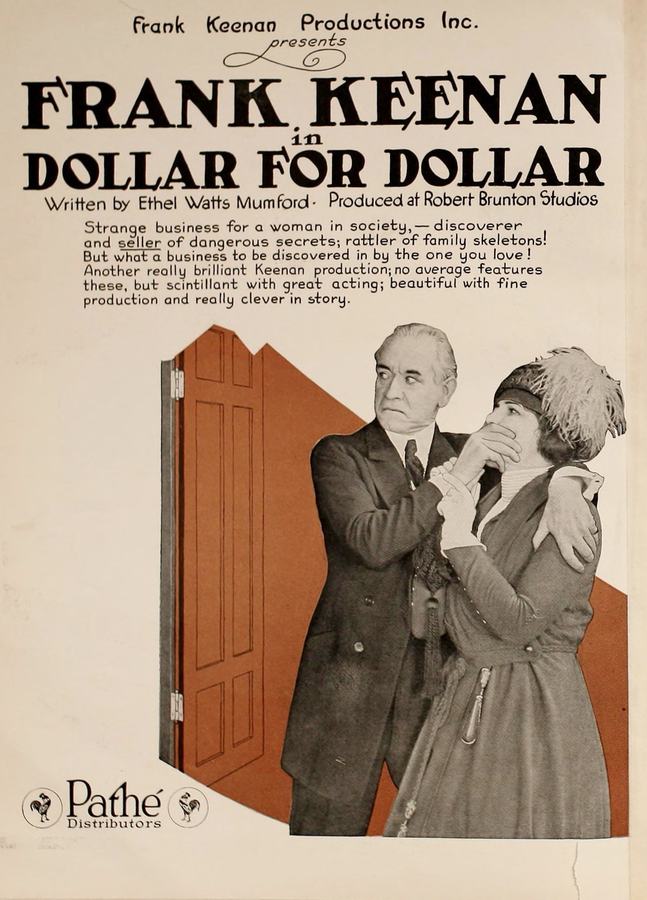
If Wall Street had a fever dream in 1920, it would look exactly like Dollar for Dollar: gilt edges corroding into human plasma, ticker tape morphing into widow’s veil, every handshake a strangulation postponed.
Director Frank Keenan—also brooding onscreen as the doomed partner—shoots Manhattan like a Expressionist cathedral. Note the shot where Gard’s private railcar snakes through the warehouse district: windows barred by cruciform shadows, steam clouds ejaculating from funnels like guilty prayers. The film stock itself seems nervous, scratching its own emulsion as if trying to erase complicity.
Katherine Van Buren’s Mrs. Marteen is no fragile doyenne—she enters frame chin-first, eyes already calculating compound interest on grief. Watch the micro-tremor when she first pockets the blackmail letter: a pulse of moral terror quickly smothered by the steely set of her jaw. It’s the silent era’s answer to Eyes of the Heart’s wounded clairvoyant, but instead of second sight she wields second wives.
Larry Steers essays Gard with the unctuous grandeur of a Roman cardinal who has franchised indulgences. His hand gestures carve up space like a butcher quartering futures contracts; when he kneels in a chapel aisle, the smirk he shoots the crucifix is worth ten intertitles. Frank Keenan, as the crooked partner Kincaid, has a death-rattle monologue—delivered entirely in haunting insert cuts of cancelled stock certificates fluttering to the floor like albatross feathers.
Mumford’s intertitles—razor-sharp couplets of Edith-Wharton-meets-Barnum—deserve resurrection in every business-ethics syllabus. "A woman wronged keeps her books in the red of her eyelids" appears superimposed over a close-up of Van Buren’s tearless glare, indicting not merely Gard but the entire ledger-love ethos of the age. Compare the fiscal chicanery here to the dowry brinkmanship in Should a Woman Tell?—both films understand marriage as hostile takeover, yet Dollar for Dollar adds the kicker: every vow is a callable bond.
Cinematographer Jay Belasco—yes, of the theatrical dynasty—litters the mise-en-scène with reflective traps: polished mahogany, chauffeur goggles, even a fountain pen nib that catches the widow’s profile and fractures it into shrapnel. The result is cubist guilt; characters confront their own duplicity in every surface. One sequence cross-cuts between Gard counting cash in a private safe and Marteen cataloguing her blackmail trophies—both actions share the same visual rhythm, a metronome of moral equivalence.
Time itself becomes negotiable. Jump-cuts leapfrog weeks; a dissolve from ticker tape to noose loops implies the market’s cyclical cannibalism. Note the absence of calendars or newspapers—only stock quotes and death certificates mark temporal passage, underscoring that under capitalism the only reliable chronometer is profit or loss.
Modern viewers conditioned for Hans-Zimmer bass drops may scoff, yet the picture’s silence is its own sonic weapon. In the pivotal boardroom confrontation, the camera dollies past twenty cigar-chomping males; you hear the cigars die in ashtrays, the leather chairs exhale. When the widow finally utters (via intertitle) "Your signature is bigamy in ink," the lack of diegetic reverb makes the line detonate inside the skull.
Released months after the 19th Amendment’s ratification, Dollar for Dollar weaponizes the newly enfranchised woman as both avenger and entrepreneur of pain. Where Thoughtless Women moralizes against flapper excess, this film flips the scolding finger back at patriarchal piracy. Van Buren’s character is never punished for sexual knowledge; her downfall, if it can be called that, stems from trusting the legal system to honor a woman’s contract. The jury of grimy faces that closes the film resembles nothing so much as a Wall Street boys’ club, ensuring the more things change…
Seekers of proto-noir DNA should cross-reference The Wolf’s predatory seductions or the fatalistic landscapes of Barranca trágica. Yet Dollar for Dollar distinguishes itself by embedding criminality inside corporate charters, prefiguring Force of Evil by three decades. Even The Valley of Decision shares its Calvinist sense of spiritual bankruptcy, though that film seeks redemption—our feature here cannot even spell the word without a stock split.
The last confirmed print screened at a 1924 Newark fundraiser and vanished—likely decomposed in a Jersey storage vault whose humid breath melted nitrate to goo. Rumors swirl of a 16mm abridgment held by a Buenos Aires collector, scenes subtitled in Spanish that compress Mumford’s epigrams into haiku of greed. Digital masochists scour Huo wu chang bootlegs hoping for mislabeled canisters; alas, Chinese distributors rarely swapped Confucian tragedy for American bigamy.
Because every crypto-scam, SPAC hustle, and influencer Ponzi ripples from the same moral lacuna this film dissects. Because Katherine Van Buren’s arched eyebrow contains more feminist fury than three seasons of prestige-TV monologues. Because Jay Belasco’s chiaroscuro makes Instagram filters look like kindergarten crayons.
Watch it—if you unearth it—with the lights off, phone dead, wallet sealed in another room. Measure your breathing during the final close-up: widow Marteen behind courthouse pillars, the camera retreating as though ashamed to witness. If your pulse syncs with that slow zoom, congratulations—you’ve just audited the original Master Class in Moral Hazard, tuition payable in souls, dollar for dollar.
Grade: A+ (If found) | Availability: Extinct (Keep the faith) | Rewatchability: ∞ for capitalists, insomniacs, and ex-spouses
IMDb —
1929
Community
Log in to comment.