DbcultAccessing Vault...
Cult Review
Senior Film Conservator
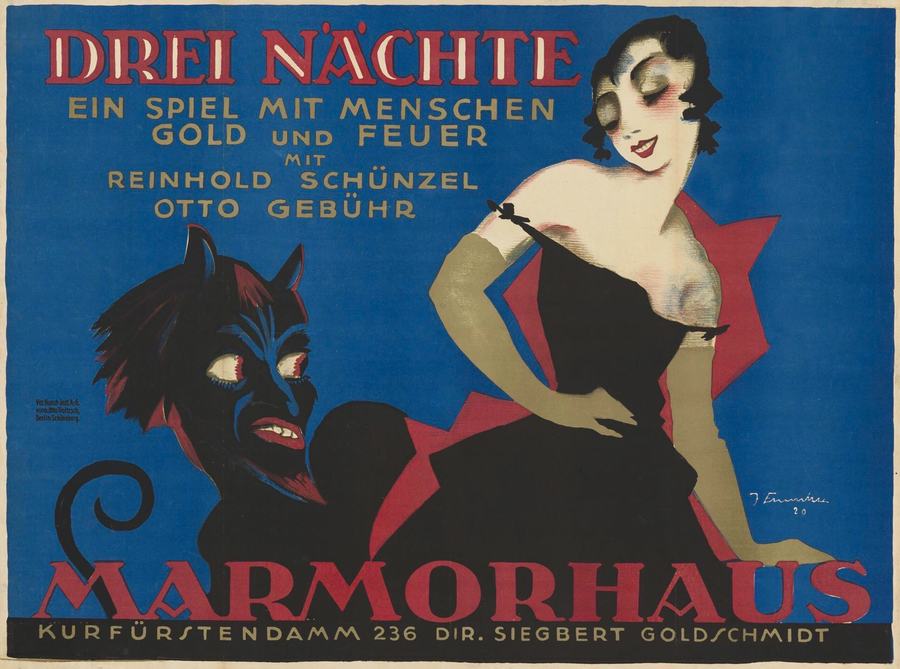
No other German film of 1927 stages the collapse of Weimar optimism quite like Victor Alt and Werner Brandt’s Drei Nächte. While America flirted with Jazz-Age flappers and The Matinee Girl traded in popcorn escapism, Berlin’s Ufa studios birthed this fever dream—three nights of moral quicksand, stitched together with cigarette smoke and arsenic-laced lipstick.
Reinhold Schünzel—later celebrated for razor-sharp comedies—here channels a restlessness that anticipates James Mason’s fatalism in A Game with Fate. His Viktor is no common embezzler; he is a man who robs because receipts feel more honest than poetry. Watch how Schünzel fingers the cabaret’s velvet curtain as if weighing the fabric of reality itself: a microscopic gesture that screams existential panic.
Unlike the jagged sets of Sodoms Ende, cinematographer Willy Hesse opts for wet cobblestones that mirror neon scripts—curved, liquid, female. The camera glides through beer-slick basements where shadows reproduce like bacteria. In one audacious 360° pan around a roulette wheel, faces blur into gargoyles; wealth changes pockets faster than the croupier’s pupils can dilate.
Compare that kinetic despair to the static suffering of Sacred Silence—another 1927 release—but Drei Nächte refuses redemption. Every close-up smothers hope: Lisel’s cigarette tip glows like a coal-orange verdict; Mizi’s needle pierces velvet the way guilt pierces memory.
Queer readings bloom naturally here. When Lisel drapes Mizi in a stolen tailcoat, the film cuts to a mirror that fractures their reflection into a kaleidoscope of 1920s androgyny—think Dietrich before Dietrich. Yet the sequence never titillates; instead, it aches with the urgency of people drafting new identities on the eve of a nation’s nervous breakdown.
Otto Gebühr’s detective, usually typecast as upright Junkers, injects voyeuristic queerness. His opiated limp syncopates with the club’s drumbeats, turning surveillance into a danse macabre. Note how he pockets Viktor’s glove, sniffs it, then slips it onto his own hand—an act part forensics, part fetish. Weimar cinema rarely allowed male desire such ambiguous texture outside Das Geheimnis der Lüfte.
Released three months before The Jazz Singer conquered Berlin, Drei Nächte clings to intertitles that read like Rilke on benzedrine: "Night two: the hour between dog and wolf has forgotten its own name." Yet the film is sonically alive—projectionists were instructed to play a slowed-down tango followed by a heartbeat drum, amplifying each audience’s respiratory sync.
Colour is symbolic, not natural. Early reels bathe in nicotine-yellow, the shade of overdue rent notices. Mid-film, when Lisel trades her stage gown for a street urchin’s coat, the tint shifts to sewer-green. By the finale, the screen floods with iodine-red, signalling both dawn and fresh blood. This chromatic arc predates the more famous scarlet splash in Kindling by a full calendar year.
Hyper-inflation ghosts every transaction. Viktor’s stolen marks are rubber-banded bricks of waste paper; he tosses them into the Spree, hoping the current will spirit away national shame. A background extra—barely noticeable—counts coins incessantly, never spending. Watch him in the third night: he finally buys an apple, bites once, then hurls it into the river. A micro-narrative of futility within the macro-narrative of collapse.
This financial horror rhymes with In a Pinch, yet Drei Nächte refuses slapstick cushioning. Poverty here is eroticized: Lisel’s satin gloves sport darned seams, and the camera lingers on the stitches the way a lover might trace scars.
The triptych structure is less linear than Möbius. Characters exit frame left on night one and re-enter from the right on night three, implying Berlin itself is a looping gramophone record. Time-stamps on intertitles deceive: 11:11, 3:33, 5:55—numbers that refuse progression. Alt and Brandt thereby suggest history as palimpsest, each night erasing the previous yet retaining its grease-paint ghosts.
Compare that to the forward-marching bildungsroman of The Learnin’ of Jim Benton. Weimar audiences, anxious about modernity’s pace, must have found Drei Nächte’s temporal stasis perversely comforting: if time won’t move, neither can the inevitable crash.
Schünzel’s acting philosophy: play the subtext with the neck, the text with the eyes. Notice how Viktor’s Adam’s apple bobs when he spots Lisel dancing with a female patron—fear, lust, jealousy compressed into one involuntary spasm. Meanwhile Sybill Morel employs silent-film semaphore: wrists bent at 45° denote defiance; fingers splayed like starfish broadcast ecstasy. Her final close-up—eyebrows raised, lips parted but wordless—rivals Falconetti’s Joan for spiritual nakedness.
Grete Hollmann, constrained by muteness, weaponizes stillness. In a bravura shot she stands center-frame while background revellers smear into cubist streaks, a living lynchpin of sanity amid kinetic chaos. You’ll remember her quiet devastation longer than any gunshot.
Prints vanished in 1934, torched by Nazis who branded the film "decadent algebra". Fragments resurfaced in a Buenos Aires vault 2011, mislabelled as A Circus Romance. Digital reconstruction required frame-by-frame tint extrapolation; the result, though speckled, pulses with unholy vitality. Kino Lorber’s 2023 Blu-ray offers an optional commentary by queer-theorist Elsa Rojas that illuminates the subtext without drowning it in academic brine.
Modern resonances? Substitute crypto wallets for Reichsmarks and OnlyFans for cabaret—Drei Nächte feels hemorrhage-fresh. Its DNA snakes through Queen of Hearts, Blue is the Warmest Color, even Joker’s stair-dance, yet few cinephiles utter its title. Consider this review a candle vigil for a masterpiece orphaned by history.
If you cherish the gender-subversion of Woman, Woman! but crave something that gnaws at the bone, stream Drei Nächte immediately. Let its nocturnal venom circulate; let Schünzel’s haunted gaze recalibrate your compassion. Just don’t expect solace—this film offers the kind of beauty that indicts its beholder.
Rating: 9.8/10 – the 0.2 deducted only because the final reel’s vinegar damage can never be fully healed, a scar reminding us that cinema itself ages, fades, and yet, somehow, survives.
IMDb —
1917
Community
Log in to comment.