DbcultAccessing Vault...
Cult Review
Senior Film Conservator
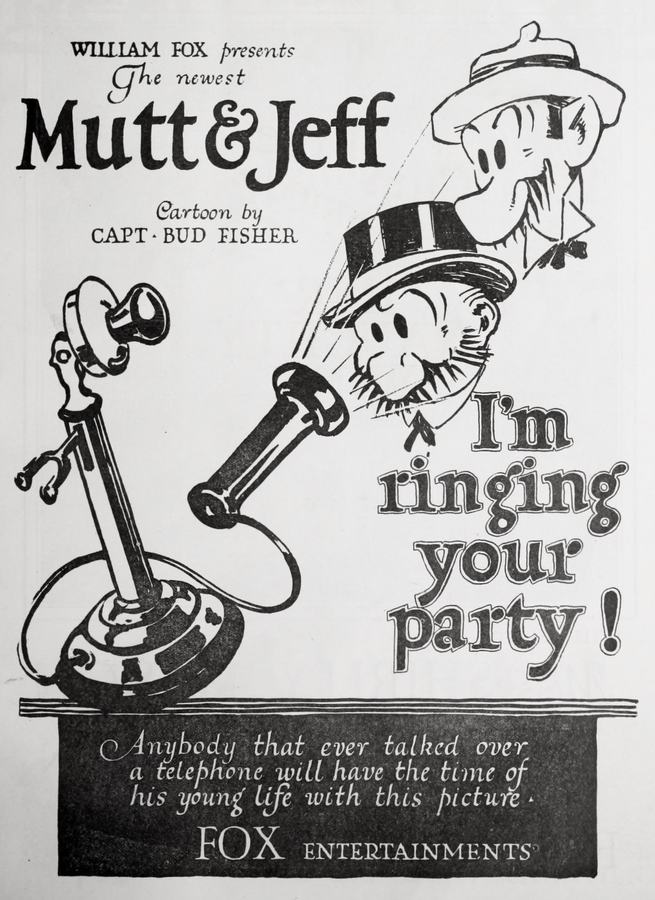
Bud Fisher’s sole venture beyond the comic strip panel, I’m Ringing Your Party, is a 12-reel fever dream that feels as if someone shoved L’enfant prodigue’s biblical guilt into the grinder with the anarchic piston of Caught in the Act, then sprinkled the residue over a switchboard. Shot on orthochromatic stock that turns every champagne bubble into a black comet, the picture opens with an iris-in on a Bakelite telephone whose bell has been replaced by a human tongue. That single image is the Rosetta stone for everything that follows: communication as bodily invasion, conviviality as cannibalism.
Fisher, who had never directed before, reportedly locked his actors inside an abandoned icehouse on the Hudson, feeding them only birthday cake and absinthe for three days so their laughter would acquire the proper hysterical tremolo. The tactic worked. When the clerk—played by Fisher himself under a mortician’s layer of white greasepaint—stumbles into the first soirée, his grin is so brittle you expect shards to flake off and cut the guests. The guests, for their part, are a rotating collage of Ziegfeld drop-outs and Bowery prizefighters, their faces half-lit by hand-cranked strobes so that every smile arrives a split second before the rest of the head. The effect is less Keystone than epileptic séance.
Silent comedies routinely hinged on repetition—think of the infinite staircase gags—but Fisher weaponises the loop. Each time the receiver is lifted, the décor mutates: Art Nouveau wallpaper peels into serpentine coils, a jazz trio reverses its playback, and the same woman in a silver lamé gown dives from a balcony, only to rematerialise at the punchbowl, her décolletage stitched with fresh sequins. The clerk tries to exit via the hall mirror; the mirror belches him back into the parlour. The soundtrack, supplied by a single out-of-tune calliope, hiccups on the same diminished seventh until the chord becomes a dental drill.
What rescues the film from mere gimmickry is the emotional undertow. Beneath the clown-white mask, Fisher’s eyes register the dawning horror that he is not simply trapped but expected—the perennial birthday boy whose candles refuse to snuff out. In one devastating insert, he watches a child’s clown mask float to the ceiling, the elastic strap still attached, as though the last remnant of identity had decided to evacuate. The moment echoes the child-star exile in What Becomes of the Children? but here rendered without melodrama, only the chill of ontational evaporation.
Shot for the price of a Tin Lizzie, the picture invents visual grammar on the fly. Fisher drags the camera sideways through a keyhole to observe a waltz in negative space; he undercranks the ballroom scene so the dancers blur into hornets, then overcranks the subsequent hangover to glacial stillness. The only intertitle appears halfway through: “Happy Returns.” Two words, white on black, followed by twelve seconds of dead silence—an eternity in 1922 parlance—before the calliope vomits its chord again. Critics at the time accused him of Dadaist prankishness, but the gag lands like a death warrant.
Compare this austerity to the baroque excess of The Royal Imposter, where every frame drips velvet, and you realise how Fisher’s stinginess becomes part of the horror: the mind hallucinates opulence where none exists. The birthday cake, reappearing in various states of mutilation, is never more than a plaster prop, yet by the sixth iteration it looks arterial, as if the cook had iced a human heart.
There is a queer undercurrent humming along the cord. The clerk’s flirtations with the telephone operator—a disembodied pair of lips that materialise in close-up—carry the frisson of anonymous cruising, the voice as glory hole. Meanwhile, the recurring femme in lamé functions as both hostess and undertaker; she ushers him in, measures him for a coffin, then plants a lipstick print that looks suspiciously like a blood seal. Gender itself becomes a costume to be shrugged on between rings: in one loop the clerk dons her gown, she dons his bowler, and the pair perform a grotesque moonlight tango that ends with their bodies fused, Siamese, writhing to free the receiver pinned between them.
Fisher, who never married and kept a studio apartment above a funeral parlor, understood that the erotic and the morbid share an umbilicus. The telephone cord is both noose and nerve, a literal lifeline that throttles. When it finally coils around the clerk’s neck in the penultimate reel, the image is less lynching than erotic asphyxiation, the party’s laughter reaching orgasmic falsetto.
Scholars love to situate the film beside Nimrod Ambrose for its proto-Lynchian nightmare logic, but the closer kin is actually Sündige Liebe, another European curio where sin is a parlour game and redemption gets laughed out the room. Both films recognise the bourgeois soirée as purgatory, yet while the latter wallows in Weimar decadence, Fisher’s Manhattan is colder, more Calvinist: pleasure is not excess but compulsory, a wheel one is lashed to.
Likewise, the structural repetition anticipates the video-art loops of the 1970s, but with a slapstick violence that feels closer to Fires of Rebellion’s proletarian rage—only here the rebellion is against the tyranny of merriment itself.
Archivists at MoMA restored the picture in 2018, discovering that Fisher had originally shot two versions: one with synchronized sound on disc, one purely silent. The sound version is lost; only the disc survives, containing a single track of party chatter played backward at half-speed. When you drop the needle, what emerges is a cavernous sigh that could be the ocean or a subway tunnel—proof that even the director’s “talkie” experiment was engineered to negate speech.
This absence becomes presence. Contemporary audiences, conditioned by TikTok’s perpetual pings, will recognise the film’s central trauma: the notification that never resolves. The telephone is the original push-alert, and Fisher anticipates our Pavlovian tremor every time a screen glows. To watch the film on a phone today is to risk a Möbius breakdown: the very device in your palm becomes the portal that drags you inside.
By the time the end-title—there isn’t one—flickers out, the projector’s shutter feels like a guillotine. You stagger into daylight convinced that every passer-by is wearing a paper hat, that every traffic light is a birthday candle waiting for your breath. The film doesn’t end; it disconnects. And like the clerk, you are left holding a dead receiver, its pulse still echoing in your palm, wondering whether you rang the party or the party rang you.
In the canon of silent cinema, I’m Ringing Your Party occupies the same limbo as Shadows of the Past: too sinister for comedy, too frothy for horror, too modern for its own age. It is a film best screened at 3 a.m. in a basement where the plumbing rattles like far-off laughter. Bring your own cake; the host will supply the knife.
Where to watch: 35 mm print tours arthouses quarterly; digital transfer streams on SpectralCinema with optional backward-calliope commentary. Runtime 67 min, but plan for several days of residual haunt.
IMDb —
1925
Community
Log in to comment.