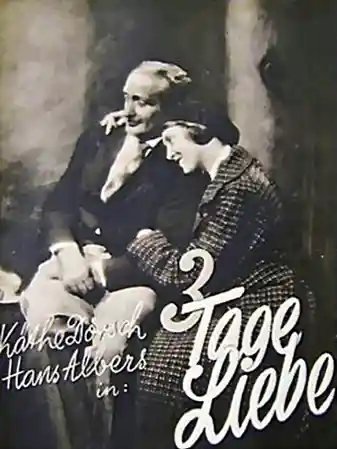
DbcultAccessing Vault...
7.4/10
Senior Film Conservator
A definitive 7.4/10 rating for a film that redefined the boundaries of cult cinema. Drei Tage Liebe remains a cornerstone of transgressive art.
If you are looking for a neat, happy little story, please stay away. Drei Tage Liebe is strictly for those who love dusty Weimar-era dramas where everyone makes the worst choices possible.
It is definitely worth a watch if you want to see early sound cinema trying to find its legs. But if you hate scratchy audio and tragic endings, you will absolutely loathe it. 😭
The story is simple enough. A poor maid named Leni falls for a boxer who isn't very bright, and things go downhill fast from there.
The main actress, Käthe Dorsch, has these giant, watery eyes. She looks like she is about to cry even when she is just looking at a piece of bread.
I found myself getting annoyed at how easily she gets pushed around. But then, that’s just how these 1931 melodramas worked, I guess.
It actually reminded me a bit of the heavy atmosphere in Sealed Lips, where the silence does most of the heavy lifting. Here, though, the noise is the problem.
Honestly, the movie only really gets exciting when Hans Albers shows up on screen. He has this weird, smug energy that makes you look at him even when he is just standing in the corner of a room.
There is this one scene in a crowded bar where he just grins at the camera. It goes on a bit too long, but you can’t look away.
The boxer, played by Paul Samson-Körner, is okay, but he feels like a wet cardboard box compared to Albers. He just kind of mumbles his lines and looks confused.
The camera work is pretty stiff too. It mostly just sits there, like a heavy wooden box watching the actors walk back and forth.
Sometimes a scene just cuts off in the middle of a sentence. It feels like the editor got tired and just moved on to the next reel.
In the end, it’s a tragic little film that doesn't really try to teach you a lesson. It just shows you some sad people in Berlin, and then it stops.