DbcultAccessing Vault...
6.4/10
Senior Film Conservator
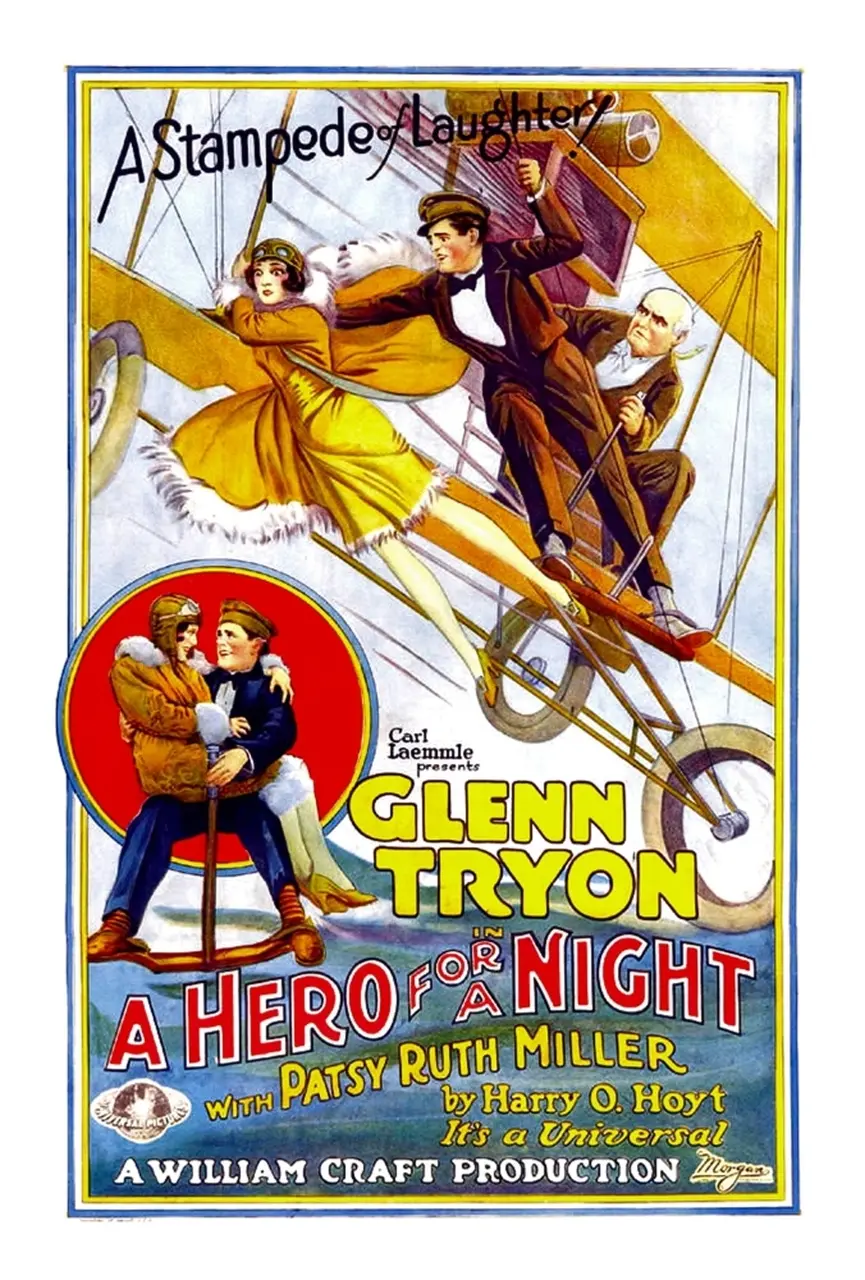
A definitive 6.4/10 rating for a film that redefined the boundaries of cult cinema. A Hero for a Night remains a cornerstone of transgressive art.
Is 'A Hero for a Night' a cinematic relic or a forgotten gem deserving of modern attention? Short answer: it’s a charming, if somewhat predictable, romantic comedy that offers a delightful glimpse into the innocent storytelling of its era, making it surprisingly watchable for cinephiles and silent film enthusiasts today. This film is unequivocally for those who appreciate the foundational artistry of early cinema, the expressive power of silent acting, and a narrative unburdened by contemporary cynicism. However, it is decidedly not for viewers seeking complex psychological depth, explosive action, or a narrative pace that mirrors today's rapid-fire editing; those accustomed only to modern blockbusters may find its deliberate rhythm challenging.
The film, a product of a transitional period in Hollywood, stands as a testament to the enduring appeal of a simple, heartfelt story. It works. But it’s flawed. Yet, its flaws are often part of its charm, reflecting the nascent stage of an art form still finding its voice.
Absolutely, if you approach it with the right expectations. This isn't a film that will redefine your understanding of cinema, nor does it possess the groundbreaking technical innovations of a Murnau or Eisenstein. Instead, 'A Hero for a Night' offers a quiet satisfaction, a gentle comedic touch, and a palpable sense of the era's romantic sensibilities. It's a journey back in time, not just to a different cinematic age, but to a different way of experiencing narrative.
This film works because: Its core premise of an underdog finding love across social strata is timeless, executed with an endearing simplicity that allows the performances to shine without excessive melodrama.
This film fails because: Its narrative adheres too closely to conventional romantic comedy tropes of the era, offering few genuine surprises or profound character developments that might elevate it beyond pleasant diversion.
You should watch it if: You have an appreciation for silent cinema, enjoy lighthearted romantic comedies, or are keen to explore the filmographies of its charming leads, Patsy Ruth Miller and Glenn Tryon.
William James Craft, while not a household name in the pantheon of great directors, demonstrates a keen eye for character interaction within the constraints of silent storytelling. His direction here is understated, focusing on clear visual cues and the expressive capabilities of his cast. The film’s strength lies in its unpretentious approach to a classic 'rags-to-riches' adjacent romance, where a cab driver's earnestness battles the superficial allure of wealth and status.
Patsy Ruth Miller, as the rich model, brings a surprising warmth to a role that could easily have been one-dimensional. Her performance balances the demands of her character's social standing with glimpses of genuine vulnerability. There’s a particular scene where she subtly conveys boredom at a high-society event, her eyes scanning the room with a distant longing, suggesting a life beyond the champagne flutes and forced smiles. It’s a moment that resonates, hinting at the emptiness beneath the glamour.
Glenn Tryon, as the cab driver, is the film's beating heart. His physicality, a hallmark of silent comedy, is never over-the-top, instead conveying a grounded sincerity. His gestures, particularly when he first encounters Miller’s character, are a masterclass in silent film acting – a blend of awe, nervousness, and an undeniable spark of admiration. He’s not just driving a cab; he’s driving the film’s emotional core.
The pacing of 'A Hero for a Night' feels remarkably fluid for a film of its vintage. While intertitles are, of course, a necessity, they are integrated with a rhythm that rarely feels intrusive. Craft understands when to let the actors' expressions carry the scene and when to interject with dialogue or exposition. This balance is crucial in maintaining audience engagement, especially for modern viewers less accustomed to this form of narrative delivery.
Cinematography, while not revolutionary, is competently handled. The film effectively uses contrasts between the cramped, functional interior of the cab and the expansive, often lavish sets of the model’s world. There's a notable sequence where the camera follows Tryon's cab through bustling city streets, capturing the energy of the urban environment. It’s a simple shot, but it effectively grounds the character in his reality before he's thrust into a different one. The lighting, too, serves its purpose, often highlighting the faces of the actors to emphasize their emotional states, a common but effective technique of the era.
One might argue that the film could have pushed its visual metaphors further, perhaps contrasting the grit of the working class with the polished, almost artificial sheen of the elite in a more pronounced way. However, its restraint also contributes to its accessibility, preventing it from veering into heavy-handed social commentary. It prefers warmth over critique.
Beyond Miller and Tryon, the supporting cast, including Lloyd Whitlock and Leo White, add flavor to the proceedings. Whitlock, often cast in more villainous or antagonistic roles, here plays a more ambiguous figure, adding a subtle layer of tension to the romance. His presence is a quiet reminder of the societal expectations and potential rivals that Tryon's character must overcome.
What truly elevates the performances is the palpable chemistry between Miller and Tryon. It's not an explosive, grand romance, but a slow burn of mutual respect and attraction that feels genuine. Their interactions, particularly in moments of shared vulnerability or comedic awkwardness, are the film's strongest asset. For example, a scene where they are forced to spend time together in an unexpected situation, their initial discomfort gradually melting into shared laughter, is a highlight. It speaks volumes without a single spoken word.
This authentic connection is what makes the simple plot work. Without it, the film would risk becoming just another period piece. With it, it becomes a charming anecdote about finding love where you least expect it. It’s a powerful reminder that even in the silent era, the most effective tool in a filmmaker’s arsenal was often the human face and the emotions it could convey.
The film's tone is predominantly lighthearted and optimistic, leaning heavily into romantic comedy territory. There are moments of genuine humor, often derived from situational irony or the clash of social customs. It’s a film that believes in the power of individual character over class distinctions, a sentiment that feels both quaint and enduringly hopeful.
While it doesn't delve deeply into social commentary, the underlying theme of class difference is ever-present. The cab driver's initial hesitation, the model's surprise at his sincerity, and the societal pressures they both face are subtly woven into the narrative. It's not the biting satire of some contemporary films, nor the stark realism of others like Das Todesgeheimnis, but rather a gentler exploration of how love might bridge divides. This is perhaps where the film's unconventional observation lies: it posits that true heroism isn’t about grand gestures, but about authentic self-presentation and genuine connection, regardless of one's station.
Some might find this thematic simplicity a weakness, yearning for a more robust examination of the era's social complexities. However, its refusal to get bogged down in heavy themes allows its central romance to flourish without distraction. It’s a film that prioritizes warmth and charm over intellectual dissection, and it largely succeeds on those terms.
Watching 'A Hero for a Night' today is a fascinating exercise in understanding cinematic evolution. The tropes it employs – the chance encounter, the mistaken identity (implied in the 'hero' aspect), the overcoming of obstacles – are still staples of romantic comedies. You can see echoes of its simple charm in later films, even those with sound. It proves that a compelling story doesn't always need complex special effects or a multi-million-dollar budget; it needs relatable characters and a narrative arc that resonates with the human experience.
Compared to some of its contemporaries, 'A Hero for a Night' doesn't aim for the epic scope of a Home, Sweet Home or the intense drama of an Infatuation. Its ambitions are more modest, focusing on the intimate rather than the grand. This focused approach is precisely why it remains so accessible. It doesn’t demand a deep understanding of historical contexts or cinematic movements to be enjoyed. It simply asks you to invest in its characters.
The film's biggest strength, surprisingly, is its innocence. In an era where cynicism often dictates narrative, the earnestness of 'A Hero for a Night' feels almost revolutionary. It's a breath of fresh air, reminding us that sometimes, a simple love story is all we need. It's a film that doesn't try to be more than it is, and that honesty is profoundly appealing.
Here’s a concise breakdown of what works and what doesn’t in 'A Hero for a Night':
'A Hero for a Night' won't be hailed as a lost Paradise Lost or a groundbreaking masterpiece, and it doesn't try to be. Instead, it’s a delightful, unassuming piece of silent cinema that delivers exactly what it promises: a charming romantic comedy with an earnest heart. It’s a film that reminds us of the power of simple storytelling and the timeless appeal of love conquering social divides. For those willing to embrace its era and its inherent limitations, it offers a thoroughly enjoyable viewing experience. It's a testament to the fact that sometimes, all you need is a good story, well-told, by actors who know how to convey emotion without uttering a single word. Give it a watch; you might find yourself surprisingly charmed by this quiet hero and his night of destiny.
IMDb 6.4
1937
Community
Log in to comment.