DbcultAccessing Vault...
Cult Review
Senior Film Conservator
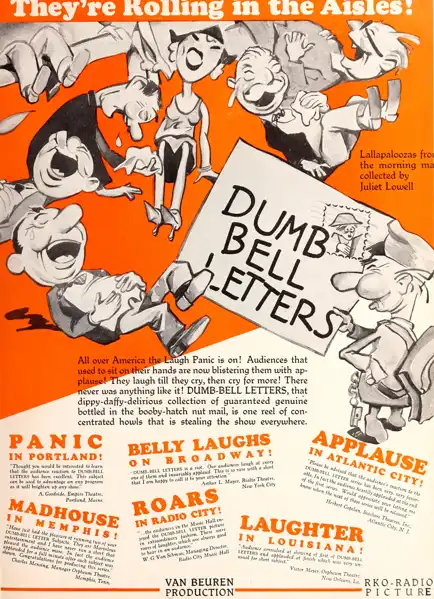
If you have six minutes to spare and love dusty, weird relics from the early days of talkies, Dumb-Bell Letters No. 16 is a bizarre little treat. Anyone looking for an actual story or modern comedy will absolutely hate this, but history nerds who like laughing at dead people's typos will find it strangely charming. ✉️
It is basically the 1930s equivalent of a "funny tweets" compilation. The whole premise is just a narrator reading real, incredibly stupid letters sent to businesses, which were collected by a woman named Juliet Jowell.
Some of these letters are so mangled they almost sound like poetry. I found myself rewinding one part where a guy complains about a washing machine because his handwriting in the reenactment looked exactly like my uncle's.
It is a very specific kind of humor, like looking at old scrapbooks in a basement. Unlike more polished comedies of the era, like The Front Page, there is zero budget here.
It feels incredibly cheap, like they shot it in an afternoon using whatever office desks they had lying around. The music in the background has this constant, scratchy hiss that actually makes it funnier.
You can hear the narrator occasionally run out of breath. It is a very human mistake that they just decided to keep in the final cut.
There is a weird comfort in knowing that people in 1930 were just as illiterate and confused by basic technology as we are today. One letter about a "leaking stove" goes on for so long that the narrator voice gets noticeably deeper, like he is getting tired of reading it.
It reminds me of the simple absurdity you find in Riding a Tricycle, where the camera just watches something mundane until it becomes funny. Its definitely more entertaining than sitting through a tedious melodrama like The Breath of Scandal, even if it is barely a movie.
It is not art, and it is definitely not going to change your life. But if you want to see a genuine slice of historic weirdness, this one is worth a quick look.
Year
1935
IMDb Rating
—

Editorial
Deciphering the legacy of transgressive cult cinema.
Community
Log in to comment.