DbcultAccessing Vault...
Cult Review
Senior Film Conservator
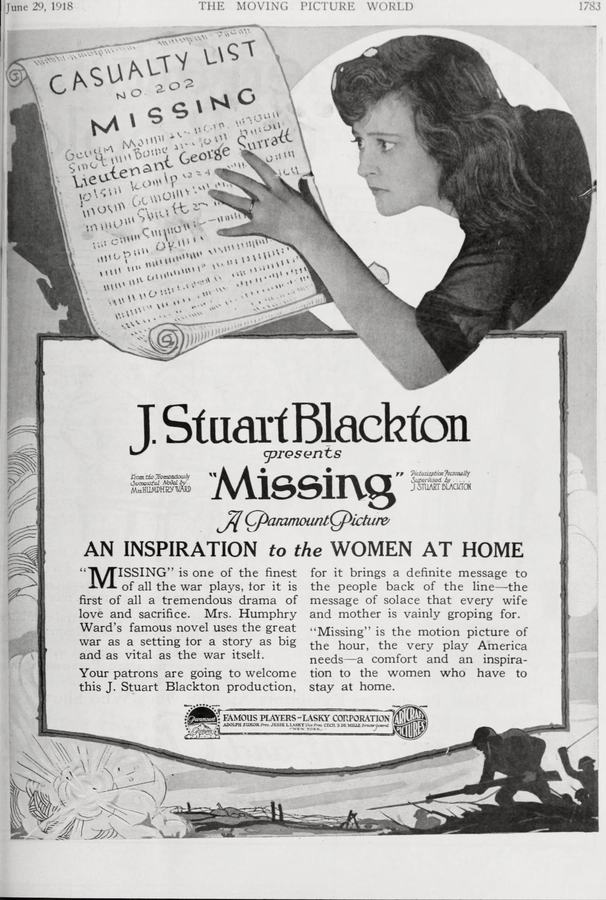
Black-toned intertitles flicker like magnesium flares, announcing a world where marriage certificates carry more lethal velocity than artillery shells. Director James Young, adapting Mrs. Humphrey Ward’s Edwardian doorstop, eschews trench warfare spectacle in favor of intimate carpet-bombing on the home front. The result is a film that feels less like a narrative than an exhumed diary—pages foxed with secrets, smelling of gunpowder and violet water.
Cinematographer J. Stuart Blackton paints chiaroscuro with a palette limited to candle, moon, and murk. Notice the sequence where Eleanor, veiled in crepe, descends a staircase whose banisters cast zebra-stripe shadows across her torso—an omen that grief will brand her like a prisoner’s barcode. When John reappears, the camera tilts upward, revealing his silhouette against a vaulted railway station roof; the iron ribs echo the flying buttresses of Rheims Cathedral, half-destroyed yet defiant. Such compositional rhymes stitch battlefield absence to domestic presence without a single subtitle.
Thomas Meighan’s John Ashby is a study in shell-shocked minimalism: eyes that blink like faulty shutters, shoulders permanently braced for the next barrage. His amnesia is never telegraphed via histrionic gesticulation; instead, Meighan lets a tremor in the left hand betray the abyss within. Opposite him, Kathleen O’Connor’s Eleanor oscillates between porcelain composure and hairline fractures of panic—a duality best glimpsed when she practices smiling into a hand-mirror, rehearsing widowhood like an actress learning a cursed role.
Yet the film’s gravitational rogue star is Marcia Manon as Vera. She prowls through parlors with the languid poise of a panther who has already counted every exit. Watch her eyes in the letter-forgery scene: they glide across the desk blotter as though reading future headlines of her own downfall, then narrow with reptilian resolve. Manon understands that silent-villainy is most chilling when punctuated by stillness, not Snidely Whiplaw mustache-twirls.
Ward’s source novel, all 600 pages of moral thicket, is distilled into intertitles that snap like whipcords. One card reads: “A lie is a debt payable in the coin of sleepless nights.” The aphorism lands like a guillotine, sparing us the Victorian circumlocution that bogs down many literary adaptations of the era. Blackton and Young further prune subplots—gone are the charity bazaars and parliamentary debates—leaving a lean 72-minute nerve that never sutures over its own wounds.
Original 1921 screenings boasted a score cobbled from Schumann’s Kinderszenen and popular foxtrots, a tonal whiplash that reflected postwar cultural vertigo. Modern restorations often substitute a single piano, weaving leitmotifs that bloom like poppies in no-man’s-land. I recommend pairing your viewing with Max Richter’s Infra—its elegiac strings amplify the film’s thesis that memory is both savior and saboteur.
Stacked against Manhattan Madness’s slapstick sabotage or Zigomar contre Nick Carter’s pulp serial bombast, Missing plays like a requiem mass. It shares DNA with The Beautiful Mrs. Reynolds in its scrutiny of matrimony as marketplace, yet surpasses that melodrama via moral ambiguity that refuses to cast any character as absolute sinner or saint. Even the dowager duchess who clucks her tongue at Vera’s machinations profits, indirectly, from wartime munitions—an economic complicity the camera frames but never sermonizes.
While the Hays Office had not yet clamped its chastity belt on Hollywood, Missing anticipates later debates about female agency. Eleanor’s final decision—to embrace or reject both suitors—rests on her own economic autonomy, a rare 1921 flourish. Note the shot where she unlocks her husband’s hidden strongbox; the key gleams like Excalibur in her palm, symbolizing fiscal as well as romantic sovereignty. Contemporary viewers may still bristle at the “woman-as-prize” structure, yet the film slyly undercuts that trope by making the ultimate victor not the male rivals but the widow who rewrites her own contract.
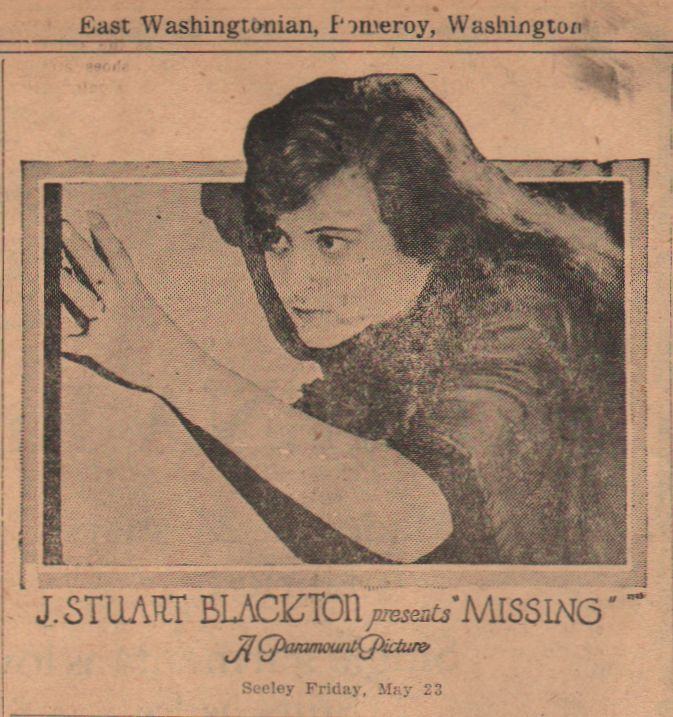
Shot on Eastman 1302 stock with an aperture ratio hovering around 1.33:1, the surviving 35 mm elements at EYE Filmmuseum retain surprising mid-tone detail—though the cyan-toned night scenes have irrevocably mottled. The Dutch print contains about 90 meters of extra footage: an extended séance where Vera consults a crystal ball, excised from U.S. release prints lest spiritualist panic inflame box-office resistance. Nitrate deterioration has claimed at least three intertitles; restoration teams have reconstructed them via secondary censorship records held in the Margaret Herrick Library.
Trade papers of 1921 praised the film’s “adult sobriety,” though Photoplay chided its “lugubrious lack of jazz-age pep.” Modern scholars have resurrected Missing as a key text in trauma-cinema genealogies, citing its prefiguration of amnesiac motifs later explored in From Dusk to Dawn and even Hitchcock’s Spellbound. The academic journal Framework devoted an entire 2019 issue to the film’s use of negative space as metaphor for shell-hole subjectivity—heady stuff, yet illuminating if you’re willing to wade through the jargon.
As of this month, the remastered edition streams on Criterion Channel, complete with an audio essay by Imogen Sara Smith. For purists, Kino Lorber’s Blu-ray offers a 2K scan plus a booklet essay on Vera’s wardrobe semiotics (yes, the black pearls she twirls really do foreshadow her downfall). If you attend a repertory screening, demand a venue that projects at 18 fps—projecting at sound speed of 24 fps turns the actors into caffeinated marionettes.
Missing endures because it understands that wars never conclude with armistice papers; they migrate into parlor games and marriage beds, metastasizing into fresh battles for dominance. To watch it is to eavesdrop on an era grappling with the realization that the twentieth century has weaponized intimacy itself. When the end credits—white letters on velvet black—fade to nothing, you may find yourself listening for phantom artillery in your own ribcage. That echo is the film’s true intertitle, written in a language beyond words.
“Memory is a lantern; hold it too steady and you set the past ablaze, swing it too wildly and you lose the path.”Missing, intertitle #42
If you crave more wartime romantic entanglements, detour into Across the Pacific or the underrated The Beautiful Lie. For lighter fare after this emotional bruising, perhaps Gift o’ Gab will massage your melancholy with screwball effervescence.
IMDb 4.7
1922
Community
Log in to comment.