DbcultAccessing Vault...
Cult Review
Senior Film Conservator

From the moment the opening credits roll, the viewer is thrust onto the deck of a weather‑worn steamer, its iron hull groaning under the weight of both cargo and concealed emotions. The camera lingers on the churning ocean, a visual metaphor for the undercurrents that will soon dominate the cramped corridors of the ship's interior. Cliff Bowes, embodying the irate father, exudes a weary authority that feels earned rather than performed, his eyes constantly scanning the horizon as if searching for an escape route from the familial quagmire he has helped construct.
Virginia Vance, as the daughter, is a study in restrained longing. Her glances toward the porthole are not merely scenic; they are windows into a yearning for autonomy that the narrative carefully nurtures. The suitor, a character whose name remains deliberately vague, is portrayed with a mix of earnestness and calculated charm that feels eerily reminiscent of the relentless romantic pursuit found in The Romance Promoters. Yet, unlike the latter's overt comedy, Bowes’ film cloaks its tension in a muted palette of shadows and muted dialogue, allowing the audience to feel the pressure rather than be told about it.
Bowes’ father wields a repertoire of paternal tactics that range from the subtle—such as rearranging the daughter’s schedule to keep her occupied—to the overt, like confronting the suitor in the ship’s galley with a clenched jaw and a voice that threatens to crack the very timbers of the vessel. Each maneuver is underscored by a low, throbbing score that mimics the ship’s engine, reinforcing the notion that the father's machinations are as integral to the journey as the steam that powers the craft.
The film’s pacing mirrors the mechanical rhythm of the steamer: slow, deliberate, then punctuated by sudden bursts of drama. This structure evokes the narrative cadence seen in Ashes of Vengeance, where the protagonist’s internal conflict is reflected in the external environment. Here, the father’s attempts to control become a choreography of power, each step calculated to keep his daughter within the safe harbor of his protection, even as that harbor begins to feel more like a prison.
The suitor, in stark contrast, employs a series of increasingly audacious strategies. He slips notes into the daughter’s cabin, each parchment edged with a flourish that suggests both romantic idealism and a strategic mind. He enlists the ship’s steward, a minor character whose brief but memorable cameo adds a layer of comic relief reminiscent of the side‑kick archetype in Fools and Their Money. The steward’s bemused expression as he delivers a love‑letter to the unsuspecting daughter provides a momentary respite from the mounting tension.
What distinguishes this suitor from his counterparts in other period dramas is his willingness to confront the father directly, a boldness that escalates during a storm‑riven night when the ship’s lights flicker and the sea roars. In that dimly lit corridor, the suitor’s voice cuts through the howling wind, pleading not just for the daughter’s affection but for a chance to prove his worth beyond the confines of paternal suspicion. The scene’s chiaroscuro lighting, with shadows swallowing the father’s silhouette, underscores the shifting power dynamics and hints at the inevitable unraveling of the father’s control.
Director’s use of confined spaces—tight corridors, cramped cabins, and the claustrophobic engine room—creates a visual metaphor for the characters’ emotional entrapment. The camera often employs low angles when focusing on the father, amplifying his looming presence, while high angles frame the suitor, subtly diminishing his perceived threat until his actions speak louder than his stature.
The sound design, though restrained by the era’s technological limits, utilizes the ship’s ambient noises—steam hisses, metallic clanks, distant horn blasts—to punctuate moments of heightened drama. When the father’s temper flares, the engine’s roar crescendos, creating an auditory echo that aligns his fury with the vessel’s mechanical heartbeat. This technique draws a parallel to the auditory motifs in The World’s Applause, where sound becomes an extension of character psychology.
Cliff Bowes delivers a performance that oscillates between stoic restraint and raw, unfiltered anger. His eyes, often narrowed, convey a history of loss that informs his overprotectiveness. In contrast, Virginia Vance’s portrayal of the daughter is a masterclass in subtlety; she communicates yearning through a lingering glance at the horizon, a sigh caught in the ship’s draft, and a hesitant smile when the suitor’s presence becomes undeniable.
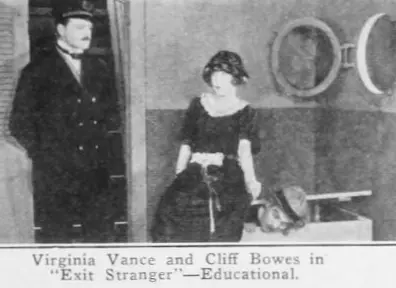
The chemistry between the two leads is palpable yet restrained, mirroring the film’s overall tone. Their interactions are laced with unspoken tension, each word weighed against the backdrop of the rolling sea. This dynamic evokes the delicate interplay seen in Just Peggy, where familial bonds are tested by external romantic forces.
At its core, Exit, Stranger interrogates the age‑old conflict between paternal authority and youthful autonomy. The steamer, forever moving forward, becomes a symbol of inevitable change; no amount of parental interference can halt its course. The film suggests that attempts to anchor a daughter’s fate are as futile as trying to stop a ship mid‑ocean.
Moreover, the sea functions as a dual metaphor: it is both a barrier and a conduit. For the father, it represents the vast unknown that threatens to swallow his control. For the suitor, it offers the promise of new horizons, a chance to navigate beyond the father’s restrictive currents. This dichotomy aligns with the thematic currents explored in The Springtime of Life, where nature itself becomes an active participant in human drama.
When juxtaposed with the melodramatic fervor of La voix d'or, Exit, Stranger opts for a more restrained, almost theatrical approach. Its tension is built through silence and suggestion rather than overt dialogue, a technique that rewards attentive viewers with a richer, more immersive experience.
In terms of narrative economy, the film mirrors the tight plotting of White Tiger, delivering a concise story that never strays from its central conflict. Yet, unlike the action‑driven tempo of White Tiger, Exit, Stranger leans heavily into psychological warfare, making every glance, every whispered word a battlefield.
Released in the late 1920s, the film captures the zeitgeist of an era when societal expectations regarding courtship were undergoing rapid transformation. The father’s resistance can be read as a manifestation of lingering Victorian mores, while the suitor embodies the emerging modernist confidence that would come to define the Roaring Twenties.
Although Exit, Stranger never achieved the commercial success of contemporaneous blockbusters, its influence can be traced in later works that explore the claustrophobic tension of confined settings, such as the later maritime drama The Man Who Dared. Its subtle critique of patriarchal control predates the more explicit feminist narratives of the 1930s, positioning it as a quiet forerunner in the evolution of gender dynamics on screen.
Exit, Stranger stands as a testament to the power of understatement. Its deliberate pacing, nuanced performances, and atmospheric use of the steamer setting coalesce into a film that rewards patient viewing. The narrative’s resolution—where the daughter finally asserts her own desire, stepping onto the deck as the ship cuts through a sunrise‑tinted horizon—offers a poignant affirmation of personal agency without resorting to melodramatic excess.
For cinephiles seeking a film that marries thematic depth with visual elegance, this understated drama provides a compelling case study. Its influence, though subtle, reverberates through later cinematic explorations of familial conflict and romantic perseverance, making it a hidden gem worthy of rediscovery.

IMDb 6.3
1933
Community
Log in to comment.