DbcultAccessing Vault...
7.1/10
Senior Film Conservator
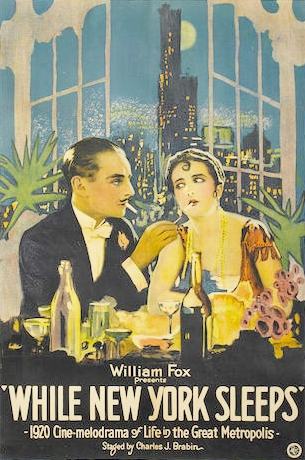
A definitive 7.1/10 rating for a film that redefined the boundaries of cult cinema. While New York Sleeps remains a cornerstone of transgressive art.
No other American film of 1924 treats darkness as both curtain and spotlight quite like While New York Sleeps. Charles Brabin, fresh from his Grand Guignol experiments with The Transgressor, jettisons the moral sermonettes of contemporaneous city symphonies and opts for a triptych that drips with sardonic jazz-age nihilism. The result is a film that feels closer to a gin-soaked fever dream than to the uplift melodramas that clogged the era’s marquees.
Each segment is introduced by a clock-face superimposed over the Manhattan skyline—hands spinning, gears grinding—suggesting that time itself is a con artist, hustling every soul toward a punchline already written. It’s a device that anticipates the fatalistic montage of The Midnight Man, yet here the city is not backdrop but co-author, a sentient organism exhaling neon and ash.
Estelle Taylor, sculpted in chiaroscuro, plays a salesgirl promised to two men: a shipping clerk who smells of machine oil and a traveling salesman whose smile never reaches his pupils. On the eve of her shotgun wedding, a lithe burglar (Harry Sothern) slithers through her kitchen window, pockets her dowry, then—moved by the tremor in her lower lip—engineers a Rube Goldberg reversal that exposes both fiancés as bigamists. The scene of revelation is staged in a modest parlor, yet Brabin crams it with vertiginous angles, ceiling fans casting shadows like helicopter blades. Taylor’s face, caught between a gasp and a grin, becomes a microcosm of a city learning that salvation can arrive wearing a domino mask.
Here the film pivots from noir fable to carnival shakedown. Marc McDermott and Earl Metcalfe essay a pair of tin-horn sharpies running a stock-tip scam out of a lobster palace. Their mark, played by William Locke, wears the rumpled tweed of a rube; only after the swindle do we learn he’s an undercover Pinkerton with a ledger full of names and a wife dying of radium poisoning. The reversal is swift—Brabin cuts from the con men’s victory smirk to a holding cell where the electric light flickers like a bad omen—but what lingers is the montage of Times Square itself, its jumble of fire-escapes and Camel ads forming a vertiginous labyrinth where ambition and desperation swap costumes.
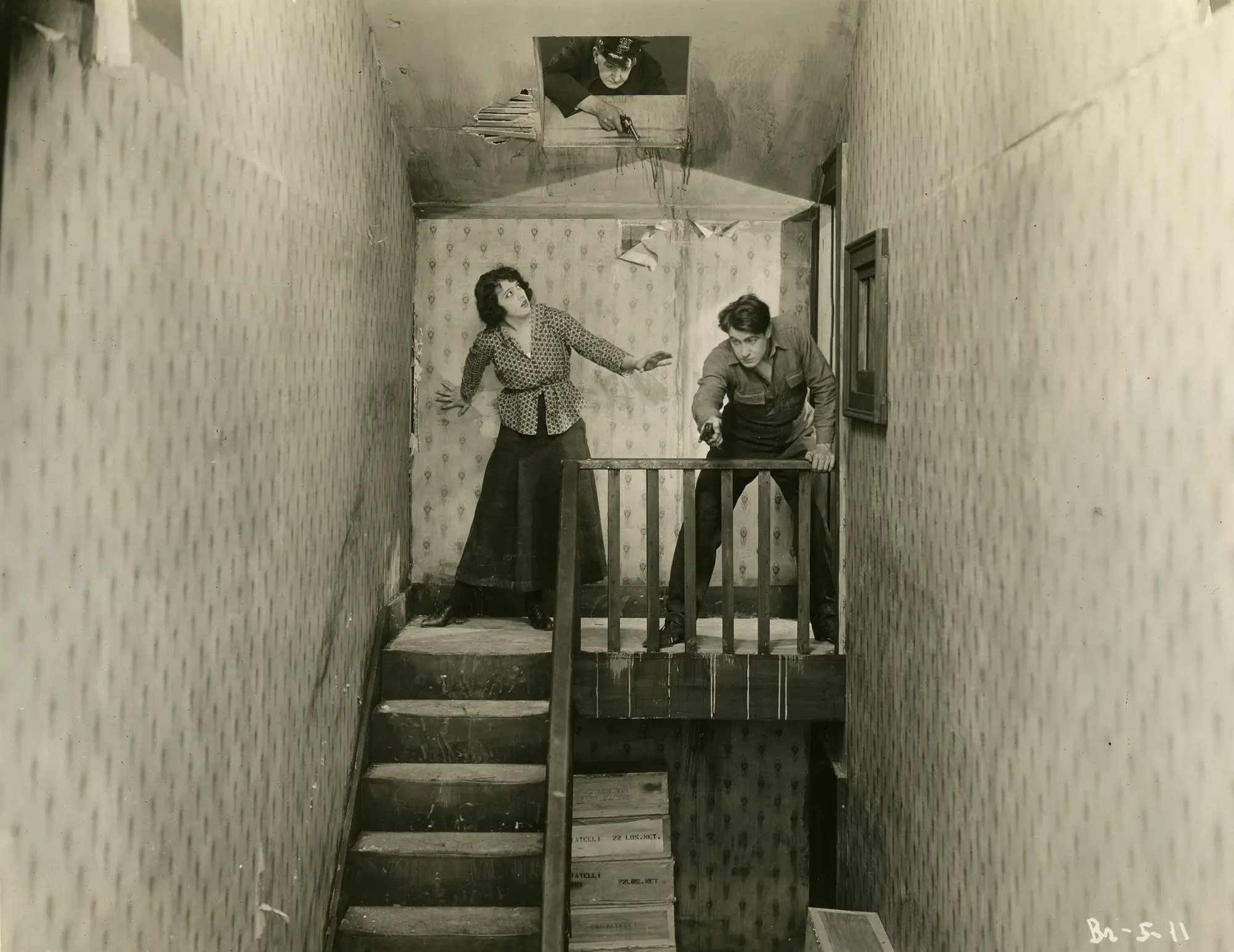
The final movement strips the city to its skeletal core. A dockworker (Sothern again) returns from Sing Sing to find his adolescent son recruited by a juvenile gang. The boy is shot during a botched warehouse heist; the father, paralyzed by a stroke, can only track the blood’s slow creep across the floorboards. Brabin confines the camera to a wheelchair’s height, turning every doorway into a proscenium arch and every neighbor into a mute chorus. The effect is suffocating yet weirdly luminous—like watching Mothers of Men through frosted glass. When the father finally blinks a tear, the city outside erupts in sirens, as if Manhattan itself is acknowledging the gulf between spectacle and suffering.
The conceit of repertory casting could have devolved into stunt; instead it becomes a hall-of-mirrors meditation on identity. Sothern’s burglar, grifter, and patriarch share no surface traits—his gait shifts from feline to wooden to catatonic—yet each incarnation carries the residual melancholy of the others. Taylor, luminous in beaded flapper garb, reappears briefly in segment III as a nurse whose single compassionate glance feels like a whispered apology for the universe. The strategy predates the shape-shifting personas of Tih Minh but operates on a more human register: faces recycled by fate, scrubbed clean of prior sin yet haunted by déjà vu.
Cinematographer William J. Black sidesteps the squared realism of most East Coast productions, opting instead for tilted planes and guttering streetlamps that echo Murnau without slipping into pastiche. Note the shot in segment II where a roulette wheel fills the frame, its white ball orbiting like a rogue moon; Brabin superimposes the gamblers’ faces onto the spinning disk, fusing predator and prey into a single hydra. Compare that kinetic flourish with the static tableaux of The Fettered Woman and you sense how aggressively this film wrestles the medium into modernity.
Thomas F. Fallon’s title cards deserve an essay of their own. One card, following the burglar’s rooftop escape, reads: “Safe in the clouds where coppers’ whistles can’t hurl a rope.” The line pirouettes between poetry and pulp, evoking both the vertigo of height and the class contempt baked into the city’s bones. Elsewhere, a card interrupts a tearful reunion with the abrupt clause: “Love arrived too late, wearing yesterday’s hat.” The terse elegance prefigures Hemingway’s dialogue vignettes, yet the words are soaked in nickelodeon swagger.
For decades the only surviving elements were 9.5 mm Pathescope reels housed in a Belgian convent—shades of Zigeunerprinsessen’s own diaspora. In 2022, Cineteca di Bologna performed a 4K wet-gate restoration from a 35 mm nitrate print discovered in São Paulo, resurrecting the original amber tinting and the lavender glow of the Times Square sequences. The new scan premiered at Il Cinema Ritrovato, accompanied by a live score from the Alloy Orchestra that replaced traditional rag with prepared-piano clanks and bowed-saw laments. As of late 2024, the restoration streams on Criterion Channel and plays select repertory houses; a 4K UHD is rumored for 2025 with commentary by MoMA’s Ron Magliozzi.
While the silent version remains definitive, one cannot help but fantasize alternate scores. Imagine DJ Shadow’s chopped breaks underscoring the burglar’s rooftop ballet, or Julia Holter’s haunted lullabies cocooning the paralytic father. The film’s modular structure—three self-contained crescendos—invites mix-and-match sonic re-imaginings much like the open-source ethos of Fighting for Love, yet its emotional spine is so taut that any accompaniment risks gilding the lily.
Upon release, Variety dismissed the picture as “a dime-store Decameron,” while Photoplay praised its “slick urban fatalism.” Later scholars locate the film at a crossroads: part of the post-Greed wave of nickel-plated cynicism, immediate precursor to the gangland sagas that would crest with Underworld and The Racket. Feminist critics have reclaimed Taylor’s roles as early prototypes of the urban working-woman navigating patriarchal booby traps, akin to the protagonists in Her New York but stripped of reformist treacle.
I first encountered this film on a scratched VHS in a graduate seminar on metropolitan modernity; the tape jammed every ten minutes, yet the fragmented experience mirrored the city’s own staccato rhythm. Years later, standing on the Roosevelt Island tram at 2 a.m., I recalled the burglar’s silhouette against a billboard for Turkish Airlines and felt the same vertiginous mix of possibility and peril that Bratin distilled. Great cinema plants such seeds of haunted recognition; they sprout when the screen goes dark and the real city, relentless, keeps writing sequels.
While New York Sleeps is neither a curio nor a footnote—it is a pocket-sized epic that turns the city’s contradictions into a Möbius strip of grace and graft. Its triptych structure prefigures everything from Cloud Atlas to The Ballad of Buster Scruggs, yet its pulse is unmistakably Jazz Age, syncopated and raw. If you crave moral clarity, look elsewhere; if you savor the metallic aftertaste of a town that devours its children then mints them into legends, this is your ticket to the all-night carnival.
IMDb 6
1936
Community
Log in to comment.