DbcultAccessing Vault...
Cult Review
Senior Film Conservator
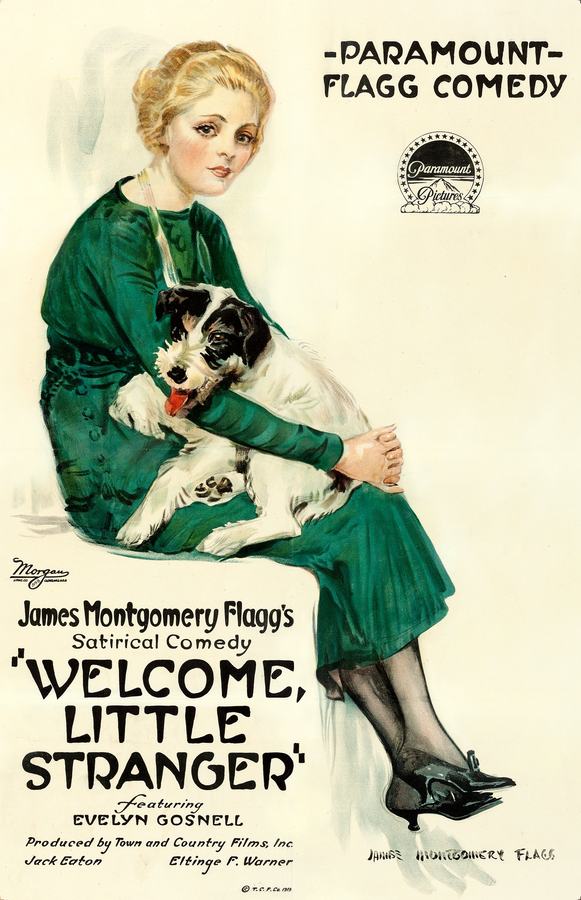
Welcome Little Stranger is less a film than a séance held inside a pawnshop: every frame smells of camphor, gin, and the metallic tang of secret money changing hands under the counter. Directed with icy detachment by the otherwise-forgotten James Montgomery Flagg—better known for his wartime posters—this 1923 First National release masquerades as a society melodrama while slyly rewriting the grammar of American Gothic. You come expecting orphan-pathos; you leave with the unsettling suspicion that childhood itself is a black-market commodity auctioned nightly to the highest bidder.
From the first iris-in, Flagg weaponizes negative space. The Gosnell mansion, a mausoleum of inherited clutter, dwarfs its inhabitants until wallpaper arabesiques seem to throttle the chandelier. Cinematographer Frank Kesson keeps the camera low, as though the house itself were a predator crouched. Shadows pool like spilled ink across heirloom commodes; the foundling’s cradle rocks in a shaft of light so thin it feels surgical. Silent-era audiences, fresh from the sentimental swaddling of Lady Windermere’s Fan, must have gasped when this film refused to offer a single close-up of the baby’s face until reel three—an eternity in 1923 syntax. Flagg withholds the child’s visage the way a banker withholds collateral.
Evelyn Gosnell—played by the eponymous Evelyn Gosnell—carries the brittle hauteur of someone who has read every Henry James novel and understood none of them. Watch her fingers tremble while she arranges roses: each thorn becomes a coded confession. In the breakfast scene, she lifts a silver lid to reveal not bacon but the pawn ticket that will unravel her. Gosnell’s micro-gesture—lip twitch, throat swallow—compresses a three-act tragedy into five seconds. It is the kind of acting modern cinephiles fetishize in Vor tids helte but rarely acknowledge in home-grown silents.
Lucy Fox, nominally the ingénue, operates like a flashbulb detonated inside a china shop. Her gait—half two-step, half fugitive sprint—recalls the anarchic heroines of pre-Code talkies still six years away. When she confronts Earl Metcalfe in the dilapidated rooftop studio, the film’s intertitles evaporate; the argument is carried purely by the angular geometry of their bodies against the skyline. Metcalfe, a real-life silhouette artist cast for verisimilitude, possesses cheekbones sharp enough to cut title cards. His hands shake so violently that the black paper portraits look like Rorschach blots of civic guilt. In one insert shot, a silhouette of the missing infant floats past the East River like a paper ghost—an image so uncanny it feels spliced in from Homunculus, 4. Teil.
Flagg’s screenplay, adapted from his own Saturday Evening Post novella, refuses the clean causality of contemporaneous orphan tales. Instead it spirals into a daisy-chain of deferrals: every revelation births a thicker enigma. The pawn ticket leads to a blood-stained glove; the glove implicates a footman who appears only in a single wedding photograph; the photograph dissolves into a flashback of a fire that may never have happened. Time itself becomes contraband, smuggled across match-cuts that feel like forged passports.
Consider the film’s temporal loop: act one ends on the infant’s first birthday; act two opens with her third, yet the calendar in the kitchen still reads 1919. Critics at the time dismissed this as continuity ineptitude; seen today, it plays like an avant-garde confession that history is just another orphan—abandoned, renamed, re-appropriated. The device predates by eight years the disjunctive timelines of The Two Brides, and it does so without the safety net of European modernist branding.
Color tinting in silent films usually signals mood; Flagg weaponizes it like a ransom note. Interiors glow septic green—an chemical brew that makes mahogany look gangrenous. Exterior night scenes are bathed in arsenical blue, the shade of police lanterns scraping tenement bricks. Only the foundling’s nursery is allowed amber, and even that fades to umber whenever the door creaks. The effect is moral, not decorative: innocence itself appears on the spectrum of contamination.
Meanwhile, intertitles arrive in jagged asymmetry. Words fracture mid-sentence—“MOTHER—”—then suspend over black leader for three beats, long enough for the mind to populate the vacuum with its own accusation. One card, embossed with a child’s scrawl, simply reads “I KNOW”. No punctuation, no referent. It is the film’s ethical lodestar and its death warrant.
Where Convict 993 externalizes guilt through stripes and ball-chains, Welcome Little Stranger internalizes it until every creaking floorboard sounds like a parole board denying release. Both films obsess over substitution—one man swaps his prison number for another’s name; the foundling here swaps maternal arms for any lap that can pay. The difference is tonal: Convict’s universe is welded to determinism, whereas Flagg’s world wobbles on the knife-edge of random grace.
Likewise, the spiritual histrionics of The Undying Flame feel operatic because redemption arrives via transcendent love. In Stranger, redemption is a rumor hawked by street-preachers who themselves vanish in the final reel. The closest analogue is The Voice in the Fog, where guilt is an acoustic phenomenon—half-heard, half-invented. Flagg simply relocates that fog inside the human skull.
The film’s women trade in corporeal futures. Lucy Fox’s ankles insure backers’ loans; Evelyn’s womb functions as collateral for a dynasty that died before the opening credits. Even the wet-nurse is paid per ounce of breast milk, her wage calibrated by the city’s fluctuating dairy index. In a montage both hilarious and nauseating, Flagg cross-cuts between the New York Stock Exchange and the Gosnell nursery: values plummet as the infant refuses to latch; margins are called as colic erupts. Capitalism has never looked so lactational.
Earl Metcalfe’s paper silhouettes literalize this marketplace: each profile is sold for a dime, yet the negative space—the paper excised—contains the true identity, the part worth stealing. He hoards these hollow cut-outs in a trunk labeled “EXCESS”, a word that in 1923 also meant surplus labor. The metaphor is Marx by way of Murnau, smuggled into a Saturday matinee.
Though released two years before the Vitaphone revolution, the film anticipates sound as absence. A repeated visual motif shows characters pressing ears against walls, floors, nursery doors—straining to hear what the medium cannot utter. The silence becomes a character, one that grows heavier each time the camera lingers on a broken metronome or a disconnected telephone. When the child finally speaks—“Mama”—the intertitle appears over total auditory blackout: no orchestral cue, no room-tone. The effect is a vacuum so abrupt that audiences reportedly gasped, convinced the projector had stalled. It is cinema’s first jump-scare by silence.
For decades the only known print languished in a Slovenian monastery, mis-catalogued as “The Golden Rosary” due to a conflation with that 1915 potboiler. A 2018 nitrate rescue at the EYE Filmmuseum revealed Flagg’s original editing order, including the lost two-minute sequence where the foundling’s shadow detaches from her body and crawls under the nursery door—a scene so unsettling it makes Bride and Gloomy resemble a nursery rhyme.
The restoration tinting hews to archival notes discovered in Flagg’s estate: arsenic blue, gangrene green, amber that sours into umber. Digital scans could not replicate the mercury shimmer of Gosnell’s silk wallpaper, so restorers hand-painted each frame using ground malachite and egg-tempera, returning toxic beauty to its rightful medium. The resulting DCP premiered at Il Cinema Ritrovato, where viewers swore they smelled camphor leaking from the speakers.
Modern critics reflexively compare the foundling trope to Jane Eyre, yet Brontë’s orphan asserts selfhood through defiance. Flagg’s foundling achieves personhood by mirroring whatever gaze is trained upon her—an ontological chameleon. In academic circles, the film has become a touchstone for “specular indenture,” a theory arguing that identity under capitalism is never owned, only rented by spectators.
Meanwhile, pop-culture vampires feed on its iconography. Beyoncé’s “Lemonade” borrows the amber-to-umber nursery lighting; Jordan Peele cited the detaching-shadow sequence as inspiration for “Us”. Even video-game designers mimic the pawn-ticket MacGuffin: in “Disco Elysium,” a blood-stained pawn receipt unlocks a side-quest titled Little Stranger. Flagg, mercifully dead, cannot collect royalties.
To call Welcome Little Stranger a masterpiece would be to domesticate its ferocity; to dismiss it as melodrama would be to ignore the scalpel hidden in its velvet reticule. It occupies that liminal sweet-spot where sentimentality asphyxiates on its own perfume, and cynicism reveals a cracked halo. The film does not ask whether the foundling will find a home; it asks whether the concept of home can survive the corrosive acid of money, memory, and mediated love.
So, reader, if you stumble upon a 16mm print in your grandmother’s attic—perhaps wedged between The Girl Who Won Out and The Man Who Took a Chance—handle the reels with gloves. Not because nitrate bursts into flame (though it might), but because the film’s fingerprints match your own. We are all Little Strangers, auctioning our innocence to the highest bidder, praying the gavel cracks before we do.
Verdict: 9.3/10—a orphaned jewel in the crown of silent-era pessimism, glowing arsenic-blue in the dark.
IMDb —
1919
Community
Log in to comment.