DbcultAccessing Vault...
4.8/10
Senior Film Conservator
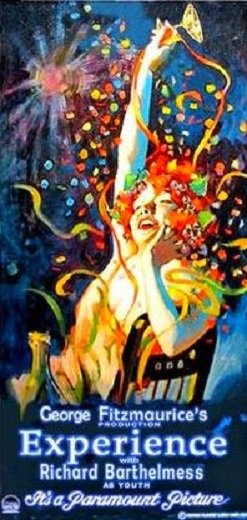
A definitive 4.8/10 rating for a film that redefined the boundaries of cult cinema. Experience remains a cornerstone of transgressive art.
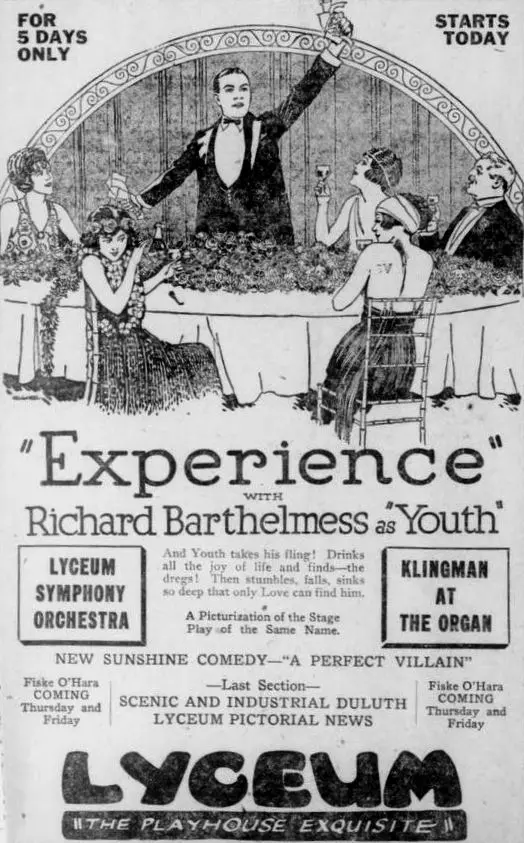
In the annals of early cinema, few films encapsulate the allegorical might and moral gravitas of a bygone era quite like the 1918 masterpiece, Experience. This isn't merely a film; it's a grand, sweeping morality play, rendered in the evocative chiaroscuro of silent-era artistry. Directed with a keen eye for symbolism and written by the insightful duo of George V. Hobart and Waldemar Young, Experience transcends its narrative simplicity to deliver a profound meditation on the human condition, the perils of urban allure, and the ultimate triumph of enduring virtues. It's a journey that resonates with timeless truths, chronicling the universal struggle between aspiration and corruption, innocence and disillusionment, despair and eventual redemption.
At its core, Experience is the odyssey of Youth, portrayed with a compelling blend of naiveté and burgeoning desire by Richard Barthelmess. His character is not a specific individual but an everyman, a vessel for the audience's own hopes and fears. The film opens by establishing his humble, contented existence, tethered to the warmth of his mother's affection. Yet, this pastoral idyll is soon disrupted by the insidious whispers of Ambition. This isn't the healthy drive for self-improvement, but a more covetous, almost predatory force, urging him towards the glittering promise of the city. He departs, leaving behind the maternal hearth, accompanied by two benevolent spirits: Love, personified with tender grace by Marjorie Daw, and the ever-optimistic Hope. This initial setup immediately establishes the film's allegorical framework, where abstract concepts are given tangible, human form, reminiscent of medieval morality plays or even the grand scale of The Last Days of Pompeii, albeit focused on an internal, rather than external, cataclysm.
Upon his arrival in the bustling metropolis, Youth is immediately assailed by a kaleidoscope of new sensations. The city, a character in itself, pulses with a dangerous vibrancy. Here, he encounters Pleasure, embodied by the captivating Sibyl Carmen, whose allure is both undeniable and ultimately destructive. Pleasure, with her superficial charm and intoxicating presence, quickly diverts Youth's attention. In a moment of fateful misjudgment, he bids Opportunity to wait, believing he can indulge in hedonistic pursuits and still seize his destiny later. Opportunity, however, is a fickle mistress, and she refuses to tarry, vanishing into the urban sprawl, leaving Youth to his nascent folly. This pivotal moment underscores a crucial life lesson: chances, once spurned, rarely return on demand. It's a poignant depiction of how easily immediate gratification can eclipse long-term aspirations, a theme that resonates just as powerfully today.
The narrative then plunges Youth deeper into the city's underbelly, specifically the infamous 'Primrose Path,' a cabaret that serves as a thinly veiled metaphor for the descent into vice. Here, Pleasure acts as his guide, introducing him to an array of figures who embody the corrupting forces of the urban landscape. We meet Beauty, whose superficiality masks a lack of substance; Wealth, whose opulence is detached from true value; Fashion, representing the fleeting and superficial trends of society; and, most dangerously, Temptation, portrayed with cunning subtlety by Nita Naldi. This ensemble cast of abstract concepts, made flesh, creates a vivid tableau of the snares awaiting the unwary. The visual storytelling, characteristic of silent film, relies heavily on exaggerated gestures and symbolic settings to convey these complex ideas, a technique that allows the audience to instantly grasp the moral implications of each encounter.
While Youth is engrossed in this intoxicating, yet ultimately hollow, world, a tragic development occurs back home: his mother dies. Love, ever vigilant and compassionate, sends a telegram to apprise him of the devastating news, a message intended to pull him back from the precipice. Crucially, this telegram is intercepted by Temptation, whose malevolent influence ensures Youth remains ignorant of his loss and further entrenched in his self-destructive path. When Love herself ventures to the city, seeking to reclaim her beloved Youth, she is cruelly turned away from the garish gates of the Primrose Path. This rejection of Love by the forces of vice is a heart-wrenching moment, highlighting the tragic consequences of Youth's choices and the growing chasm between his former self and his current state. It’s a powerful visual metaphor for how easily genuine affection can be shut out when one is consumed by fleeting desires.
From this point, Youth's downward spiral accelerates. Chance, an indifferent arbiter of fate, leads him to a gambling house, a den of false hope and swift ruin. Here, he squanders everything, save for a single, precious memento: the ring given to him by Love. This small, symbolic item becomes his last tangible link to his former purity and the virtues he once held dear. Stripped of his material possessions, Youth finds himself haunted by the spectral figures of Poverty and Delusion. These are not mere abstract concepts here; they are tangible, oppressive presences, mirroring his internal torment. The film brilliantly uses visual metaphor to show his psychological unraveling, making the audience feel the weight of his despair. His former companions – Beauty, Wealth, Fashion, and even Pleasure – have, with the exception of the ever-scheming Temptation, completely forgotten him, their loyalty as ephemeral as their names suggest. This abandonment underscores the superficiality of his city life and the emptiness of the relationships he forged there.
In his darkest hour, Youth encounters Vice and Habit, two formidable forces that seek to cement his downfall. He is at his most vulnerable, susceptible to their corrosive influence. Under their sway, he finally consents to go with Crime to rob Wealth's house, a desperate act born of utter destitution and moral compromise. This decision marks the absolute nadir of his journey, a complete capitulation to the forces of darkness. The tension builds, the audience bracing for the inevitable tragedy. However, it is at this precise moment, on the very precipice of committing a heinous act, that a faint, ethereal sound pierces the urban din: the singing of a church choir. This unexpected auditory intrusion acts as a spiritual awakening, a sudden, profound recall to the innocence and moral compass he once possessed. It's a moment of grace, a sudden shaft of light in the overwhelming darkness, reminiscent of the profound spiritual awakening depicted in films like Birth, where a character's entire perspective can shift in an instant.
The choir's melody serves as a powerful catalyst, stirring within Youth a deep-seated longing for home, for the purity he had abandoned. He turns away from Crime, rejecting the path of destruction he was about to embrace. This is the turning point, the moment of true repentance and self-discovery. He embarks on the arduous journey back, no longer alone, but accompanied by a new, invaluable companion: Experience. This figure, often depicted as a wise, weary elder, represents the cumulative knowledge gained through hardship and suffering. It is through his profound journey, his trials and tribulations, that Youth has truly learned. He returns to his former abode, where, against all odds, Love and Hope have patiently awaited his return. Their unwavering presence underscores the enduring power of these virtues, capable of outlasting even the most profound periods of despair. Their reunion is not just a happy ending, but a testament to the resilience of the human spirit and the unyielding nature of true affection.
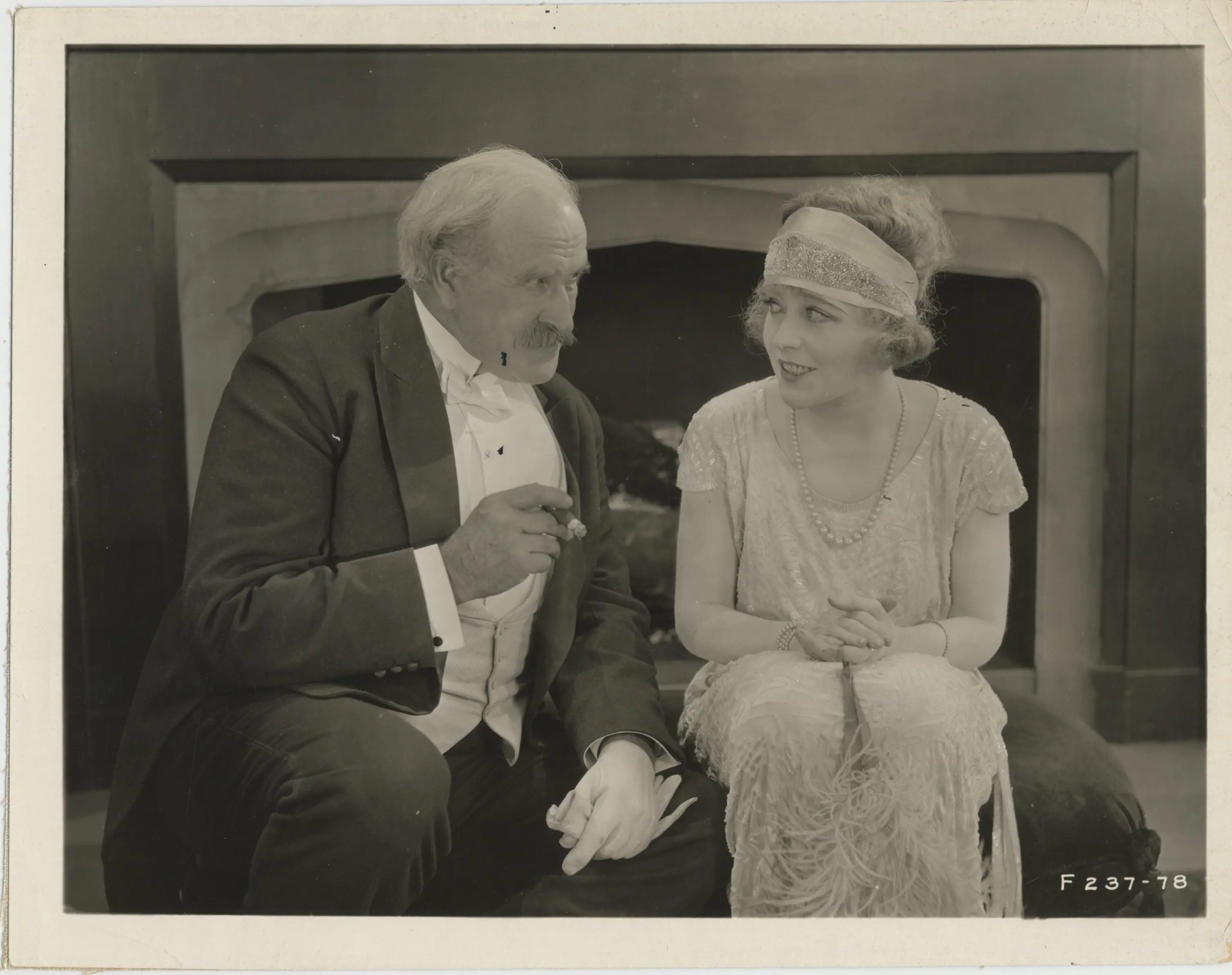
The film concludes with a powerful resolution. Ambition, the initial instigator of Youth's journey, again seeks to sway him. But this time, Youth is different. He is no longer the naive, easily swayed individual who first left home. With Love firmly at his side, and the hard-won wisdom of Experience guiding him, he starts a new life. This isn't a rejection of ambition entirely, but a redefinition of it. His ambition is now tempered by moral clarity, grounded in the values of love and hope, and informed by the painful lessons of the past. The film doesn't suggest that one should avoid ambition, but rather that ambition, unchecked by virtue and wisdom, can lead to ruin. It's a nuanced message, delivered with the stark clarity typical of silent film narrative.
The performances in Experience, particularly by Richard Barthelmess as Youth, are exemplary of the silent era's expressive acting style. Barthelmess conveys a vast spectrum of emotions – from innocent wonder to tortured despair, and finally to serene wisdom – primarily through facial expressions and body language. Marjorie Daw's portrayal of Love is a beacon of purity and steadfastness, providing a crucial emotional anchor. Sibyl Carmen and Nita Naldi, as Pleasure and Temptation respectively, exude the seductive danger necessary for their roles, their every gesture dripping with an alluring menace. The entire ensemble, including Jed Prouty, Agnes Marc, and the myriad of actors embodying the allegorical figures, contributes to the film's rich tapestry, making these abstract concepts feel remarkably concrete and impactful.
George V. Hobart and Waldemar Young's screenplay is a masterclass in allegorical storytelling. They manage to imbue abstract concepts with dramatic weight and emotional resonance, crafting a narrative that is both simple in its premise and profound in its implications. The direction ensures that the visual language supports this allegorical intent, with striking imagery that contrasts the idyllic countryside with the chaotic city, and the opulent decadence of the Primrose Path with the stark desolation of Youth's despair. The use of intertitles, while a necessity of the era, is handled artfully, providing just enough context without detracting from the visual narrative.
Experience is a film that speaks to the perennial human struggle for meaning and moral rectitude. It posits that while the world may offer endless temptations and opportunities for error, the path to redemption is always open, paved by genuine introspection and the enduring power of love and hope. It's a powerful reminder that true wealth lies not in material possessions or fleeting pleasures, but in the integrity of one's character and the strength of one's moral compass. This film stands as a testament to the power of early cinema to convey complex philosophical ideas through visual poetry, remaining as relevant today as it was over a century ago. Its message of redemption, the importance of listening to one's conscience, and the unwavering power of love, makes Experience a truly timeless cinematic achievement, a journey for the soul that continues to resonate deeply with audiences seeking both entertainment and enlightenment.

IMDb —
1929
Community
Log in to comment.